• HOME
  • NEWS
  • EXPLORE
    • CAREER
      • Companies
      • Jobs
    • EVENTS
    • iGEM
      • News
      • Team
    • PHOTOS
    • VIDEO
    • WIKI
  • BLOG
  • COMMUNITY
    • FACEBOOK
    • INSTAGRAM
    • TWITTER
Sunday, July 5, 2026
BIOENGINEER.ORG
No Result
View All Result
  • Login
  • HOME
  • NEWS
  • EXPLORE
    • CAREER
      • Companies
      • Jobs
        • Lecturer
        • PhD Studentship
        • Postdoc
        • Research Assistant
    • EVENTS
    • iGEM
      • News
      • Team
    • PHOTOS
    • VIDEO
    • WIKI
  • BLOG
  • COMMUNITY
    • FACEBOOK
    • INSTAGRAM
    • TWITTER
  • HOME
  • NEWS
  • EXPLORE
    • CAREER
      • Companies
      • Jobs
        • Lecturer
        • PhD Studentship
        • Postdoc
        • Research Assistant
    • EVENTS
    • iGEM
      • News
      • Team
    • PHOTOS
    • VIDEO
    • WIKI
  • BLOG
  • COMMUNITY
    • FACEBOOK
    • INSTAGRAM
    • TWITTER
No Result
View All Result
Bioengineer.org
No Result
View All Result
Home NEWS Science News Biology

New laser technique may help detect chemical warfare in atmosphere

Bioengineer by Bioengineer
March 26, 2018
in Biology
Reading Time: 2 mins read
1
Share on FacebookShare on TwitterShare on LinkedinShare on RedditShare on Telegram
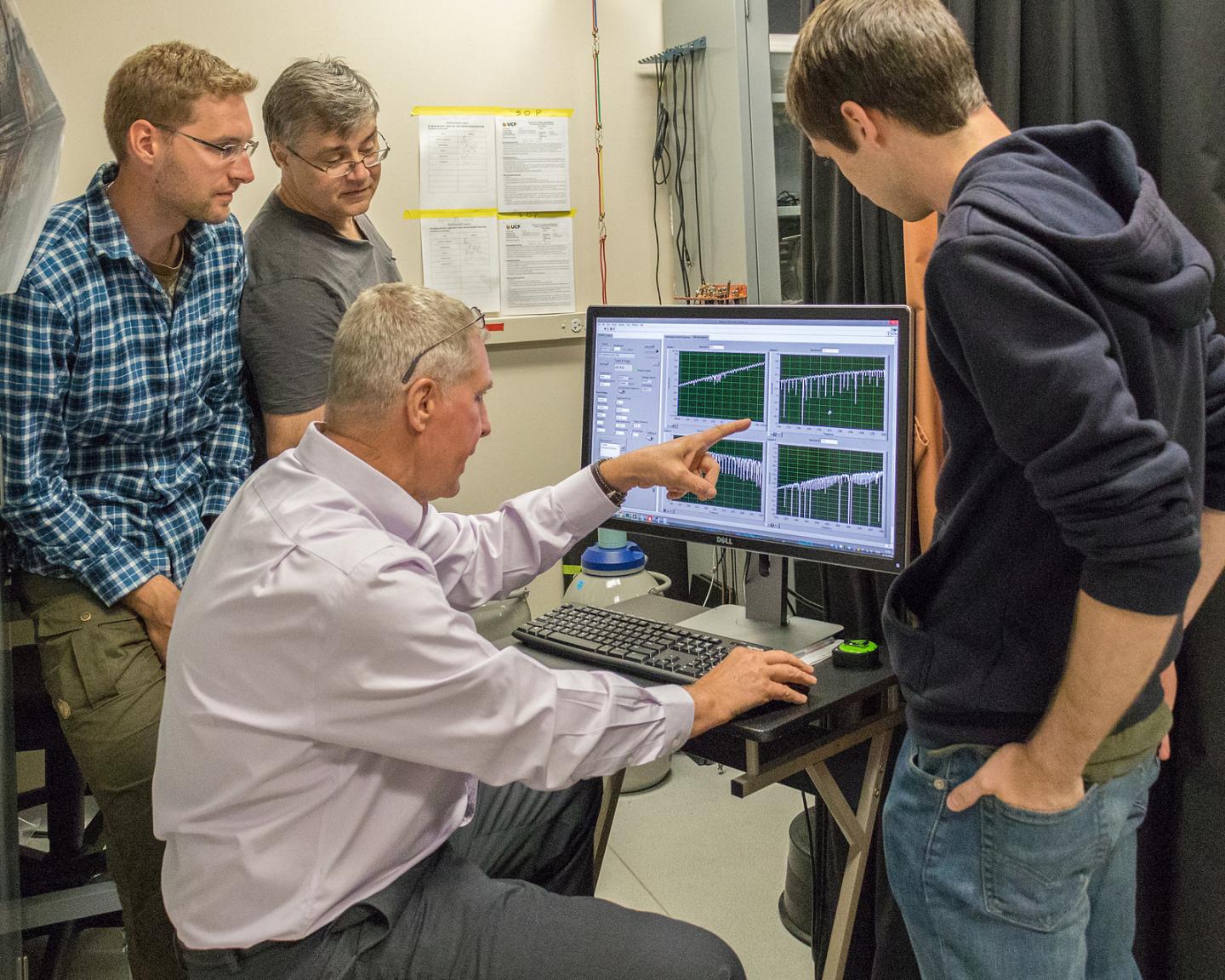
IMAGE

Credit: UCF: Karen Norum

The Department of Homeland Security could benefit from a reliable, real-time instrument that could scan the atmosphere for toxic agents in order to alert communities to a biological or chemical attack. UCF optics and photonics Professor Konstantin Vodopyanov is developing just such a technology to accomplish that.

He has found a new way to use infrared lasers to detect even trace amounts of chemicals in the air. Every chemical is made up of individual molecules that vibrate at their own unique frequency. Vodopyanov has found a way to use lasers to detect these vibrations.

The technique is so accurate and sensitive that he can determine if there is a molecule of any chemical present even at concentrations as low as one part per billion. So even if someone tried to hide the toxic chemicals, his technique would be able to detect them.

His findings are published online this week in Nature Photonics.

"We still have much work ahead," he said. "We are now working on broadening the range of the laser frequencies that can get the job done. If costs can be reduced and the tech made mobile, the applications could be endless."

A similar principle is used in the medical field to detect biomarkers for different kinds of health conditions, including cancer, by taking breath samples.

It's possible, Vodopyanov said, because of the rules of physics.

"The frequencies of molecules are very distinct, but they are invariant – here, on a different continent, on a different planet, anywhere," Vodopyanov said. "It is universal. Think of it as a molecular fingerprint. So when we use the laser we can detect these fingerprints with great precision."

The novel approach could open the door for developing non-invasive technology, including sensors, that could be used to detect:

  • airborne agents that could be encountered in a biological or chemical attack at home or on the battlefield
  • traces of life by space explorers on missions to other planets or asteroids

To see a video explanation click here: https://youtu.be/PPBZeLLXdoY

Other collaborators on the Nature Photonics paper include Andrey Muraviev at UCF's the College of Optics & Photonics, Viktor Smolski of IPG Photonics — Mid-Infrared Lasers in Birmingham, AL, and Zachary Loparo from UCF's Department of Mechanical and Aerospace Engineering.

Vodopyanov obtained his doctorate from the Lebedev Physical Institute in Moscow. He's spent years teaching and conducting research in Russia, Germany, the United Kingdom and Stanford University in California before joining UCF in 2013. He's also worked in industry, including the Silicon Valley start-up Picarro, which was developing a laser-based breath analyzer for early detection of ulcers. He's written more than 300 papers and is funded by various organizations including the Defense Advanced Research Projects Agency, Office of Naval Research, Air Force and NASA.

###

Media Contact

Zenaida Gonzalez Kotala
[email protected]
407-823-6120
@UCF

http://www.ucf.edu

Share12Tweet8Share2ShareShareShare2

Related Posts

Evolution-Inspired Biosensors Revolutionize Lipid Tracking in Real Time — Biology

Evolution-Inspired Biosensors Revolutionize Lipid Tracking in Real Time

July 2, 2026
New Study Reveals How to Reduce Risk of Dangerous Wildlife Encounters This Summer — Biology

New Study Reveals How to Reduce Risk of Dangerous Wildlife Encounters This Summer

July 2, 2026

Hepatic IFRD1 Alleviates Metabolic Dysfunction-Linked Steatohepatitis Through the GLUD1/α-KG Pathway

July 2, 2026

Intricate Food Webs Support Ecosystem Health and Stability

July 2, 2026
Please login to join discussion

POPULAR NEWS

  • Detection of EDCs in Breast Milk and Infant Urine Up to Six Months Highlights Early Exposure Risks

    77 shares
    Share 31 Tweet 19
  • Saying Goodbye to PGY-6: Pediatric Fellowship Realities

    103 shares
    Share 41 Tweet 26
  • New Drug Candidate Developed at McMaster Shows Potential for Treating Brain Cancer

    58 shares
    Share 23 Tweet 15
  • KTU Researchers Explore Ultrasound’s Role in Enhancing Blood Flow Beyond Diagnostics

    53 shares
    Share 21 Tweet 13

About

We bring you the latest biotechnology news from best research centers and universities around the world. Check our website.

Follow us

Recent News

Quasi-Bound States Boost Quantum Well Photoresponse

Lysine Pyruvylation Links Glycolysis to Epigenetics

Multiphysics Coupling: Single vs. Multiple DeepONet Branches

Subscribe to Blog via Email

Success! An email was just sent to confirm your subscription. Please find the email now and click 'Confirm' to start subscribing.

Join 83 other subscribers
  • Contact Us

Bioengineer.org © Copyright 2023 All Rights Reserved.

Welcome Back!

Login to your account below

Forgotten Password?

Retrieve your password

Please enter your username or email address to reset your password.

Log In
No Result
View All Result
  • Homepages
    • Home Page 1
    • Home Page 2
  • News
  • National
  • Business
  • Health
  • Lifestyle
  • Science

Bioengineer.org © Copyright 2023 All Rights Reserved.