• HOME
  • NEWS
  • EXPLORE
    • CAREER
      • Companies
      • Jobs
    • EVENTS
    • iGEM
      • News
      • Team
    • PHOTOS
    • VIDEO
    • WIKI
  • BLOG
  • COMMUNITY
    • FACEBOOK
    • INSTAGRAM
    • TWITTER
Wednesday, July 22, 2026
BIOENGINEER.ORG
No Result
View All Result
  • Login
  • HOME
  • NEWS
  • EXPLORE
    • CAREER
      • Companies
      • Jobs
        • Lecturer
        • PhD Studentship
        • Postdoc
        • Research Assistant
    • EVENTS
    • iGEM
      • News
      • Team
    • PHOTOS
    • VIDEO
    • WIKI
  • BLOG
  • COMMUNITY
    • FACEBOOK
    • INSTAGRAM
    • TWITTER
  • HOME
  • NEWS
  • EXPLORE
    • CAREER
      • Companies
      • Jobs
        • Lecturer
        • PhD Studentship
        • Postdoc
        • Research Assistant
    • EVENTS
    • iGEM
      • News
      • Team
    • PHOTOS
    • VIDEO
    • WIKI
  • BLOG
  • COMMUNITY
    • FACEBOOK
    • INSTAGRAM
    • TWITTER
No Result
View All Result
Bioengineer.org
No Result
View All Result
Home NEWS Science News Biology

New insights into evolution of gene expression

Bioengineer by Bioengineer
September 8, 2020
in Biology
Reading Time: 2 mins read
0
IMAGE
Share on FacebookShare on TwitterShare on LinkedinShare on RedditShare on Telegram

IMAGE

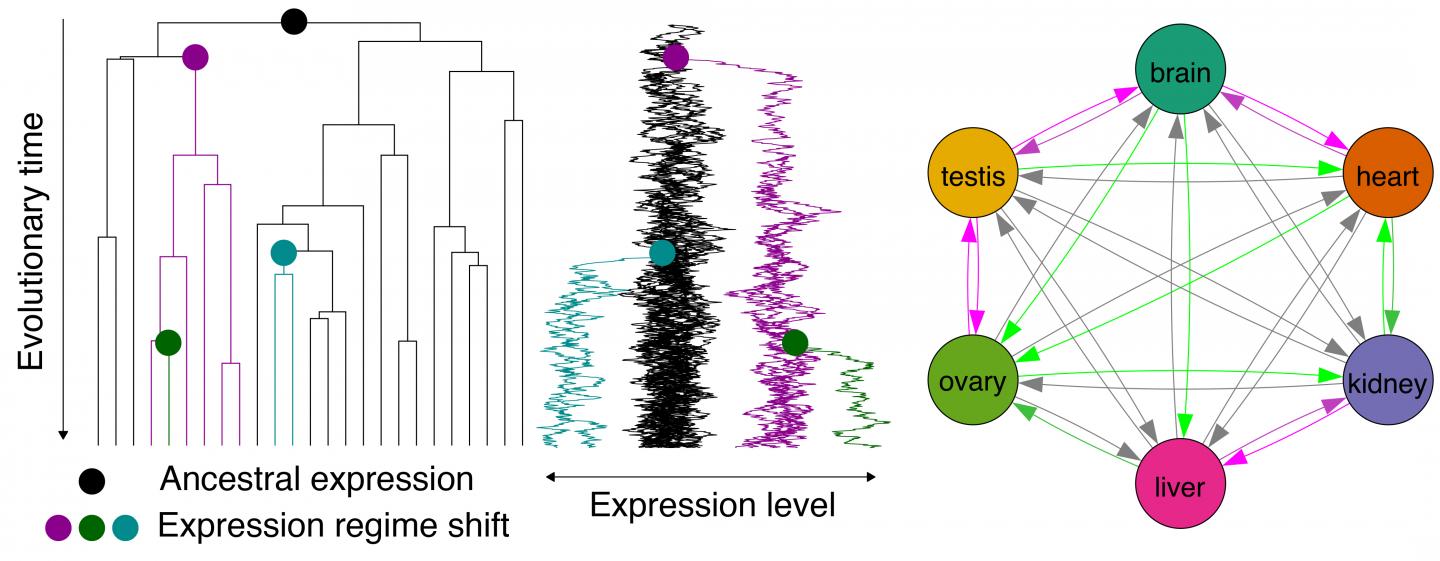
Credit: Graphic: Kenji Fukushima / University of Wuerzburg

Vertebrate organs organize physiological activities, and the diverse expression patterns of thousands of genes determines organ identities and functions. Because of this, the evolution of gene expression patterns plays a central role in organismal evolution.

Major organ-altering evolutionary events such as development of the hominoid brain are also associated with gene expression shifts. However, although gene duplication is well-known to play an important role in expression pattern shifts, the evolutionary dynamics of expression patterns with and without gene duplication remain poorly understood.

„An important question is whether long-term expression in one organ predisposes genes to be subsequently utilized in other organs. The answer is yes”, says Dr. Kenji Fukushima from Julius-Maximilians-Universität (JMU) Würzburg in Bavaria, Germany. „There are preadaptive propensities in the evolution of vertebrate gene expression, and the propensity varies with the presence and type of gene duplication.”

Funded by the Alexander von Humboldt Foundation

Kenji Fukushima now reports this and other findings with his co-author David D. Pollock (University of Colorado, School of Medicine, Aurora, USA) in the journal Nature Communications.

Dr. Fukushima holds a research position at the JMU Chair for Molecular Plant Physiology and Biophysics. Here, since 2018, the Japanese evolution biologist has been building up a working group, funded with 1.6 million euros by the Alexander von Humboldt Foundation. The renowned foundation had selected him as the winner of its Sofja Kovalevskaja Prize 2018. The award is intended for exceptionally talented young researchers.

Complex history of gene family trees

For their study the scientists amalgamated 1,903 RNA-seq datasets from 182 research projects. The date include six organs (brain, heart, kidney, liver, ovary, and testis) from 21 vertebrate species, ranging from freshwater fish and frogs to lizards, birds, rodents and humans. So they revealed a complex history of gene family trees. This allowed them to analyse the evolutionary expression of a broad set of genes.

###

Media Contact
Dr. Kenji Fukushima
[email protected]

Related Journal Article

http://dx.doi.org/10.1038/s41467-020-18090-8

Tags: BiologyEvolutionGenesGeneticsZoology/Veterinary Science
Share12Tweet8Share2ShareShareShare2

Related Posts

The concealed geometry behind breeding constraints

The concealed geometry behind breeding constraints

July 18, 2026
Organic fertilizer helps biochar immobilize cadmium in contaminated soil

Organic fertilizer helps biochar immobilize cadmium in contaminated soil

July 18, 2026

Asteroid impact may have reshaped tuna evolution alongside dinosaur extinction

July 18, 2026

Wild snapdragons subtly change color to attract bees

July 17, 2026
Please login to join discussion

POPULAR NEWS

  • Groundbreaking Discovery: New Shark Species Identified for the First Time — Technology and Engineering

    Groundbreaking Discovery: New Shark Species Identified for the First Time

    34 shares
    Share 14 Tweet 9
  • Controlled Study Defines Pediatric Long COVID Features

    32 shares
    Share 13 Tweet 8
  • Behavioral Nudge Boosts Medication Prescriptions for Alcohol Reduction

    35 shares
    Share 14 Tweet 9
  • Clean Cooking and Remittances Slash Somalia’s Ecological Footprints

    31 shares
    Share 12 Tweet 8

About

We bring you the latest biotechnology news from best research centers and universities around the world. Check our website.

Follow us

Recent News

Sleep Quality Links Synergistically with Frailty to Increase Cardiometabolic Multimorbidity in Elderly Chinese

Cognitive reserve helps older adults resist frailty and recover better

Physical Activity and Health Inequality in China’s Older Adults

Subscribe to Blog via Email

Success! An email was just sent to confirm your subscription. Please find the email now and click 'Confirm' to start subscribing.

Join 85 other subscribers
  • Contact Us

Bioengineer.org © Copyright 2023 All Rights Reserved.

Welcome Back!

Login to your account below

Forgotten Password?

Retrieve your password

Please enter your username or email address to reset your password.

Log In
No Result
View All Result
  • Homepages
    • Home Page 1
    • Home Page 2
  • News
  • National
  • Business
  • Health
  • Lifestyle
  • Science

Bioengineer.org © Copyright 2023 All Rights Reserved.