• HOME
  • NEWS
  • EXPLORE
    • CAREER
      • Companies
      • Jobs
    • EVENTS
    • iGEM
      • News
      • Team
    • PHOTOS
    • VIDEO
    • WIKI
  • BLOG
  • COMMUNITY
    • FACEBOOK
    • INSTAGRAM
    • TWITTER
Wednesday, April 1, 2026
BIOENGINEER.ORG
No Result
View All Result
  • Login
  • HOME
  • NEWS
  • EXPLORE
    • CAREER
      • Companies
      • Jobs
        • Lecturer
        • PhD Studentship
        • Postdoc
        • Research Assistant
    • EVENTS
    • iGEM
      • News
      • Team
    • PHOTOS
    • VIDEO
    • WIKI
  • BLOG
  • COMMUNITY
    • FACEBOOK
    • INSTAGRAM
    • TWITTER
  • HOME
  • NEWS
  • EXPLORE
    • CAREER
      • Companies
      • Jobs
        • Lecturer
        • PhD Studentship
        • Postdoc
        • Research Assistant
    • EVENTS
    • iGEM
      • News
      • Team
    • PHOTOS
    • VIDEO
    • WIKI
  • BLOG
  • COMMUNITY
    • FACEBOOK
    • INSTAGRAM
    • TWITTER
No Result
View All Result
Bioengineer.org
No Result
View All Result
Home NEWS Science News

New Hubble mosaic of the Orion Nebula

Bioengineer by Bioengineer
March 17, 2017
in Science News
Reading Time: 3 mins read
0
Share on FacebookShare on TwitterShare on LinkedinShare on RedditShare on Telegram
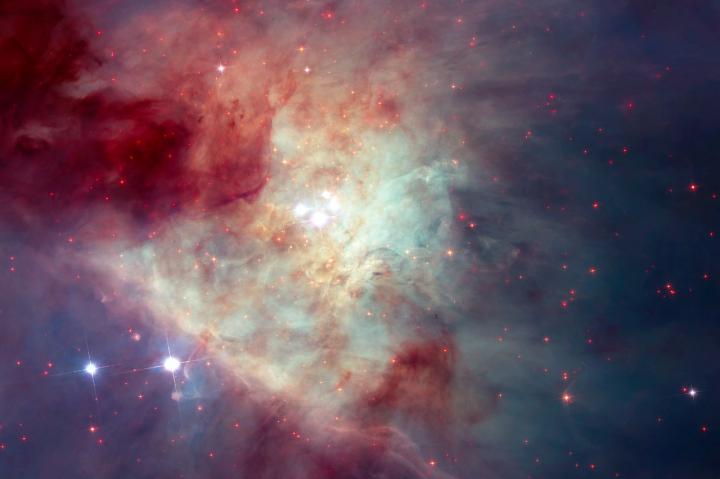
IMAGE

Credit: NASA, ESA/Hubble

In the search for rogue planets and failed stars astronomers using the NASA/ESA Hubble Space Telescope have created a new mosaic image of the Orion Nebula. During their survey of the famous star formation region, they found what may be the missing piece of a cosmic puzzle; the third, long-lost member of a star system that had broken apart.

The Orion Nebula is the closest star formation region to Earth, only 1400 light-years away. It is a turbulent place — stars are being born, planetary systems are forming and the radiation unleashed by young massive stars is carving cavities in the nebula and disrupting the growth of smaller, nearby stars.

Because of this ongoing turmoil, Hubble has observed the nebula many times to study the various intriguing processes going on there. This large composite image of the nebula's central region, combining visual and near-infrared data, is the latest addition to this collection.

Astronomers used these new infrared data to hunt for rogue planets — free-floating in space without a parent star — and brown dwarfs in the Orion Nebula. The infrared capabilities of Hubble also allow it to peer through the swirling clouds of dust and gas and make the stars hidden within clearly visible; the unveiled stars appear with bright red colours in the final image. Among these, astronomers stumbled across a star moving at an unusually high speed — about 200 000 kilometres per hour [1]. This star could be the missing piece of the puzzle of a star system that had been broken apart 540 years ago.

Astronomers already knew about two other runaway stars in the Orion Nebula which were most likely once part of a now-defunct multiple-star system. For years it was suspected that the original system contained more than just these two stars. Now, by virtue of accident and curiosity, Hubble may have found the missing third piece of this cosmic puzzle.

Whether the new star is indeed the missing — and the last — piece of the puzzle will require further observations. So will the answer to the question of why the original star system broke apart in the first place. While there are several theories — interactions with other, nearby stellar groups, or two of the stars getting too close to each other — none can be ruled out or confirmed yet.

And while the astronomers are looking for the answers to these questions, who knows what mystery they will find next?

###

Notes

[1] The relative speed of the star was calculated by comparing observations made in 1998 with the recent ones. The speed of the newly discovered star is almost 30 times the speed of most of the nebula's stellar inhabitants.

More information

The Hubble Space Telescope is a project of international cooperation between ESA and NASA.

Image credit: NASA, ESA

Links

Images of Hubble – http://www.spacetelescope.org/images/archive/category/spacecraft/

Hubblesite release – http://hubblesite.org/news_release/news/2017-11

Contacts

Mathias Jäger
ESA/Hubble, Public Information Officer
Garching, Germany
Cell: +49 176 62397500
Email: [email protected]

Media Contact

Mathias Jäger, ESA/Hubble, Public Information Officer
[email protected]
49-176-623-97500
@Hubble_space

http://www.spacetelescope.org

############

Story Source: Materials provided by Scienmag

Share12Tweet8Share2ShareShareShare2

Related Posts

KIST-IAE Collaborative Team Surpasses Performance Limits in Lithium-Air Batteries with Innovative Two-Dimensional Catalyst

KIST-IAE Collaborative Team Surpasses Performance Limits in Lithium-Air Batteries with Innovative Two-Dimensional Catalyst

April 1, 2026

Brain Metastases Show Unique Macrophage Spatial Patterns

April 1, 2026

PRSS56 Drives and Treats Human High Myopia

April 1, 2026

Early cfEBV DNA Guides Nasopharyngeal Cancer Treatment

April 1, 2026
Please login to join discussion

POPULAR NEWS

  • blank

    Revolutionary AI Model Enhances Precision in Detecting Food Contamination

    96 shares
    Share 38 Tweet 24
  • Imagine a Social Media Feed That Challenges Your Views Instead of Reinforcing Them

    1006 shares
    Share 398 Tweet 249
  • Promising Outcomes from First Clinical Trials of Gene Regulation in Epilepsy

    51 shares
    Share 20 Tweet 13
  • Popular Anti-Aging Compound Linked to Damage in Corpus Callosum, Study Finds

    43 shares
    Share 17 Tweet 11

About

We bring you the latest biotechnology news from best research centers and universities around the world. Check our website.

Follow us

Recent News

KIST-IAE Collaborative Team Surpasses Performance Limits in Lithium-Air Batteries with Innovative Two-Dimensional Catalyst

Brain Metastases Show Unique Macrophage Spatial Patterns

PRSS56 Drives and Treats Human High Myopia

Subscribe to Blog via Email

Enter your email address to subscribe to this blog and receive notifications of new posts by email.

Join 78 other subscribers
  • Contact Us

Bioengineer.org © Copyright 2023 All Rights Reserved.

Welcome Back!

Login to your account below

Forgotten Password?

Retrieve your password

Please enter your username or email address to reset your password.

Log In
No Result
View All Result
  • Homepages
    • Home Page 1
    • Home Page 2
  • News
  • National
  • Business
  • Health
  • Lifestyle
  • Science

Bioengineer.org © Copyright 2023 All Rights Reserved.