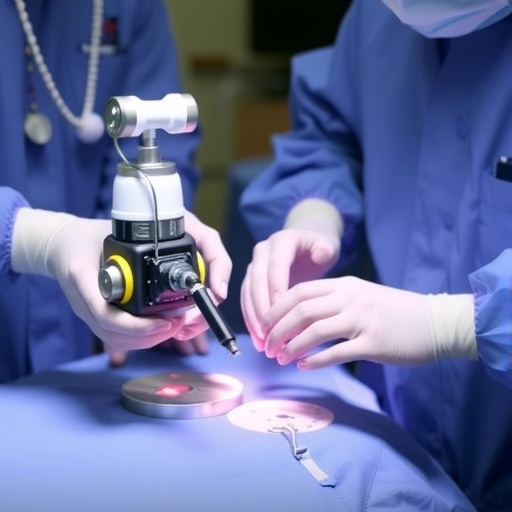
A team of engineers and surgeons in China has built a handheld surgical robot that brings robotic dexterity to laparoscopic surgery in a package small enough to hold in one hand, and their prototype has now shown laboratory performance figures that could challenge the dominance of the multimillion-dollar operating room robots that currently define surgical automation. The device, described in the International Journal of Computer Assisted Radiology and Surgery, is a modular, electrically driven instrument in which a fingertip joystick moves a flexible wrist-like tip through an intuitively matched, one-to-one correspondence known as master-slave isomorphism. In a series of benchtop trials and simulator-based suturing tasks, the prototype achieved a combined yaw and pitch range of ±90 degrees at its end effector, a maximum trajectory error of 3.43 millimeters, and a master-slave control delay of 0.304 seconds, while allowing surgeons to swap its disposable tips in under seven seconds.
The work was carried out by Li Ma, Bingyue Yang, Jie Shao, Qiao Hu and Zicai Zhu of the School of Mechanical Engineering at Xi’an Jiaotong University, working with the Shaanxi Key Laboratory of Intelligent Robots and the Department of Surgical Oncology at the university’s First Affiliated Hospital. Their motivation stems from a long-standing tension in minimally invasive surgery. Since the laparoscopic revolution of the 1990s, surgeons have operated through narrow keyhole incisions using long rigid instruments that dramatically reduce patient trauma compared with open surgery. But that reduction in invasiveness carries a steep mechanical penalty. Rigid laparoscopic tools pass through the abdominal wall at a fixed pivot point, which reverses the direction of instrument motion at the tip, restricts the wrist-like freedom a surgeon naturally expects, and forces uncomfortable, fatigue-inducing postures during long operations.
Full-scale surgical robots such as the da Vinci system solved much of that problem by decoupling the surgeon’s hands from the instrument, filtering tremor and restoring wrist-like articulation deep inside the body. Decades of clinical data and large single-institution series, including reports of more than 10,000 robotic cases, have demonstrated the safety and effectiveness of such platforms, particularly for complex procedures like gastric and colorectal cancer resection. Yet these systems remain extraordinarily expensive to purchase and maintain, occupy significant operating room space, and require dedicated teams of scrubbed and unscrubbed staff to set up and dock. For many hospitals, particularly in resource-constrained health systems, the cost calculus simply does not close. Handheld robotic instruments emerged as a counter-proposal: keep the surgeon at the table with direct visual and manual contact, but embed the articulation and dexterity of a robot into the instrument itself.
Earlier handheld devices pursued that goal largely through clever mechanics rather than electronics. Instruments such as FlexDex translated wrist and finger motion mechanically, through cable linkages and compliant mechanisms, into tip articulation without any motors or computers at all, offering what researchers have described as robot-like dexterity without computers and motors. Other commercial and academic designs, including multi-degree-of-freedom articulating instruments, have shown that challenging suturing tasks become easier when the tip can flex. But mechanical solutions impose compromises. The mapping between the surgeon’s hand and the instrument tip is fixed at the time of design, wrist-controlled operation can feel unintuitive during fine maneuvers, and the mechanics can be complex and difficult to manufacture. The Xi’an team chose a different route: put small electric motors in the handle and let software define the relationship between hand motion and tip motion.
The resulting prototype is organized around three key subsystems. The first is the joystick controller held under the surgeon’s fingers. Its geometry is deliberately isomorphic with the continuum end effector at the instrument tip, meaning the joystick’s axes of motion correspond directly, in both direction and sense, to the rotations of the tip. When the surgeon tilts the joystick forward, the tip pitches forward inside the body; when the joystick rolls left, the tip yaws left. That one-to-one correspondence is the essence of master-slave isomorphism, and it stands in contrast to the mirrored, reversed kinematics that plague conventional rigid laparoscopic instruments. Intuitive control matters not merely for comfort but for safety, because cognitive load during surgery is a finite resource, and every moment spent mentally inverting a coordinate system is a moment not spent on the anatomy.
The second subsystem is the end effector itself, a multi-layer cross-shaped Hooke hinge structure that behaves as a continuum wrist. Rather than using a small number of discrete rotational joints, the device bends continuously through stacked hinge layers arranged in orthogonal orientations, allowing the tip to combine yaw and pitch into smooth, compound trajectories. The researchers modeled this behavior using continuous curvature methods, a mathematical framework standard in continuum robotics that describes the backbone of the manipulator as a curve with smoothly varying curvature rather than as a chain of rigid links. This modeling choice is what enables the joint incremental proportional control scheme they propose: instead of commanding absolute joint positions, the controller computes small increments for each of the tip’s drive joints proportional to the instantaneous error between the desired and current tip orientation, producing stable, smooth tracking even across the full ±90-degree combined range.
The third subsystem is a quick-change mechanism that addresses the practical economics of surgery. Surgical instruments are consumables; tips dull, foul, and must be replaced between uses or between steps of a procedure. In conventional robotic setups, instrument exchange can consume valuable operating room minutes. The team’s mechanism lets the sterile tip module be detached and replaced in less than seven seconds, a figure they measured directly on the prototype. Because the electronics and motors reside in the reusable handheld master unit, only the inexpensive tip module is discarded, an architecture intended to cut per-procedure costs substantially compared with robotic platforms whose instrument arms are themselves expensive limited-use items.
Quantifying how faithfully the slave tip follows the master joystick required an independent measurement system, so the team constructed an optical three-dimensional motion capture rig to record both the joystick trajectory and the corresponding tip trajectory simultaneously. From those synchronized recordings they extracted the device’s accuracy and latency characteristics. The maximum trajectory error across the tested movements was 3.43 millimeters, and the master-slave control delay was 0.304 seconds. Latency is a critical parameter for any teleoperated or semi-teleoperated surgical device; prior research using surgical simulators has examined how delay degrades performance in telesurgery and sought to establish acceptable latency thresholds, since even modest lag disrupts the sensory-motor loop between what a surgeon sees and what the instrument does. A delay of roughly a third of a second places the prototype in a range where deliberate surgical maneuvers remain feasible, though the authors note it as a characteristic of the current early-stage prototype rather than an optimized value.
The ±90-degree combined yaw and pitch range deserves particular attention because it roughly doubles the articulation available through many existing handheld wrist instruments and approaches the freedom that full robotic platforms provide. The team demonstrated that the robot can execute multi-axis circular movements with excellent consistency, meaning that when commanded to trace circular paths that combine yaw and pitch simultaneously, the tip reproduced those compound trajectories repeatably. Consistency of this kind matters clinically because suturing in confined spaces, for example deep in the pelvis or around the esophageal hiatus, frequently demands oblique, compound wrist angles rather than simple planar motion. Finally, in proof-of-concept trials with a laparoscopic simulator, the device grasped tissue and performed suturing tasks more easily than would be expected with conventional rigid instruments, providing an early functional validation that the kinematic numbers translate into practical surgical capability.
Beyond its immediate performance figures, the study makes a methodological contribution. The joint incremental proportional control approach, in which each rope-driven joint of the continuum mechanism is controlled through proportional increments derived from the master input, is general enough, the authors argue, to be applied to other rope-driven continuum robots. Tendon-driven continuum architectures are now widespread in medical robotics, from single-port access systems to steerable catheters and endoscopes, and they share a common control challenge: the mapping between actuator cable lengths and tip pose is nonlinear, coupled, and sensitive to friction and compliance in the transmission. An incremental proportional scheme sidesteps some of the calibration burdens of model-based approaches by reacting to error locally at each joint, making it an attractive, computationally lightweight option for compact, battery- or motor-driven devices where embedded processing power is limited.
The device’s modular, handheld philosophy also speaks to a broader conversation about how surgical robotics should scale. Several research groups have previously explored dexterous and modular handheld surgical robots, and commercial handheld articulating instruments have accumulated growing clinical datasets, including multicenter analyses of learning curves for procedures such as laparoscopic right hemicolectomy. The consistent finding across that literature is that wrist-like articulation shortens the time it takes surgeons to master difficult laparoscopic maneuvers and reduces the ergonomic strain that contributes to chronic injury among minimally invasive surgeons. A handheld electric device that matches those ergonomic benefits while avoiding the capital cost of a full robotic platform could widen access to advanced minimally invasive care in hospitals and health systems that cannot justify a docked robot for their surgical volumes.
The Xi’an work remains a prototype study, and the authors are careful about its scope. All testing to date has been benchtop and simulator-based; the study involved no patients or live animals and required no ethics committee approval. Achieved control delay, trajectory error, and the durability of the quick-change mechanism under real sterilization cycles and real tissue mechanics remain to be validated in more demanding preclinical settings. Latency in particular will need to fall if the device is to support the fastest phases of surgical work. Nevertheless, the combination of a full ±90-degree articulation envelope, sub-3.5-millimeter trajectory error, sub-seven-second instrument exchange, and an isomorphic finger-controlled interface represents one of the most complete engineering demonstrations to date of what a genuinely affordable, electric handheld surgical robot can achieve. The research was supported by the Postdoctoral Fellowship Program of the China Postdoctoral Science Foundation and the Postdoctoral Research Funding Project of Shaanxi Province. If subsequent iterations close the latency gap and survive preclinical testing, the operating room of the future may look less like a stage dominated by a four-armed tower and more like a surgeon at the table, holding in one hand a robot that fits where a scalpel does.
Subject of Research: Development and evaluation of a master-slave isomorphic, modular handheld electric robotic prototype for laparoscopic surgery, featuring a joystick controller, a multi-layer cross-shaped Hooke hinge continuum end effector, quick-change instrument exchange, and joint incremental proportional control.
Subject of Research: Medicine
Article Title: Development of a master-slave isomorphic modular handheld electric robotic prototype for laparoscopic surgery
Article References: Ma, L., Yang, B., Shao, J., Hu, Q., & Zhu, Z. (2026). Development of a master-slave isomorphic modular handheld electric robotic prototype for laparoscopic surgery. International Journal of Computer Assisted Radiology and Surgery. https://doi.org/10.1007/s11548-026-03759-0
Image Credits: AI Generated
DOI: 10.1007/s11548-026-03759-0
Keywords: Handheld surgical robot, Continuum robotics, Master-slave isomorphic control, Laparoscopic surgery, Articulated end effector, Quick-change mechanism, Joint incremental proportional control, Hooke hinge, Minimally invasive surgery, Motion capture evaluation, Surgical latency, Modular surgical instruments
Cite Scienmag News
APA MLA Chicago
Ophelia Keating. (September 7, 2026). New handheld master-slave robot developed for laparoscopic surgery. Scienmag. https://scienmag.com/new-handheld-master-slave-robot-developed-for-laparoscopic-surgery/
Ophelia Keating. “New handheld master-slave robot developed for laparoscopic surgery.” Scienmag, 7 September 2026, https://scienmag.com/new-handheld-master-slave-robot-developed-for-laparoscopic-surgery/. Accessed 7 September 2026.
Ophelia Keating. “New handheld master-slave robot developed for laparoscopic surgery.” Scienmag. September 7, 2026. https://scienmag.com/new-handheld-master-slave-robot-developed-for-laparoscopic-surgery/
Copy citation Download RIS
Tags: compact handheld surgical robot prototypefingertip joystick controlflexible wrist-like robotic tipflexible wrist-like surgical instrumenthandheld surgical robotinnovation in surgical robotics Chinalab performance of surgical robotslaboratory performance of surgical robotslaparoscopic surgery automationmaster-slave control in surgeryminiature master-slave surgical deviceminiature robotic surgical deviceminimally invasive surgical robotsmodular electrical surgical toolsmodular surgical robot designperformance metrics of portable surgical robotsreal-time master-slave control in surgeryreal-time surgical robot responsivenessrobotic dexterity in minimally invasive surgeryrobotic suturing techniquessurgeon-controlled robotic suturingsurgical robot development China