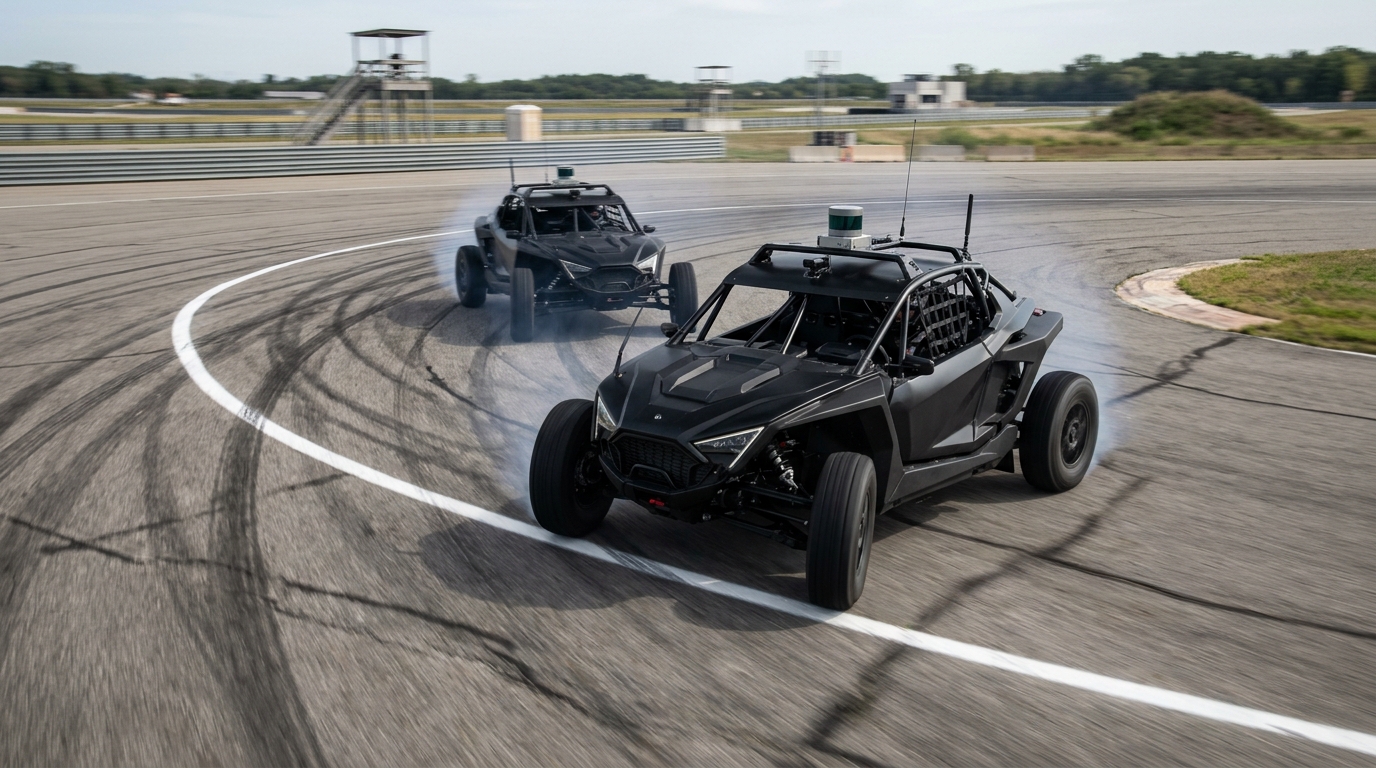
Researchers have developed a geometric framework that resolves a convex target defense problem within a variant of the classical Game of Two Cars, bypassing the computational complexity of solving Hamilton-Jacobi-Isaacs equations. Published in Autonomous Intelligent Systems, the study investigates an adversarial engagement where a faster, more maneuverable defender vehicle seeks to intercept an attacking vehicle before it enters an arbitrary convex target set on an obstacle-free plane. Both agents follow nonholonomic Dubins car dynamics with bounded turning radii. By constructing an Attacker Dominance Region from forward reachable sets, the framework provides an exact method for determining game outcomes and synthesizing optimal trajectory strategies.
Adversarial interactions between autonomous agents are traditionally modeled as pursuit-evasion differential games, tracing their roots to predator-prey dynamics and defense operations. While classical techniques like Pontryagin’s Maximum Principle and Krasovskii’s extremal aiming method address simplified scenarios, comprehensive formulations depend on solving Hamilton-Jacobi-Isaacs partial differential equations. In reach-avoid problems involving multiple terminal sets, backward integration frequently encounters singular surfaces where distinct characteristics intersect. Existing geometric simplifications, such as Apollonius circles or Voronoi partitions, typically rely on simple motion models or require supplementary equation-based verification, limiting their tractability when vehicles obey curvature bounds and asymmetric velocity limits.
To reflect vehicle constraints more faithfully than double-integrator models, the authors model both defender and attacker as Dubins cars. Under these kinematic equations, each vehicle moves forward at a controlled linear velocity up to its upper bound while steering at an angular rate constrained within symmetric limits. When an agent applies its maximum turning rate, its trajectory follows a circular arc determined by its minimum turning radius. The state of each vehicle is completely described by its planar spatial coordinates and heading angle. The combined system evolves in a six-dimensional state space encompassing position vectors and directional headings for both participating agents.
The guarded target is mathematically defined as a compact, convex planar subset bounded by the zero sub-level set of a twice continuously differentiable convex function, accommodating general convex profiles including circular regions. To frame the competitive encounter, the investigation establishes four structural assumptions. The attacker and defender begin separated, and the attacker starts entirely outside the target boundary. Furthermore, the defending vehicle possesses a strict dynamic advantage, maintaining higher maximum linear velocity and greater maximum angular velocity than the attacker. Both agents operate under non-anticipative information structures, and the total engagement duration is assumed sufficiently long relative to vehicle turning rates, ensuring long-range geometric interaction.
The competition concludes under one of two mutually exclusive terminal events, depending on which terminal set is encountered first by the joint position trajectory. A capture event occurs if the defender intercepts the attacker at identical spatial coordinates outside the target region. Conversely, an attack victory occurs if the attacker reaches the target boundary before interception takes place. Because terminal outcomes are fully governed by initial configurations under optimal play, the state space naturally splits into disjoint winning zones separated by a semipermeable Barrier surface. When capture is guaranteed, the defender maximizes distance from capture to target, whereas the attacker minimizes that margin.
When initial conditions place the game inside the attack winning zone, the attacker is assured of reaching the target boundary before interception. Under this circumstance, the defender adopts an optimal strategy to minimize its final Euclidean separation from the attacker at the instant target intrusion occurs, while the attacker acts to maximize this terminal distance. Both regimes satisfy minimax inequalities defining value functions for capture and attack scenarios. Solving the target defense problem therefore demands two consecutive determinations: locating the exact Barrier surface that partitions the initial state space, and synthesizing optimal feedback strategies that realize saddle-point equilibrium within each respective region.
Rather than attempting backward integration across intersecting characteristics, the researchers introduce a forward reachability formulation to delineate player capabilities under nonholonomic constraints. A player’s reachable set comprises all planar positions attainable from its initial state within a designated time horizon. Under the long-range engagement assumption, the reachable set boundary is traced exclusively by Circle-Straight trajectories, which consist of an initial turn at the vehicle’s minimum turning radius followed by straight-line travel. Because each vehicle can initiate either a clockwise or counterclockwise turn, the overall reachable boundary merges paths generated under both discrete turning directives, producing an envelope whose coordinates are computed by integrating kinematic equations over turning and straight durations.
From these reachable set boundaries, the authors construct the Attacker Dominance Region, defined as the spatial region where the attacker can arrive strictly before or simultaneously with the defender. Because each vehicle possesses two initial turning options, four pairwise directional configurations arise. For each combination, a sub-region boundary is established by identifying the locus of points where both vehicles arrive at identical coordinates at the exact same travel time. The union of these four mode-specific sub-regions defines the overall dominance region, whose planar complement forms the Defender Dominance Region. Applying the Implicit Function Theorem confirms that boundary segments remain continuously differentiable, with non-smooth cusps appearing only along switching surfaces where directional modes transition.
The geometric relationship between the Attacker Dominance Region and the convex target set directly resolves the Game of Kind, determining which player holds the winning advantage. The researchers quantify this interaction by calculating the minimum Euclidean distance between the dominance region and the target, utilizing orthogonal projections onto the convex target boundary. In Theorem 1, the authors establish the mathematical definition of the Barrier function based on this signed minimum distance. If the closest dominance region point lies outside the target set, minimum separation is strictly positive, meaning sets do not intersect and defender capture is guaranteed. If that point lies within the target, distance is non-positive, guaranteeing attacker success.
Once the winning region is identified, the Game of Degree characterizes equilibrium strategies and terminal points for both agents. In the capture region, the outcome converges to a Capture Equilibrium point on the dominance region boundary, minimizing distance to the target boundary under simultaneous arrival constraints. Conversely, in the attack region, interaction terminates at an Attack Equilibrium point along the intersection of the target boundary and dominance region, maximizing terminal separation. Both points exist by the Weierstrass Extreme Value Theorem.
In Theorem 2, optimal control policies generating these equilibrium trajectories are derived through Pontryagin’s Maximum Principle. Because each agent’s Hamiltonian is affine with respect to linear and angular velocities, optimal controls dictate that both vehicles constantly operate at maximum linear speed. Curvature control is governed by switching functions evaluating costate multipliers: when non-zero, angular velocity switches to extreme left or right bounds, tracing maximum-curvature circular arcs. When the switching function vanishes over a non-trivial interval, the vehicle enters a singular arc where heading remains constant and angular velocity equals zero, producing straight-line motion. Verifying the Generalized Legendre-Clebsch condition confirms that these singular arcs are locally optimal, rigorously validating the Circle-Straight trajectory structure.
The resulting control laws follow a piecewise-constant form defined by a single switching instant separating the initial turning maneuver from subsequent straight travel. If an agent’s initial heading is already aligned with its terminal destination, the turning duration becomes zero and motion proceeds entirely in a straight line. By applying inverse kinematics to the computed equilibrium point, Algorithm 1 determines the exact turning duration and execution time for each vehicle across all four directional configurations, selecting the mode that minimizes the Barrier function. Because Pontryagin’s Maximum Principle restricts admissible candidates and the algorithm exhaustively evaluates the finite set of valid directional modes, the resulting trajectory profile achieves global optimality without requiring iterative numerical partial differential equation solvers.
Numerical simulations verified these theoretical findings across contrasting operational environments. In both scenarios, attacker coordinates started at [6, -5] with heading pi/6, while the defender started at [2, 5] with heading pi/2, with maximum speed and turn bounds of 1.0 for the attacker and 1.2 for the defender. In the first scenario, a compact target scaled at r=1 placed initial states within the defender’s capture region. In the second scenario, expanding the target scale to r=5 shifted initial states into the attack region. The attacker reached the boundary at [3.404, -2.7577] in 4.747 seconds, achieving terminal separation of 2.894 from the defender.
Comparative simulations against baseline defender strategies, including Pure Pursuit and game-theoretic nonlinear model predictive control, further demonstrated the proposed framework’s performance across three distinct initial configurations facing an optimal attacker. Under identical conditions where baseline methods failed to prevent intrusion, the proposed strategy guaranteed interception. When all defender strategies intercepted the attacker, the proposed method maximized terminal distance to the target, and when intrusion was physically unavoidable, it achieved the tightest final separation. The authors emphasize that while the framework provides an exact, near real-time solution for long-range engagements through GPU-accelerated computing, short-duration encounters involve different motion primitives, suggesting future hybrid architectures that integrate geometric reachability with local short-range controllers.
Subject of Research: Differential games and target defense under Dubins car dynamics
Article Title: Guarding a convex target set in a particular case of the game of two cars
Article References: Xu, J., He, Q., Meng, M., & Li, X. (2026). Guarding a convex target set in a particular case of the game of two cars. Autonomous Intelligent Systems, 6(1), Article 3. https://doi.org/10.1007/s43684-026-00125-4
Image Credits: AI Generated
DOI: 10.1007/s43684-026-00125-4
Keywords: differential games, Game of Two Cars, target defense, Dubins car, Attacker Dominance Region, reachability analysis, optimal control, pursuit-evasion, Guarding, convex, target, particular
News Source: Denise Maddox. (November 7, 2026). New Geometric Method Solves Convex Target Defense in Two-Car Pursuit Games. Scienmag.