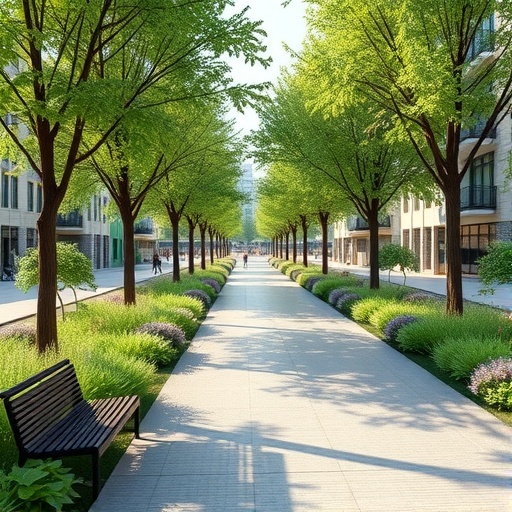
Across the world’s largest cities, a quiet competition is unfolding over one of the most valuable resources in urban life: access to open green space. Parks, riverside corridors, community gardens, wooded slopes and landscaped public areas are often described as shared assets, yet their benefits are rarely distributed evenly. A new study by Zhang, Lu, Shao and colleagues, published in Scientific Reports, introduces a multi-scale collaborative governance framework designed to measure how metropolitan residents share green spaces—and, crucially, who may be left out of that sharing. The research places urban greenery at the center of a rapidly growing scientific debate about environmental justice, public health and the future design of megacities.
The issue is more complex than simply counting parks on a map. Two neighborhoods can contain the same total area of greenery while offering dramatically different experiences to residents. One may have a large, accessible park connected to sidewalks and public transport; the other may contain fragmented vegetation behind highways, industrial fences or private developments. Even a well-designed park can be difficult to use if it is too far away, poorly connected, unsafe, overcrowded or inaccessible to older people and residents with disabilities. The study’s central concept—spatial sharing—therefore moves beyond the question of how much green space exists. It asks how urban residents, communities and administrative areas can access, use and benefit from green infrastructure across geographic boundaries.
That shift is important because metropolitan regions rarely function according to municipal borders. People routinely live in one district, work in another and spend leisure time in a third. A park located near an administrative boundary may serve thousands of residents from multiple jurisdictions, even if only one local government is responsible for its maintenance. Conversely, a neighborhood may appear well served when assessed within its own boundary but remain disconnected from a larger regional network of parks, trails and ecological corridors. By examining green-space relationships at multiple spatial scales, the framework presented in the paper is intended to reveal patterns that can disappear when researchers study cities only block by block or municipality by municipality.
Technically, a multi-scale approach can combine geographic information systems, spatial statistics and accessibility modeling to analyze green-space supply and demand. Researchers may compare the physical distribution of parks with population density, road networks, public transit, walking distances and the demographic characteristics of surrounding communities. At a fine scale, the analysis can identify whether individual residential areas have nearby green amenities. At broader scales, it can examine whether parks form connected networks, whether residents can cross administrative boundaries to reach them and whether the benefits of one district’s green infrastructure extend into neighboring areas. This layered perspective is essential because the same location can look adequately served at one scale and severely underserved at another.
The word “collaborative” in the framework points to another challenge: green-space equity cannot be solved by spatial analysis alone. Metropolitan parks are shaped by planning decisions, land ownership, public finance, transportation policy and community participation. A city government may prioritize flagship parks in central districts, while peripheral communities need smaller local spaces, tree cover or safe pedestrian connections. Neighboring authorities may also have different budgets and planning priorities, creating discontinuities in trails, ecological corridors and maintenance standards. A governance framework that treats green space as a shared metropolitan system can encourage local governments, residents, planners and other stakeholders to coordinate investments rather than managing isolated patches of urban nature.
This perspective is gaining urgency as cities become denser and climate pressures intensify. Vegetation can reduce urban heat by providing shade and cooling through evapotranspiration, while permeable landscapes can absorb rainfall and reduce stormwater runoff. Green corridors may support biodiversity and improve air quality, although their environmental performance depends on design, maintenance and local conditions. Parks also provide opportunities for exercise, social interaction and psychological recovery. Yet these benefits are not automatically universal. If the most attractive or climate-resilient spaces are concentrated in affluent areas, urban greening can deepen inequality—or trigger rising property values and displacement, a process sometimes described as green gentrification.
A measurement framework capable of identifying unequal access could give policymakers a more precise basis for intervention. Instead of asking only whether a city meets a target for park acreage, planners could evaluate the number of residents who can reach a usable green space within a realistic travel time. They could distinguish between passive greenery and functional public space, account for barriers such as major roads and rail lines, and assess whether parks are distributed according to population needs. At the metropolitan scale, authorities could identify places where shared investments—such as cross-boundary trails, connected waterways or coordinated public transit—would deliver benefits to several communities at once. Such evidence could also help test whether new projects improve access for underserved populations rather than merely increasing the city’s total green-space area.
The study’s broader significance lies in its attempt to connect measurement with governance. Urban data are increasingly detailed, but data alone do not guarantee fair outcomes. A map showing a shortage of parks does not determine who will receive funding, which land will be protected or how residents will participate in decision-making. Collaborative governance adds an institutional dimension by recognizing that green-space planning involves negotiation among actors with different interests, responsibilities and levels of power. In this view, spatial sharing is not simply a technical property of the city; it is also a social and political process. The framework can therefore be read as a call to build metropolitan green systems that are jointly planned, jointly maintained and evaluated according to public benefit.
For residents, the implications are immediate and tangible. A city’s green future will not be measured only by spectacular parks photographed from above, but by whether ordinary people can reach safe, welcoming and ecologically functional spaces in their daily lives. The research by Zhang, Lu, Shao and colleagues offers a way to examine that question with greater geographic precision, while highlighting the need for cooperation across the boundaries that divide metropolitan governments. As cities search for solutions to heat, flooding, stress and social isolation, the most powerful green infrastructure may be the network that connects many communities rather than the landmark park that serves only one. The study’s message is both technical and highly public-facing: urban nature becomes genuinely shared only when access, planning and responsibility are shared as well.
Subject of Research: Measuring equitable access to and spatial sharing of open green space in metropolitan areas through multi-scale collaborative governance.
Article Title: Measuring the spatial sharing of open green space in metropolitan areas through a multi-scale collaborative governance framework.
Article References: Zhang, T., Lu, S., Shao, L. et al. “Measuring the spatial sharing of open green space in metropolitan areas through a multi-scale collaborative governance framework.” Scientific Reports (2026). https://doi.org/10.1038/s41598-026-63992-0
Image Credits: AI Generated
DOI: 10.1038/s41598-026-63992-0
Keywords: Open green space, metropolitan areas, spatial sharing, collaborative governance, environmental justice, urban planning, green infrastructure, accessibility, multi-scale analysis, urban sustainability.
Tags: designing inclusive green spaces for diverse residentsenvironmental justice in city environmentsequitable distribution of parks and public spacesimpact of urban infrastructure on green space accessibilitymegacity green space planning and policymetropolitan green space access measurementmulti-scale collaborative governance in urban planningpublic health benefits of urban greenerysocial equity in urban environmental managementspatial sharing of green resourcesurban green space accessibility challengesurban green space equity