A new 145-million-year-old pterosaur (extinct flying reptiles that lived alongside the dinosaurs) was named today by a team of British, American and German researchers. The animal was nicknamed ‘Elvis’ when the fossil was first unearthed in Bavaria, Germany because of the giant pompadour-like bony crest on its skull.
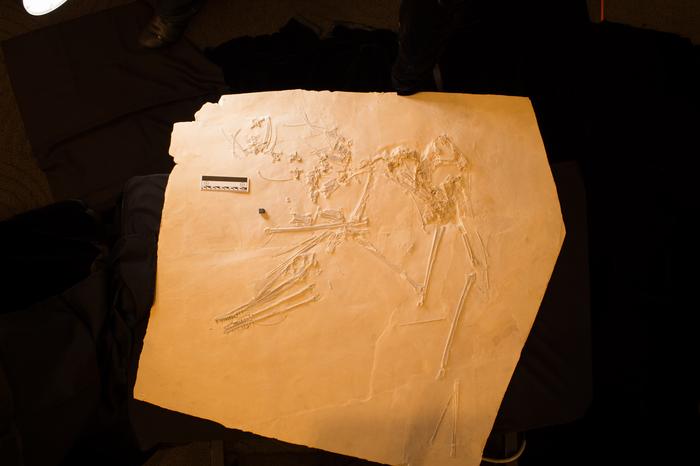
Credit: Photograph copyright René Lauer
A new 145-million-year-old pterosaur (extinct flying reptiles that lived alongside the dinosaurs) was named today by a team of British, American and German researchers. The animal was nicknamed ‘Elvis’ when the fossil was first unearthed in Bavaria, Germany because of the giant pompadour-like bony crest on its skull.
Now the animal has been given a formal scientific name of Petrodactyle wellnhoferi. The name translates as ‘Wellnhofer’s stone-finger’ honouring legendary German palaeontologist Peter Wellnhofer who spent his career working on German pterosaurs. Petrodactyle is a member of a group of pterosaurs called the ctenochasmatids that were mostly small filter feeders. Petrodactyle is a very complete skeleton with nearly every bone preserved and in remarkable detail.
Many pterosaurs are known with bony crests which they used primarily as sexual signals to other members of the species, but Pterodactyle has by far the largest crest even seen in a ctenochasmatid. Dr David Hone of Queen Mary University of London was the lead author on the study said, “Big though this crest is, we know that these pterosaurs had skin-like extensions attached to it, so in life Petrodactyle would have had an even larger crest”.
The details of the specimen are especially clear under UV light which helps show the difference between the bones and the rock in which they are embedded, which under natural light are a very similar colour. René Lauer of the Lauer Foundation, an author on the study said, “The use of UV Induced Fluorescence digital photography provided the ability to discern fine structures small bones and provided additional information regarding the structures of the bony crest which aided in the interpretations and conclusions of this unique new species”.
Petrodactyle was unusually large too. It has a wingspan of around 2 meters, but it was still an older ‘teenager’ by pterosaur standards and would have been even larger as a fully mature animal. Even so, it is one of the largest pterosaurs known from the Late Jurassic period. Bruce Lauer of the Lauer Foundation, an author on the study said “The specimen was located in a quarry which is producing scientifically important fossils that provide additional insights into Late Jurassic Pterosaurs. This research is a great example of the benefits of cooperation between amateur collectors, commercial fossil dealers, our Foundation and research scientists to advance science.”
Like other ctenochasmatids, Petrodactyle was at home on the shore of shallow seas but might have ventured into estuaries or to lakes. It’s long jaw with many small teeth would have been good for grabbing at small fish, shrimp and other aquatic prey. However, unlike most other ctenochasmatids, it had an expansion at the back of the skull to attach large jaw muscles and give it a stronger bite than many of its contemporaries. Frederik Spindler of the Dinosaurier Museum in Germany, an author on the study said, “It is amazing to document an increasingly wide range of adaptations. Pterosaurs were a fundamental part of the Jurassic ecology”.
Dr Hone concluded “Peter Wellnhofer is long overdue having a species of German pterosaur named after him to honour his lifelong contribution to the study of these amazing animals”.
The Lauer Foundation acquires, curates, and provides access to a collection of scientifically important Palaeontological specimens. The collection is available to the scientific community for research, publication, exhibition and educational outreach.
DOI
10.26879/1251
Article Title
Petrodactyle wellnhoferi (gen. et sp. nov.): A new and large ctenochasmatid pterosaur from the Late Jurassic of Germany.
Article Publication Date
14-Jul-2023