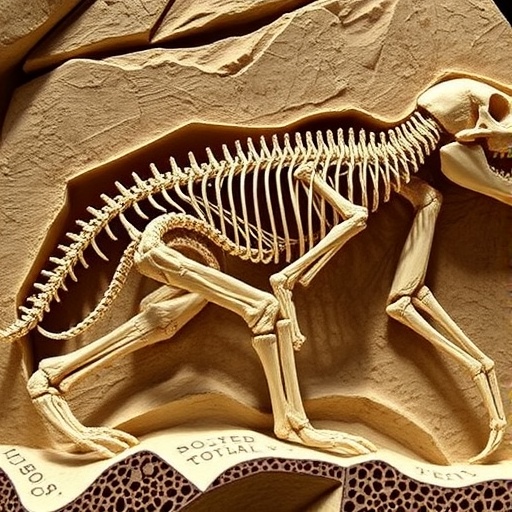
A fossilized growth signal in the bones of a 236-million-year-old cynodont may have revealed one of the earliest known examples of live birth in the mammalian lineage. The discovery, reported in Frontiers in Mammal Science, suggests that viviparity—the reproductive strategy in which embryos develop inside the mother and offspring are born alive—could have emerged at least 95 to 90 million years earlier than previously believed. The animal at the center of the study, Chiniquodon theotonicus, was a Triassic relative of mammals that lived during a period of ecological recovery following one of the most destructive mass extinctions in Earth’s history. Although the fossil record rarely preserves reproductive tissues or embryos, researchers argue that the animal’s growth pattern provides an indirect but unusually strong signal of its developmental biology.
The evidence came from the microscopic structure of a bone belonging to a fully grown C. theotonicus specimen discovered in northwestern Argentina. While examining the bone, researchers identified a distinctive growth boundary embedded within its microstructure. In living animals, a comparable feature can appear shortly after birth and is known as a neonatal line. It forms when the rapid change in growth rate associated with birth leaves a recognizable mark in bone or dental tissues. Before this study, such a line had not been documented in a cynodont, and embryonic or fetal tissues had never been identified in the group. The researchers interpreted the boundary as marking the animal’s transition from prenatal development to life outside the mother, then used its position to estimate the animal’s size at birth and at death.
The interpretation is important because cynodonts occupy a pivotal position in evolutionary history. They were not true mammals, but they possessed several anatomical and physiological characteristics associated with the mammalian lineage, including differentiated teeth, increasingly specialized jaw mechanics, and changes in posture and locomotion. Chiniquodon lived during the Triassic Period, when terrestrial ecosystems were being reorganized after the end-Permian mass extinction. During this interval, animals faced intense competition, substantial predation, increasing aridity, and pronounced seasonal fluctuations. The study’s authors propose that live birth could have offered reproductive advantages under those conditions by keeping developing embryos within the mother rather than exposing eggs to environmental instability, predators, dehydration, and temperature changes.
To test whether the growth evidence was consistent with viviparity, the researchers estimated the fossil animal’s body mass at birth and at death from measurements of its bones. The neonatal line indicated a birth mass of approximately 1.7 kilograms, while the external dimensions of the skeleton suggested a mass of about 12 kilograms when the animal died. The newborn therefore weighed roughly 14 percent of its later body mass. That ratio is far higher than the values generally observed in egg-laying reptiles and birds. It is also within the range recorded among many living placental mammals, whose young often develop extensively before birth and enter the world comparatively large and well developed.
The researchers then compared C. theotonicus with data from several thousand living mammals, non-avian reptiles, and birds. Reptiles weighing between eight and 14.5 kilograms typically produce hatchlings weighing only about nine to 53 grams, yielding neonate-to-adult mass ratios of approximately 0.1 to 0.6 percent. Birds of similar adult size produce young weighing about 110 to 357 grams, corresponding to ratios of roughly 1.3 to 4.5 percent. By contrast, mammals weighing between eight and 15 kilograms can give birth to offspring ranging from about 35.5 grams to 1.87 kilograms. Their ratios can reach nearly 19 percent. The estimated value for Chiniquodon placed it clearly among living placental mammals rather than alongside reptiles or birds.
That comparison does not constitute a fossilized photograph of pregnancy, but it provides a biological test of competing reproductive scenarios. Egg-laying amniotes generally produce offspring that are much smaller than the adult because substantial development continues after hatching. In viviparous mammals, by contrast, embryos remain protected within the reproductive tract for longer and can reach a much greater fraction of adult size before birth. The unusually large estimated neonate of C. theotonicus therefore supports the possibility that its young developed internally for an extended period. The researchers emphasize that their conclusion rests on a combination of histological evidence, body-size reconstruction, and comparative biology rather than on direct preservation of an embryo or reproductive organ.
The finding challenges the conventional timeline for the evolution of mammalian reproduction. Live birth has often been treated as a relatively late innovation within the mammalian lineage, with earlier cynodonts assumed to have retained an egg-laying reproductive system or a strategy more similar to that of modern monotremes. The new analysis suggests that at least some cynodonts may already have been producing large, live-born young during the Late Triassic. If confirmed by additional specimens, viviparity may have originated close to the beginning of the mammalian evolutionary trajectory rather than near the appearance of true mammals. That would make reproductive biology one of the traits that began changing long before the anatomical features traditionally used to define mammals had fully evolved.
The study also raises the possibility that C. theotonicus was not an isolated experiment in reproductive evolution. Viviparity has evolved independently many times among modern vertebrates, including reptiles, fishes, and amphibians, demonstrating that live birth can arise when ecological pressures favor greater protection of developing young. In the mammalian lineage, however, the transition from laying eggs to retaining embryos internally would have required profound changes in reproductive anatomy, embryonic development, nutrient exchange, and maternal physiology. The researchers cannot yet determine how advanced those systems were in Chiniquodon, or whether its young received nourishment through a structure functionally comparable to a mammalian placenta. The fossil evidence points to the timing of birth, but not to every biological mechanism that supported it.
The authors, led by paleontologist Leandro Gaetano of Argentina’s National Scientific and Technical Research Council, describe the result as a first compelling indication that live birth was present in at least one mammalian ancestor. Adriana Mancuso of CONICET and María Miceli Baro of the University of Buenos Aires contributed to the analysis. Their work demonstrates how microscopic traces in fossil bone can illuminate behaviors and life-history traits that are almost never preserved directly. A single neonatal line cannot establish that all cynodonts were viviparous, and further fossils will be needed to test the hypothesis across the group. Nevertheless, the combination of a birth-related growth mark and an exceptionally large estimated neonate has turned a long-standing evolutionary mystery into a testable scientific question: whether the defining reproductive strategy of mammals began deep in the Triassic, tens of millions of years before the first true mammals appeared.
Subject of Research: Not applicable
Article Title: Early Origin of Viviparity in the Mammalian Lineage
News Publication Date: 13-Aug-2026
Web References: https://doi.org/10.3389/fmamm.2026.1845319
References: Frontiers in Mammal Science, DOI: 10.3389/fmamm.2026.1845319
Image Credits: María de los Ángeles Miceli Baro
Keywords: Chiniquodon theotonicus, cynodonts, viviparity, live birth, mammalian evolution, Triassic Period, neonatal line, fossil bone, reproductive evolution, paleontology
Tags: cynodont reproductive evolutiondevelopment of mammalian reproductive strategiesearly live birth in mammalsevidence of viviparity in extinct speciesevolutionary origins of live birthfossil microstructure analysisfossilized bone growth signalsimpact of mass extinction on mammalian evolutionimplications for mammal evolutionary timelineneonatal line in fossil bonespaleontological discovery of reproductive traitsTriassic period mammalian ancestors