• HOME
  • NEWS
  • EXPLORE
    • CAREER
      • Companies
      • Jobs
    • EVENTS
    • iGEM
      • News
      • Team
    • PHOTOS
    • VIDEO
    • WIKI
  • BLOG
  • COMMUNITY
    • FACEBOOK
    • INSTAGRAM
    • TWITTER
Sunday, May 10, 2026
BIOENGINEER.ORG
No Result
View All Result
  • Login
  • HOME
  • NEWS
  • EXPLORE
    • CAREER
      • Companies
      • Jobs
        • Lecturer
        • PhD Studentship
        • Postdoc
        • Research Assistant
    • EVENTS
    • iGEM
      • News
      • Team
    • PHOTOS
    • VIDEO
    • WIKI
  • BLOG
  • COMMUNITY
    • FACEBOOK
    • INSTAGRAM
    • TWITTER
  • HOME
  • NEWS
  • EXPLORE
    • CAREER
      • Companies
      • Jobs
        • Lecturer
        • PhD Studentship
        • Postdoc
        • Research Assistant
    • EVENTS
    • iGEM
      • News
      • Team
    • PHOTOS
    • VIDEO
    • WIKI
  • BLOG
  • COMMUNITY
    • FACEBOOK
    • INSTAGRAM
    • TWITTER
No Result
View All Result
Bioengineer.org
No Result
View All Result
Home NEWS Science News Biology

New finding on origin of avian predentary in Mesozoic birds

Bioengineer by Bioengineer
November 18, 2019
in Biology
Reading Time: 3 mins read
0
IMAGE
Share on FacebookShare on TwitterShare on LinkedinShare on RedditShare on Telegram

IMAGE

Credit: IVPP


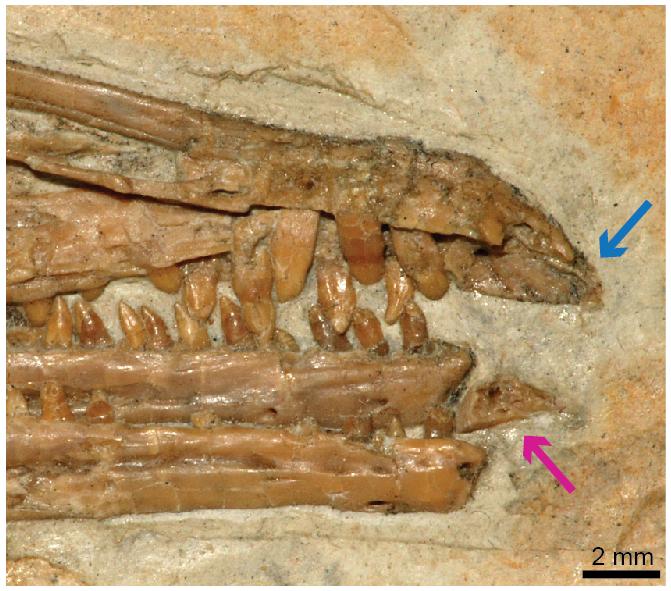
The predentary bone is one of the most enigmatic skeletal elements in avian evolution. Located at the tip of the lower jaw, this bone is absent in more primitive birds and in living birds; it is thought to have been lost during evolution. For over 30 years, the origin and function of the avian predentary has remained mysterious.

Now, however, Alida Bailleul, LI Zhiheng, Jingmai O’Connor and ZHOU Zhonghe from the Institute of Vertebrate Paleontology and Paleoanthropology (IVPP) of the Chinese Academy of Sciences have made significant progress towards solving this long-standing mystery. Their findings were published in Proceedings of the National Academy of SciencesĀ of the United States of America (PNAS) on November 18.

Using a battery of analytical methods, the team, led by Dr. Bailleul, presents strong evidence that the avian predentary was covered by a keratinous beak – a horny sheath that covers the bones of the rostrum in all living birds, all of which are edentulous and have beaks. It also provides evidence the predentary was proprioceptive, i.e., it was able to detect external mechanical stimuli; and was mobile – thus representing a now extinct form of cranial kinesis.

Cranial kinesis occurs when joints are able to move within the skull – mainly between the upper jaw and the braincase. This feature is widespread in living birds; however, it is thought to be mostly absent in Mesozoic birds.

Based on her examination of the fossilized tissues of the predentary and other jaw elements of Yanornis martini from the Jehol Biota, Dr. Bailleul identified a specific type of cartilage inside the joint between the predentary and dentary that strongly suggests some movement between these elements.

The team noticed that the predentary is only found in ornithuromorphs that have teeth. However, the tip of the premaxilla – the bone of the upper bill that would have occluded with the predentary – is without teeth. This suggests that the tip of the upper jaw, like the predentary, was also covered with a keratinous beak.

The tiny beak at the tip of the skull, combined with the sensitive and mobile predentary bone and teeth that were most likely also proprioceptive, represents a unique feeding adaptation that allowed greater dexterity when manipulating food. Although bizarre and now extinct, this unique feeding apparatus persisted in the ornithuromorph clade for at least 58 million years, from the Early to the Late Cretaceous.

Using information from the fossilized tissues and preexisting data on the embryology of living birds, the team also formulated a hypothesis regarding the origin of this bone, suggesting it is a sesamoid, similar to the human knee cap. Identification as a sesamoid means this bone is a novel skeletal innovation unique to one lineage of ornithuromorphs, and that it did not arise from a preexisting skull bone.

Although additional research on fossils birds (and also extant birds) is required to confirm some of these hypotheses, the predentary is such a small bone that it is only rarely preserved, thus making it very difficult – if not impossible – to find specimens that can shed light on the remaining pieces of this mystery.

###

Media Contact
Alida M. Bailleul
[email protected]

Related Journal Article

http://dx.doi.org/10.1073/pnas.1911820116

Tags: ArchaeologyEvolutionOld World
Share13Tweet8Share2ShareShareShare2

Related Posts

Ancient Plant Populations Reveal Fresh Insights into Climate Resilience — Biology

Ancient Plant Populations Reveal Fresh Insights into Climate Resilience

May 8, 2026
Rare Brain Disorders in Children Linked to Mutations in Lesser-Known Protein Complex — Biology

Rare Brain Disorders in Children Linked to Mutations in Lesser-Known Protein Complex

May 8, 2026

From Odd Insect to Underwater Predator: The Remarkable Evolution of a Bloodthirsty Fruit Fly

May 8, 2026

SNU Professor Sangwoo Seo’s Team Develops Next-Generation CRISPR Biocontainment Technology to Control Microbial Survival Without DNA Cleavage

May 8, 2026
Please login to join discussion

POPULAR NEWS

  • Research Indicates Potential Connection Between Prenatal Medication Exposure and Elevated Autism Risk

    839 shares
    Share 336 Tweet 210
  • New Study Reveals Plants Can Detect the Sound of Rain

    727 shares
    Share 290 Tweet 181
  • Scientists Investigate Possible Connection Between COVID-19 and Increased Lung Cancer Risk

    68 shares
    Share 27 Tweet 17
  • Salmonella Haem Blocks Macrophages, Boosts Infection

    61 shares
    Share 24 Tweet 15

About

BIOENGINEER.ORG

We bring you the latest biotechnology news from best research centers and universities around the world. Check our website.

Follow us

Recent News

Taking 8,500 Steps Daily May Aid Long-Term Weight Management, Study Finds

Group Exercise Boosts Cognition, Fitness in Dementia

Estrogen Deficiency Triggers Bone EVs Causing Cell Aging

Subscribe to Blog via Email

Enter your email address to subscribe to this blog and receive notifications of new posts by email.

Join 82 other subscribers
  • Contact Us

Bioengineer.org Ā© Copyright 2023 All Rights Reserved.

Welcome Back!

Login to your account below

Forgotten Password?

Retrieve your password

Please enter your username or email address to reset your password.

Log In
No Result
View All Result
  • Homepages
    • Home Page 1
    • Home Page 2
  • News
  • National
  • Business
  • Health
  • Lifestyle
  • Science

Bioengineer.org Ā© Copyright 2023 All Rights Reserved.