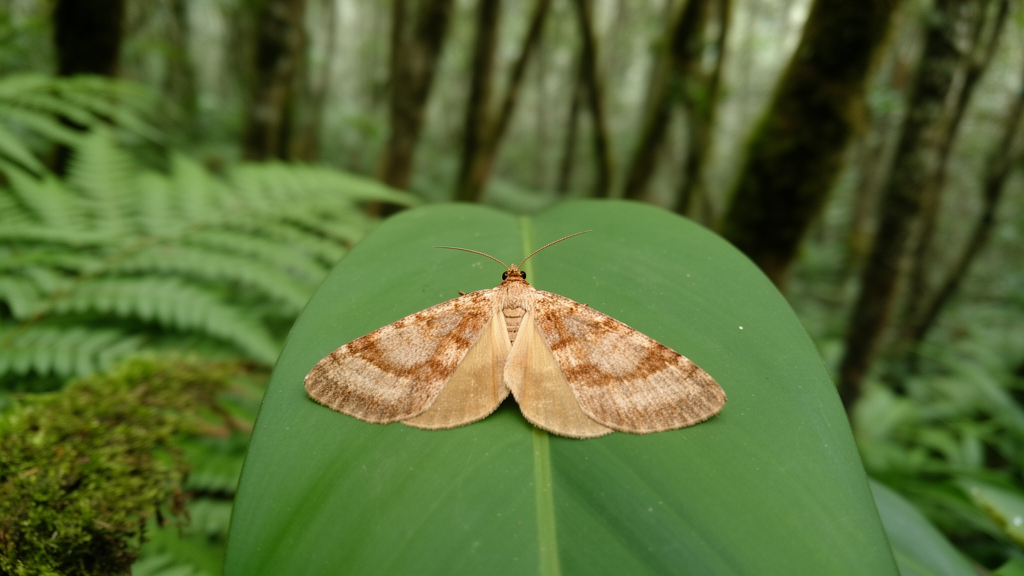
A Taiwanese population of the sun moth genus Epicroesa , previously identified as the Australian species E. thiasarcha , has been recognized as a distinct species named Epicroesa bellatula . The taxonomic study combined comparisons of adult anatomy, wing patterns, genitalia, immature stages and mitochondrial DNA barcodes. It also documented both species as larvae of the tropical tree Ceodes umbellifera , a host-plant association not previously reported for Epicroesa moths.
The name bellatula is a diminutive form of the Latin adjective bellatulus , meaning beautiful. Six Epicroesa species were recognized before this description: E. ambrosia , E. calliteucha , E. chromatorhoea , E. metallifera , E. thiasarcha and E. lylae . Most heliodinid sun moths occur in the New World, whereas Epicroesa is an Old World genus.
Before the new Taiwanese taxon was separated, its members were documented from Australia, New Guinea, Japan and Tahiti. The addition of E. bellatula raises the number of recognized species in the genus to seven and extends its documented distribution to southern Taiwan. Like its Australian relative, E. bellatula has metallic dark-brown forewings, orange distal areas with silver markings and elaborate coremata containing lanceolate scales.
Adults of both species also feed as larvae on the same plant, Ceodes umbellifera . That plant was formerly called Pisonia umbellifera before a reclassification separated the broadly defined Pisonia group into Pisonia , Rockia and Ceodes . The first recorded larval-host association for Epicroesa therefore links an Australian moth and its newly distinguished Taiwanese counterpart through the same member of Nyctaginaceae.
Adult morphology nevertheless revealed a series of consistent differences. The forewing of E. bellatula measures 2.76–3.69 mm, with a mean of 3.39 ± 0.23 mm in a sample of 30, compared with 3.05–3.94 mm and a mean of 3.55 ± 0.17 mm for 30 Australian specimens. In the Taiwanese species, the dark proximal band on the upper forewing bears an orange patch, whereas the Australian species has several narrow orange streaks.
The distal orange area contains three metallic markings in E. bellatula but four in E. thiasarcha . Metallic scaling over the basal half of the forewing and head is yellow with a green tinge in the new species, but green with a blue tinge in the Australian taxon. Behind the compound eye, the Taiwanese moth has creamy-yellow, spatulate scales; the Australian moth has dark-brown, elongate, lanceolate scales.
Differences in wing venation and genitalic structures supplied additional diagnostic characters. The hindwing vein CuA2 is present in E. bellatula but vestigial in E. thiasarcha . In males, the valva of the Taiwanese species forms an elongate, ovate lobe, while the corresponding structure in the Australian species is triangular and axe-shaped.
Female E. bellatula has two V-shaped signa, each armed with prominent spines, whereas the Australian species has an elongate, bifurcate sclerotized band accompanied by a smaller sclerite bearing short cones. These distinctions occur across multiple anatomical systems rather than being confined to a single visible wing mark. The immature stages also separated the two taxa.
Eggs of E. bellatula measured 0.35 ± 0.03 mm long and 0.20 ± 0.01 mm in diameter in a sample of six. They are ovoid and have fine sculpturing on a thin chorion. Mature larvae averaged 5.94 ± 0.39 mm long in 22 individuals.
Both species have a rounded head with a deep V-shaped medial notch, but the head capsule of E. bellatula has a Y-shaped dark-brown marking and thick lateral bands. The Australian larva instead has a pair of prominent, straight dark-brown bands. Their pupae are flattened and tapered in both species, yet differ in proportion: the mean length-to-width ratio at abdominal segment A3 was approximately 2.75 for E. bellatula and 2.58 for E. thiasarcha , based on 30 individuals of each species.
For molecular comparison, the researchers extracted genomic DNA from one adult specimen of each species and amplified a 665-base-pair fragment of the mitochondrial cytochrome c oxidase subunit I gene. The amplified products were purified, sequenced, visually checked and edited, then aligned with MUSCLE. Genetic differentiation was estimated as pairwise distances among ten individuals under the Kimura two-parameter model in MEGA 12.
The resulting COI p-distance between the Australian and Taiwanese samples was 9.75 percent, represented by GenBank accessions PZ166696 and PZ166697. This value was well above the 3 percent divergence often cited as a general species-delimitation criterion for Lepidoptera. The barcode result, together with the morphological and early-stage differences, supported recognition of the Taiwanese population as a separate species rather than an extension of the known range of E. thiasarcha .
Larvae of E. thiasarcha construct a loose silk shelter on the underside of a C. umbellifera leaf, skeletonize the leaf by consuming mesophyll tissue and deposit frass nearby. Pupation occurs beneath the leaf in a loosely constructed cocoon. Eggs of E. bellatula were recorded on leaves, young twigs and flower buds.
Its larvae also make loose silk shelters, after which they bore into flower buds or feed on the undersides of leaves. The pupa is usually attached to the underside of a leaf. Adults and immature stages have been observed at different times of the year in both species, leading the researchers to describe them as apparently multivoltine.
Although C. umbellifera supports both species, their currently known populations are separated by more than 6,000 km: E. thiasarcha is known from Queensland, Australia, while E. bellatula is known only from southern Taiwan. The authors identify two possible explanations: each species may have a broader distribution than current records show, or additional Epicroesa taxa may remain undescribed between the two regions. The authors also caution that the presence or absence of hindwing vein CuA2 should not, by itself, be treated as a reliable diagnostic character for the genus Epicroesa , because previous comparative work indicates that this feature can be lost independently in heliodinid lineages.
Subject of Research: Taxonomic identification of the Taiwanese sun moth Epicroesa bellatula and its larval association with Ceodes umbellifera .
Article Title: Sun moths in the genus Epicroesa ( Lepidoptera , Heliodinidae ) associated with Ceodes umbellifera , with description of a new species from Taiwan
Article References: Hsu, Y.-F. (2026). Sun moths in the genus Epicroesa (Lepidoptera, Heliodinidae) associated with Ceodes umbellifera, with description of a new species from Taiwan. ZooKeys, 1289, 203-214. https://doi.org/10.3897/zookeys.1289.194186
Image Credits: AI Generated
DOI: 10.3897/zookeys.1289.194186
Keywords: new species, Epicroesa bellatula, Epicroesa thiasarcha, sun moths, Heliodinidae, DNA barcoding, Ceodes umbellifera, moth taxonomy, Taiwan, Australia, moths, genus
News Source: Drew Townsend. (October 20, 2026). New Epicroesa sun moth described from Taiwan. Scienmag.