A new wearable technology made from stretchy, lightweight material could make heart health monitoring easier and more accurate than existing electrocardiograph machines
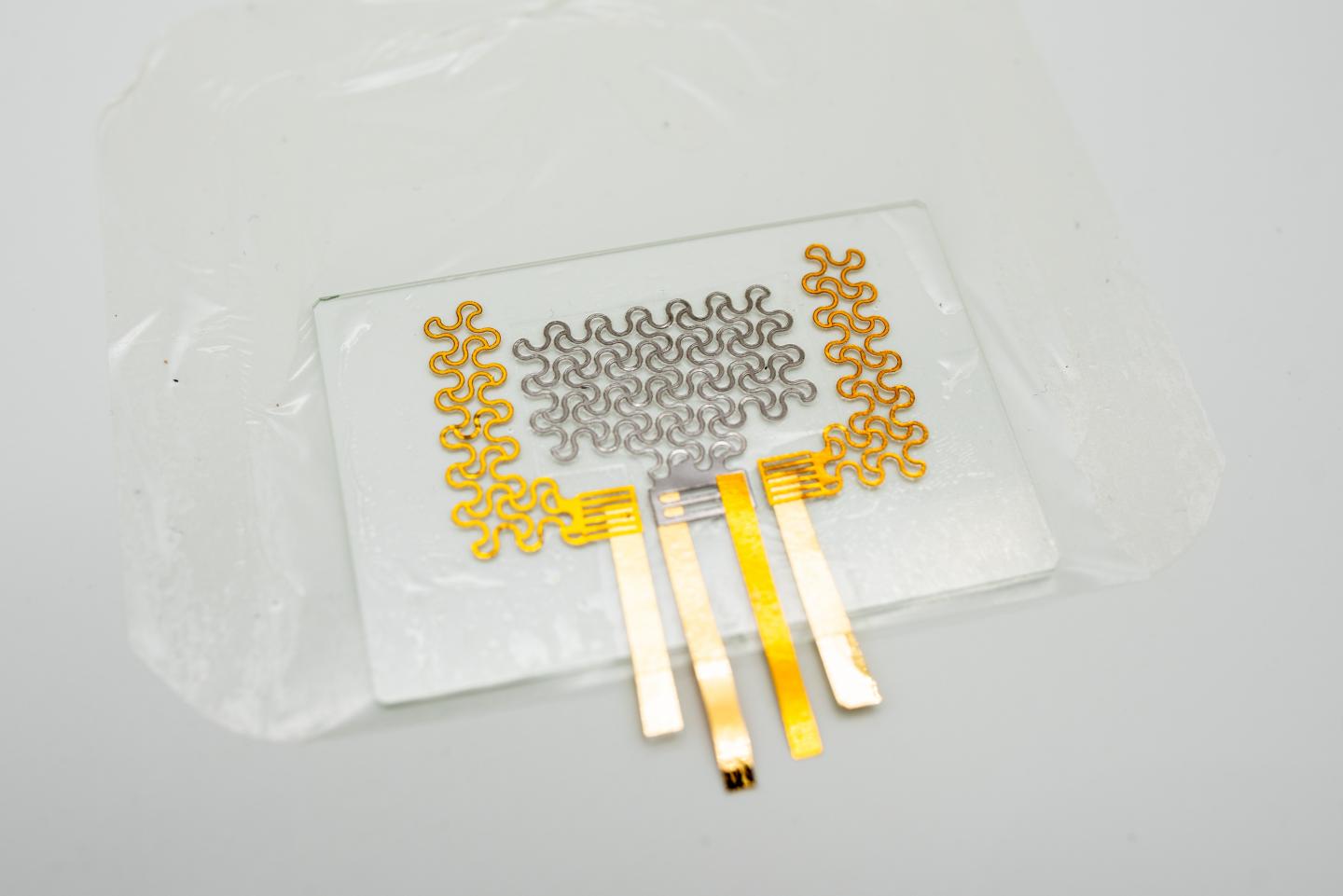
Credit: Cockrell School of Engineering, The University of Texas at Austin
AUSTIN, Texas — The leading cause of death in Texas is heart disease, according to the National Center for Health Statistics, accounting for more than 45,000 deaths statewide in 2017. A new wearable technology made from stretchy, lightweight material could make heart health monitoring easier and more accurate than existing electrocardiograph machines — a technology that has changed little in almost a century.
Developed by engineers at The University of Texas at Austin and led by Nanshu Lu in the Cockrell School of Engineering, this is the latest incarnation of Lu’s electronic tattoo technology, a graphene-based wearable device that can be placed on the skin to measure a variety of body responses, from electrical to biomechanical signals.
The research team reported on their newest e-tattoo in a recent issue of Advanced Science.
The device is so lightweight and stretchable that it can be placed over the heart for extended periods with little or no discomfort. It also measures cardiac health in two ways, taking electrocardiograph and seismocardiograph readings simultaneously. Most of us are familiar with the electrocardiogram (ECG), a method that records the rates of electrical activity produced each time the heart beats. Seismocardiography (SCG) is a measurement technique using chest vibrations associated with heartbeats. Powered remotely by a smartphone, the e-tattoo is the first ultrathin and stretchable technology to measure both ECG and SCG.
“We can get much greater insight into heart health by the synchronous collection of data from both sources,” said Lu, an associate professor in the departments of Aerospace Engineering and Engineering Mechanics and Biomedical Engineering.
ECG readings alone are not accurate enough for determining heart health, but they provide additional information when combined with SCG signal recordings. Like a form of quality control, the SCG indicates the accuracy of the ECG readings.
Although soft e-tattoos for ECG sensing are not new, other sensors, such as the SCG sensor, are still made from nonstretchable materials, making them bulky and uncomfortable to wear. Lu and her team’s e-tattoo is made of a piezoelectric polymer called polyvinylidene fluoride, capable of generating its own electric charge in response to mechanical stress. The device also includes 3D digital image correlation technology that is used to map chest vibrations in order to identify the best location on the chest to place the e?tattoo.
The e-tattoo has another advantage over traditional methods. Usually an ECG measurement requires going into a doctor’s office, where heart health can be monitored only for a couple of minutes at a time. This device can be worn for days, providing constant heart monitoring.
Lu and her team are already working on improvements to data collection and storage for the device, as well as ways to power the e-tattoo wirelessly for longer periods. They recently developed a smartphone app that not only stores the data safely but can also show a heart beating on the screen in real time.
###
Lu’s team includes faculty members and students spanning multiple engineering disciplines — aerospace engineering and engineering mechanics, biomedical engineering, electrical and computer engineering, materials science and engineering, and mechanical engineering, as well as a collaborator from UT Southwestern Medical School. In addition, at the time the research was conducted, four members of the UT Austin team were undergraduate students.
Media Contact
John Holden
[email protected]
Original Source
https:/
Related Journal Article
http://dx.