


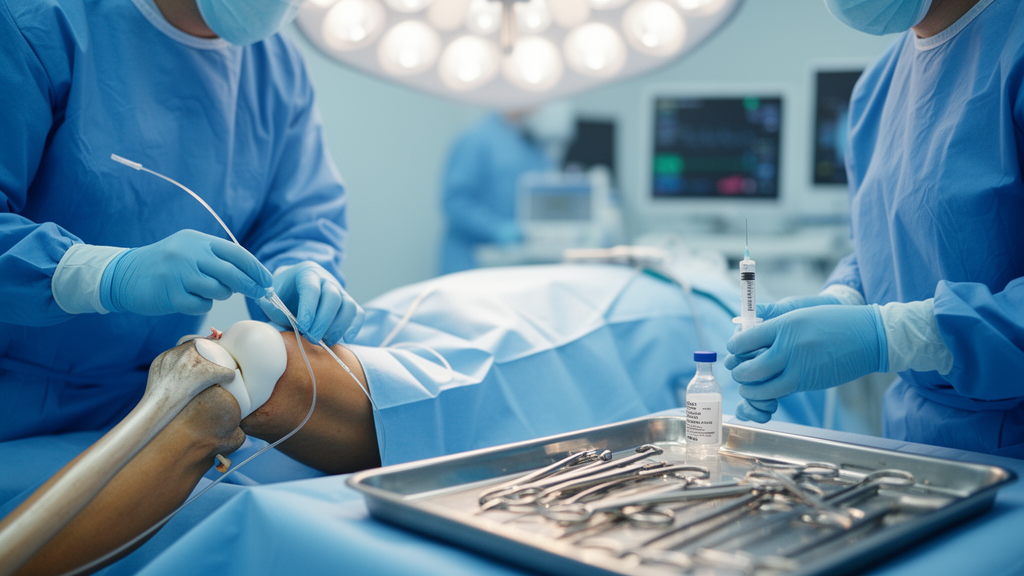
Periprosthetic joint infection is one of the most feared complications of hip and knee replacement surgery, and one of the hardest to treat. When bacteria colonize the surfaces of an implanted prosthesis, they build dense biofilms that shield them from antibiotics circulating in the bloodstream, and the infection can smolder, recur, and ultimately destroy the joint. The researchers now report a modified approach that pairs standard debridement surgery with two additional measures: vacuum-assisted wound sealing and daily infusion of antibiotics directly into the joint cavity. In a retrospective case series of 31 patients, the technique was associated with infection control in roughly nine out of ten patients over one year of follow-up, although the authors stress that these are preliminary, uncontrolled findings.
The technique, which the researchers call DVIA, builds on debridement, antibiotics, and implant retention, commonly abbreviated DAIR. DAIR is the least invasive surgical option for acute periprosthetic joint infection: surgeons open the joint, remove scar tissue and infected or necrotic bone and soft tissue, exchange the modular components of the prosthesis such as polyethylene inserts and femoral heads, scrub the component surfaces to disrupt biofilms, and irrigate the field with saline, hydrogen peroxide, and povidone-iodine, all while leaving the main implant in place. It is less invasive and less costly than single- or two-stage revision surgery, but its reported success rates vary enormously across the literature, from as low as 30 percent to as high as 90 percent, and one review cited by the authors found success as low as 46 percent in acute cases.
The rationale for the modification rests on two problems that DAIR alone does not solve. The first is pharmacological. Intravenous antibiotics, even when chosen according to susceptibility testing, may not reach concentrations at the infected joint surface that exceed the minimum biofilm eradication concentration, the drug level needed to kill bacteria embedded in a biofilm. Previous studies have shown that delivering drugs directly into the joint cavity produces local antibiotic concentrations far higher than those achieved intravenously, and can keep levels above the minimal inhibitory concentration for up to 24 hours. The second problem is mechanical and biological: patients with acute infection often have skin defects and an accumulation of exudate and necrotic tissue in the joint, which delays wound healing and undermines both infection control and functional recovery.
DVIA addresses both issues in a single postoperative protocol. After the standard DAIR procedure and implantation of new modular components, the surgeons place two medical-grade silicone drainage tubes into the joint cavity through separate small stab incisions beside the main surgical incision. These tubes serve as independent channels for drainage and antibiotic infusion. The incision and superficial wound are then covered with a polyurethane vacuum sealing drainage dressing, and continuous negative pressure of 150 mmHg is applied only to the superficial wound space. Crucially, the negative-pressure circuit does not communicate directly with the joint cavity; the joint tubes pass through the dressing foam and are sealed by an adhesive transparent drape, maintaining a sterile environment while keeping the two systems separate.
Antibiotic delivery through the tubes is tailored to the identified pathogen. Vancomycin is infused for monomicrobial Gram-positive infections, meropenem for monomicrobial Gram-negative infections, and the two drugs are combined for polymicrobial infections, fungal infections, or cases in which no pathogen is identified. Each day, the connector site is disinfected, accumulated joint effusion is aspirated, and one gram of antibiotic dissolved in 20 milliliters of normal saline is infused into the joint. The tubes are then clamped for approximately 24 hours to retain the drug. In patients with reduced kidney function, the dose is scaled down: 750 milligrams for a creatinine clearance of 30 to 49 milliliters per minute, and 500 milligrams below that threshold. The cycle continues for 12 to 14 days, the typical indwelling period of the tubes, and is stopped when clinical signs of infection have improved and the wound is acceptable. Systemic antibiotics, typically two weeks intravenously followed by six weeks orally, run in parallel.
The reported series included 31 patients treated at a single tertiary center between September 2019 and December 2023, of whom 19 had hip infections and 12 had knee infections. All were diagnosed according to Musculoskeletal Infection Society guidelines and classified as acute infections, either early postoperative infections within three months of the index arthroplasty or late hematogenous infections with symptom onset within three months in a previously well-functioning joint. Every included patient completed at least 12 months of clinical follow-up.
Over that year, three patients experienced treatment failure, including one case requiring knee amputation because the infection could not be controlled. Kaplan–Meier analysis estimated a 12-month infection-control rate of 90.32 percent, corresponding to 28 of 31 patients. The authors also report that no patients developed persistent exudates around the drainage tubes or retrograde infections caused by the tubes, a known concern with prolonged catheter retention. No antibiotic-related adverse events requiring treatment modification occurred, and no patient showed elevated serum urea or creatinine attributable to antibiotic therapy. Inflammatory markers told a consistent story: C-reactive protein and erythrocyte sedimentation rate, elevated before surgery in all infected patients, showed an overall downward trend during treatment, with a transient rebound in C-reactive protein between postoperative days three and six in most patients that the authors attribute to normal surgical inflammation.
Joint function also improved over follow-up. Knee Society Score, the Knee Society functional score, the Harris Hip Score, and the physical function scale of the 36-item Short-Form survey all increased from baseline to three months postoperatively and again to the final follow-up visit, which the authors interpret as improvement in joint mobility and daily physical function. In an exploratory pharmacokinetic assessment limited to five patients, vancomycin concentrations measured in residual joint fluid exceeded previously reported minimum biofilm eradication thresholds of 512 micrograms per milliliter for Staphylococcus aureus and 256 micrograms per milliliter for Staphylococcus epidermidis, suggesting that the technique can achieve potentially biofilm-active local drug exposure.
These results arrive amid growing interest in local antibiotic delivery for prosthetic joint infection. A recent systematic review summarized by the authors covered 15 studies involving 631 patients treated with various surgical procedures combined with intra-articular antibiotic infusion and reported an overall failure rate of approximately 11 percent. Other retrospective studies have reported 88 percent infection-free survival after single-stage revision combined with intra-articular infusion over mid- to long-term follow-up. What distinguishes DVIA, the authors argue, is the integration of vacuum sealing drainage for wound management with intra-articular infusion, an incremental modification rather than a wholly new strategy. They note that alternative local delivery vehicles carry their own drawbacks: antibiotic-loaded polymethyl methacrylate beads act as indigestible foreign particles that can damage tissue, while calcium sulfate beads have been associated with ectopic ossification and hypercalcemia.
The limitations of the study are substantial and the authors state them plainly. It is a single-center, retrospective case series with only 31 patients and just one year of follow-up, too short to assess durable infection recurrence, implant survival, or long-term function; the authors call for extended follow-up of two to five years in larger cohorts. Serial laboratory monitoring, including inflammatory markers and antibiotic concentrations, was available only in a subset of patients because of the retrospective design, so the longitudinal observations are supportive rather than definitive. Most importantly, because DVIA combines vacuum sealing drainage with intra-articular antibiotic infusion, the independent contribution of the wound-sealing component cannot be determined from this data. The authors conclude that the technique appears to be a feasible adjunctive strategy for acute periprosthetic joint infection, but that multicenter, prospective, controlled studies are needed to validate it, optimize the protocol, and clarify what each component actually contributes to the encouraging early outcomes.
Subject of Research: A surgical technique combining DAIR, vacuum sealing drainage, and intra-articular antibiotic infusion for acute periprosthetic joint infection
Article Title: DVIA technique for acute periprosthetic joint infection: a surgical technique and case series
Article References: Li, M., Wang, B., Yin, Z., Wang, C., Ding, D., Chen, X., Shen, H., & Wang, Q. (2026). DVIA technique for acute periprosthetic joint infection: a surgical technique and case series. Arthroplasty, 8(1), Article 69. https://doi.org/10.1186/s42836-026-00430-6
Image Credits: AI Generated
DOI: 10.1186/s42836-026-00430-6
Keywords: periprosthetic joint infection, DAIR, vacuum sealing drainage, intra-articular antibiotics, vancomycin, hip arthroplasty, knee arthroplasty, biofilm, case series, orthopaedic surgery, infection control, DVIA
News Source: Ophelia Keating. (October 29, 2026). New DVIA Technique Combines Wound Drainage and Joint Antibiotics for Prosthetic Infections. Scienmag.



