• HOME
  • NEWS
  • EXPLORE
    • CAREER
      • Companies
      • Jobs
    • EVENTS
    • iGEM
      • News
      • Team
    • PHOTOS
    • VIDEO
    • WIKI
  • BLOG
  • COMMUNITY
    • FACEBOOK
    • INSTAGRAM
    • TWITTER
Friday, May 15, 2026
BIOENGINEER.ORG
No Result
View All Result
  • Login
  • HOME
  • NEWS
  • EXPLORE
    • CAREER
      • Companies
      • Jobs
        • Lecturer
        • PhD Studentship
        • Postdoc
        • Research Assistant
    • EVENTS
    • iGEM
      • News
      • Team
    • PHOTOS
    • VIDEO
    • WIKI
  • BLOG
  • COMMUNITY
    • FACEBOOK
    • INSTAGRAM
    • TWITTER
  • HOME
  • NEWS
  • EXPLORE
    • CAREER
      • Companies
      • Jobs
        • Lecturer
        • PhD Studentship
        • Postdoc
        • Research Assistant
    • EVENTS
    • iGEM
      • News
      • Team
    • PHOTOS
    • VIDEO
    • WIKI
  • BLOG
  • COMMUNITY
    • FACEBOOK
    • INSTAGRAM
    • TWITTER
No Result
View All Result
Bioengineer.org
No Result
View All Result
Home NEWS Science News Chemistry

New dual mode ratio fluorescence sensing system enables rapid in situ detection of carbaryl residues

Bioengineer by Bioengineer
April 25, 2023
in Chemistry
Reading Time: 2 mins read
0
New Dual Mode Ratio Fluorescence Sensing System Enables Rapid In Situ Detection of Carbaryl Residues
Share on FacebookShare on TwitterShare on LinkedinShare on RedditShare on Telegram

A team of researchers led by Prof. JIANG Changlong from Institute of Solid State Physics (ISSP), Hefei Institutes of Physical Science of of Chinese Academy of Sciences developed a new sensing system for detecting carbaryl residues.
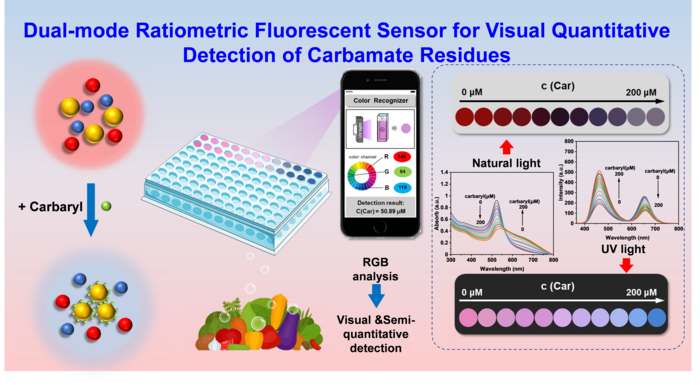
New Dual Mode Ratio Fluorescence Sensing System Enables Rapid In Situ Detection of Carbaryl Residues

Credit: ZHANG Zhong

A team of researchers led by Prof. JIANG Changlong from Institute of Solid State Physics (ISSP), Hefei Institutes of Physical Science of of Chinese Academy of Sciences developed a new sensing system for detecting carbaryl residues.

The research findings have been published in ACS Sustainable Chemistry & Engineering.

Carbaryl is a widely used insecticide that can easily enter the body through respiratory intake and dermal contact, resulting in serious health hazards, including carcinogenicity and reproductive abnormalities. Therefore, it is crucial to detect carbaryl residues in environmental and food samples. However, existing detection techniques such as surface-enhanced Raman spectroscopy and electrochemical analysis are time-consuming and require complex preprocessing, making them impractical for field testing.

To address this issue, HFIPS researchers developed a dual-mode ratiometric fluorescent probe based on a combination of silicon quantum dots (Si QDs), gold nanoparticles (AuNPs), and cadmium telluride quantum dots (CdTe QDs). This sensing center was capable of visual quantitative detection of carbaryl with high sensitivity and immediate feedback. Upon the addition of carbaryl, the dispersion of AuNPs changed, resulting in a color change of the solution that could be observed by the naked eye.

Additionally, the fluorescence emission intensity of Si QDs increased while that of CdTe QDs decreased due to the fluorescence resonance energy transfer (FRET) effect. The sensing system showed a dual response signal that performed a significant fluorescence color transition from red to blue under UV light. The detection limit (LOD) was as low as 16.3 nM, which was far below the maximum residue standard.

The researchers then designed a portable intelligent sensing platform using 3D printing technology and color recognition, which could successfully apply the sensing system to detect carbaryl in actual samples with good selectivity and anti-interference ability.

This study not only provided an advanced sensing strategy for sensitivity and rapid carbaryl detection in the field but also offered new insights into quantitative analysis of other trace analytes.

Overall, the new sensing system has the potential to contribute significantly to environmental contaminant monitoring and agrifood safety.


Journal

ACS Sustainable Chemistry & Engineering

Article Title

Ultrasensitive and On-Site Detection of Carbaryl Pesticides via Dual-Mode Nanosensors Utilizing Portable Devices

Article Publication Date

10-Feb-2023

Share12Tweet8Share2ShareShareShare2

Related Posts

Smart Hydrogels Revolutionize Information Security with Photo-Patterning and Multi-Stimuli Responsive Structural Colors — Chemistry

Smart Hydrogels Revolutionize Information Security with Photo-Patterning and Multi-Stimuli Responsive Structural Colors

May 15, 2026
Scientists Overcome Longstanding Challenge in Measuring Semiconductor Defects — Chemistry

Scientists Overcome Longstanding Challenge in Measuring Semiconductor Defects

May 14, 2026

Wall Design Highlights Deaf and Hard-of-Hearing Experience at #ASA190

May 14, 2026

New Method Finds More Efficient Route Between Earth and Moon Than Ever Before

May 14, 2026

POPULAR NEWS

  • Research Indicates Potential Connection Between Prenatal Medication Exposure and Elevated Autism Risk

    843 shares
    Share 337 Tweet 211
  • New Study Reveals Plants Can Detect the Sound of Rain

    729 shares
    Share 291 Tweet 182
  • Salmonella Haem Blocks Macrophages, Boosts Infection

    62 shares
    Share 25 Tweet 16
  • Breastmilk Balances E. coli and Beneficial Bacteria in Infant Gut Microbiomes

    58 shares
    Share 23 Tweet 15

About

We bring you the latest biotechnology news from best research centers and universities around the world. Check our website.

Follow us

Recent News

Digital Health Fear Patterns in Older Cancer Patients

A*STAR Scientists Unveil Novel Technique to Decipher RNA Structure’s Impact on Health and Disease

Smart Hydrogels Revolutionize Information Security with Photo-Patterning and Multi-Stimuli Responsive Structural Colors

Subscribe to Blog via Email

Enter your email address to subscribe to this blog and receive notifications of new posts by email.

Join 82 other subscribers
  • Contact Us

Bioengineer.org © Copyright 2023 All Rights Reserved.

Welcome Back!

Login to your account below

Forgotten Password?

Retrieve your password

Please enter your username or email address to reset your password.

Log In
No Result
View All Result
  • Homepages
    • Home Page 1
    • Home Page 2
  • News
  • National
  • Business
  • Health
  • Lifestyle
  • Science

Bioengineer.org © Copyright 2023 All Rights Reserved.