


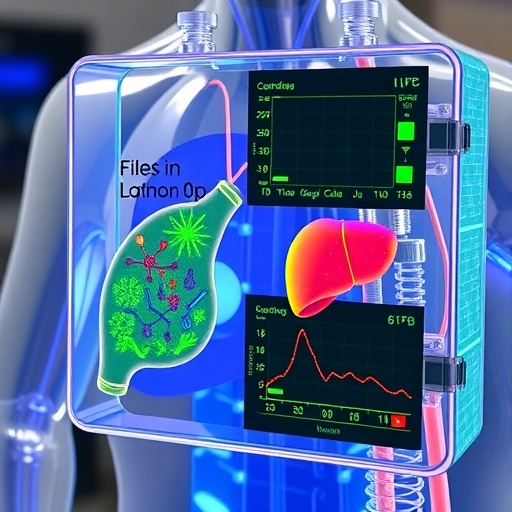
In a groundbreaking advance for organ transplantation, researchers have developed a dual-compartment biochemical monitoring platform that significantly enhances human liver perfusion assessment during clinical procedures. This innovative technology represents a pivotal leap in preserving liver function outside the body, potentially increasing the success rates of liver transplants and patient outcomes.
The platform operates by continuously sampling and analyzing critical biochemical markers in two separate compartments of the liver perfusion system—namely the vascular and extravascular spaces. This dual-compartment approach allows for unprecedented real-time monitoring of the liver’s metabolic state and cellular integrity during ex vivo perfusion. Unlike traditional single-compartment systems, which offer limited insight into the complex biochemical interactions within the liver, this device captures a comprehensive biochemical profile, enabling clinicians to make more informed decisions about organ viability.
At the heart of this technology is a miniaturized, multiplexed sensor array capable of detecting a spectrum of biochemical parameters such as glucose, lactate, electrolytes, and key enzymes indicative of cellular distress or recovery. The sensors interface with an automated data acquisition unit that processes the information and presents it through an intuitive clinical dashboard. This setup facilitates timely interventions that can optimize perfusion conditions, such as adjusting oxygen delivery or nutrient supply, ensuring the organ remains in an optimal state for transplantation.
The research team deployed this platform in a clinical setting involving human liver perfusions and demonstrated its ability to track metabolic changes accurately throughout the perfusion period. The detailed biochemical data correlated strongly with conventional markers of liver health and predicted post-transplant function more reliably than prior methods. Crucially, this enables the extension of preservation times and may allow for the utilization of marginal organs previously deemed unsuitable for transplantation.
Importantly, the device’s design emphasizes sterility, biocompatibility, and ease of integration into existing clinical workflows. Its compact footprint and real-time data transmission capabilities make it suitable for routine clinical use, lending itself to broad adoption across transplant centers worldwide. Additionally, the dual-compartment strategy may be adapted to other organ systems, opening avenues for improved preservation techniques beyond hepatology.
This advancement emerges against a backdrop of growing demands for donor organs and the pressing need to minimize ischemia-reperfusion injury—a major cause of graft failure. By providing continuous biochemical feedback, the platform offers a novel means to intervene dynamically during preservation, potentially mitigating damage and enhancing graft survival.
Future directions for this technology include refining sensor sensitivity, expanding the panel of monitored biomarkers, and integrating artificial intelligence algorithms for predictive analytics. Such improvements could further personalize organ preservation and transplantation strategies, marking a new era in transplant medicine.
This dual-compartment biochemical monitoring platform not only exemplifies the power of cutting-edge engineering applied to clinical challenges but also embodies the collaborative spirit driving innovation at the intersection of biotechnology and medicine. Its clinical deployment heralds a future where organ transplantation is safer, more efficient, and more successful.
Subject of Research: Human liver perfusion and biochemical monitoring technology
Article Title: A clinically deployed dual-compartment biochemical monitoring platform for human liver perfusion
Article References:
Zhou, K., Kim, M., Liu, CW. et al. A clinically deployed dual-compartment biochemical monitoring platform for human liver perfusion. Nat Commun 17, 5627 (2026). https://doi.org/10.1038/s41467-026-74799-y
Image Credits: AI Generated
DOI: https://doi.org/10.1038/s41467-026-74799-y
Tags: advanced liver perfusion systems with real-time dataand improving transplantation outcomesautomated data processing forclinical applications of real-time biochemical monitoring in liver transplantationcontinuous biochemical marker analysis in organ transplantationdual-compartment liver perfusion monitoring technologyex vivo liver preservation and assessmentimproving liver transplant success rates through biochemical monitoringinnovative organ preservation device with dual-compartment analysisliver tissue health during preservationmultiplexed biosensor arrays for organ viabilityreal-time biochemical monitoring in human liver perfusion systems


