

• HOME
  • NEWS
  • EXPLORE
    • CAREER
      • Companies
      • Jobs
    • EVENTS
    • iGEM
      • News
      • Team
    • PHOTOS
    • VIDEO
    • WIKI
  • BLOG
  • COMMUNITY
    • FACEBOOK
    • INSTAGRAM
    • TWITTER
Sunday, May 10, 2026
BIOENGINEER.ORG
No Result
View All Result
  • Login
  • HOME
  • NEWS
  • EXPLORE
    • CAREER
      • Companies
      • Jobs
        • Lecturer
        • PhD Studentship
        • Postdoc
        • Research Assistant
    • EVENTS
    • iGEM
      • News
      • Team
    • PHOTOS
    • VIDEO
    • WIKI
  • BLOG
  • COMMUNITY
    • FACEBOOK
    • INSTAGRAM
    • TWITTER
  • HOME
  • NEWS
  • EXPLORE
    • CAREER
      • Companies
      • Jobs
        • Lecturer
        • PhD Studentship
        • Postdoc
        • Research Assistant
    • EVENTS
    • iGEM
      • News
      • Team
    • PHOTOS
    • VIDEO
    • WIKI
  • BLOG
  • COMMUNITY
    • FACEBOOK
    • INSTAGRAM
    • TWITTER
No Result
View All Result
Bioengineer.org
No Result
View All Result
Home Headlines

New drug targets for a rare kidney and liver disease

Bioengineer.org by Bioengineer.org
January 31, 2018
in Headlines, Health, Science News
Reading Time: 2 mins read
0
Share on FacebookShare on TwitterShare on LinkedinShare on RedditShare on Telegram
IMAGE

Credit: Osaka University

ARPKD is a rare disease affecting 1 in 20000 people, but its victims are newborns, many of whom fail to see their first birthday. As for those who do survive, they often suffer from a litany of ailments including hypertension, cyst formation, and tissue scarring. Treatments normally target the symptoms of the disease because the underlying molecular causes are poorly understood.

ARPKD is caused by a mutation in the PKHD1 gene. To identify key candidate molecules that contribute to the disease, Osaka University Associate Professor Jun-Ya Kaimori and his colleagues compared cells from Pkhd1 mutant and normal mice, finding that the different expression levels of the Pkhd1 gene correlated with cell shape and cyst formation.

"PKDH1 encodes for fibrocystin/polyductin complex (FPC). The altered cell morphologies depended on the level of RhoA," explains Kaimori.

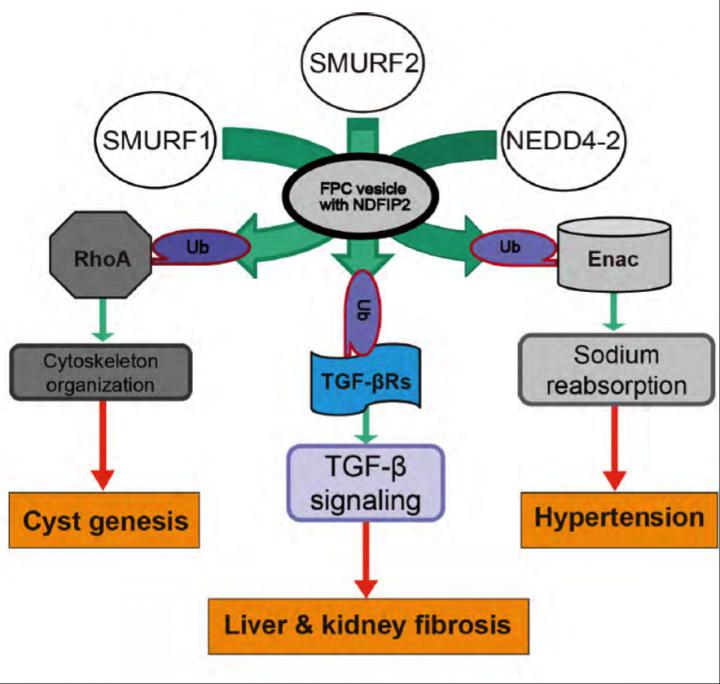
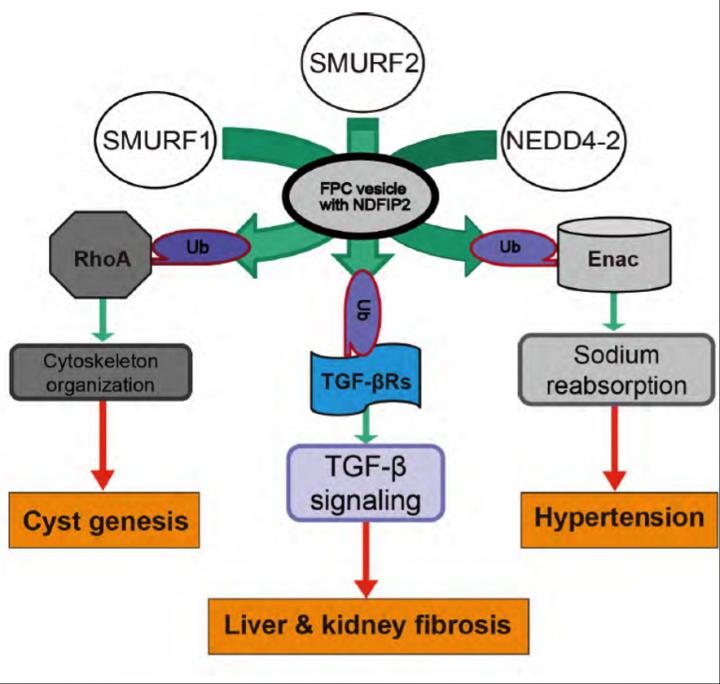
RhoA is protein that regulates cell morphology. The researchers therefore looked for molecular mechanisms through which RhoA and FPC interact, setting their eyes on ubiquitin ligases that regulate RhoA. They found that in normal mice, three E3 family members of ubiquitin ligases colocalized with FPC, but in mutant mice, the three were abnormally distributed in the cells. Adding to the importance of this observation is that the three ligases are known to have roles in regulating the three major symptoms of ARPKD.

"We found that reducing the activity of FPC altered the localization of three different E3 family ligases that contribute to cyst genesis, liver and kidney fibrosis, and hypertension," says Kaimori.

However, Kaimori doubts only these three ligases are affected by the mutation.

"Our results suggest that the disruption of Pkhd1 and FPC is likely to alter the activity of other E3 ligases," he says.

Clarifying these other ligases will provide more detail on the wide range of ailments that inflict ARKPD patients and provide promising targets for future medicines.

###

Media Contact

Saori Obayashi
[email protected]
81-661-055-886
@osaka_univ_e

http://www.osaka-u.ac.jp/en

Original Source

http://resou.osaka-u.ac.jp/en/research/2017/20170810_1 http://dx.doi.org/10.1038/s41598-017-08284-4


Share12Tweet8Share2ShareShareShare2

Related Posts

Evaluating Digoxin Use in Patients with Symptomatic Rheumatic Heart Disease

May 10, 2026

Evaluating the Effectiveness and Safety of Digitalis Glycosides in Treating Heart Failure

May 10, 2026

Urdu Fall Risk Questionnaire Adapted for Elderly

May 10, 2026

Key Pharmacological Markers for HIV Prevention in MSM

May 10, 2026
Please login to join discussion

POPULAR NEWS

  • Research Indicates Potential Connection Between Prenatal Medication Exposure and Elevated Autism Risk

    840 shares
    Share 336 Tweet 210
  • New Study Reveals Plants Can Detect the Sound of Rain

    727 shares
    Share 290 Tweet 181
  • Scientists Investigate Possible Connection Between COVID-19 and Increased Lung Cancer Risk

    68 shares
    Share 27 Tweet 17
  • Salmonella Haem Blocks Macrophages, Boosts Infection

    61 shares
    Share 24 Tweet 15

About

We bring you the latest biotechnology news from best research centers and universities around the world. Check our website.

Follow us

Recent News

Evaluating Digoxin Use in Patients with Symptomatic Rheumatic Heart Disease

Evaluating the Effectiveness and Safety of Digitalis Glycosides in Treating Heart Failure

Urdu Fall Risk Questionnaire Adapted for Elderly

Subscribe to Blog via Email

Success! An email was just sent to confirm your subscription. Please find the email now and click 'Confirm' to start subscribing.

Join 82 other subscribers
  • Contact Us

Bioengineer.org © Copyright 2023 All Rights Reserved.

Welcome Back!

Login to your account below

Forgotten Password?

Retrieve your password

Please enter your username or email address to reset your password.

Log In
No Result
View All Result
  • Homepages
    • Home Page 1
    • Home Page 2
  • News
  • National
  • Business
  • Health
  • Lifestyle
  • Science

Bioengineer.org © Copyright 2023 All Rights Reserved.