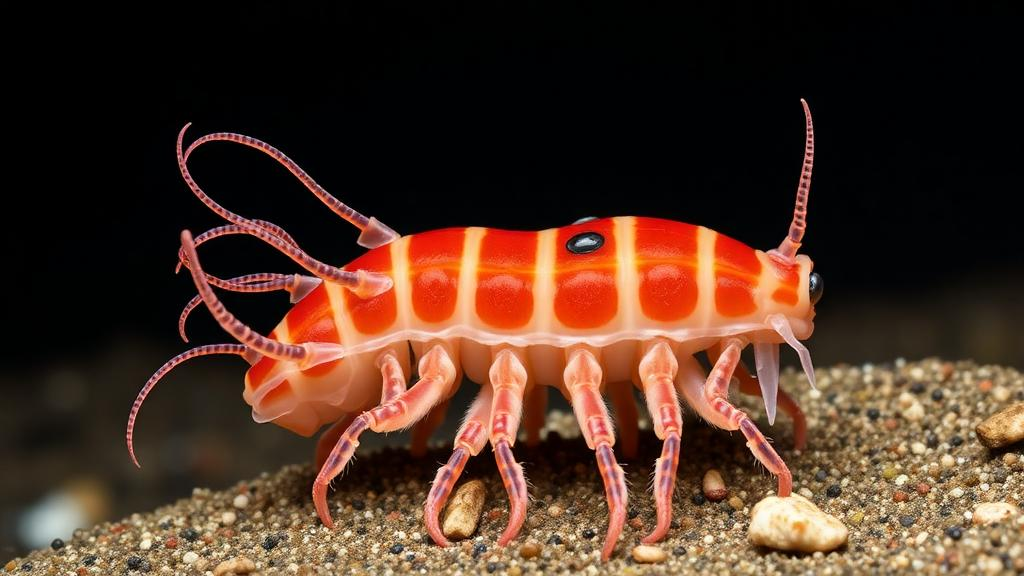
Deep beneath the waves of the western Pacific, on a seamount looming near the Mariana Trench, scientists have discovered a tiny crustacean that is forcing a rewrite of the amphipod family tree. The new species, Renomaera patricki, is not just another addition to the catalogue of deep-sea life. It is a biological anomaly, so distinct from its relatives that it required the creation of an entirely new genus, and its DNA has delivered a verdict that the family it belongs to, Maeridae, is not what taxonomists long believed it to be.
The discovery was made during a biodiversity survey of seamounts near the Mariana Trench, an area of the tropical western Pacific renowned for its vibrant and poorly explored ecosystems. Using the research vessel KEXUE and the remotely operated vehicle FAXIAN, the team collected a single amphipod specimen from a depth of 779.6 meters on a seamount tentatively named M2. Remarkably, the specimen was found in association with a deep-sea sponge of the genus Semperella, a partnership that would later inspire the species’ whimsical name.
Detailed morphological examination under a ZEISS Discovery V20 microscope revealed a crustacean unlike any of the 414 known maerid species. The animal, an elongate, laterally compressed brooding female measuring 9.3 millimeters, lacks eyes entirely, a common trait in deep-sea species but unusual among maerids, most of which inhabit sunlit shallow waters. Its mandible is missing the molar, a grinding structure present in most of its relatives. The inner plate of its first maxilla bears only a single apical plumose seta, and the inner and outer plates of its maxilliped are dramatically reduced. Perhaps most strikingly, the inner ramus of its third uropod carries long plumose setae, giving it a feathery appearance unlike anything else in the family.
These characters, in combination, are so unique that the researchers erected a new genus, Renomaera, to accommodate the species. The genus name honors retired Professor Xianqiu Ren of the Institute of Oceanology, Chinese Academy of Sciences, for his contributions to Chinese carcinology, combined with the family name Maeridae. The species name, patricki, is a nod to Patrick Star from the cartoon SpongeBob SquarePants, because Patrick is SpongeBob’s best friend and this new species was collected in association with a sponge.
But the discovery is more than a taxonomic curiosity. To understand where Renomaera patricki fits in the evolutionary history of amphipods, the team turned to molecular phylogenetics, sequencing one mitochondrial gene, cytochrome c oxidase subunit I (COI), and two nuclear genes, histone H3 and 28S ribosomal RNA. Genomic DNA was extracted from an intra-marsupial individual held by the holotype female, sequenced using Illumina HiSeq technology, and assembled de novo using SPAdes version 4.0.0. The resulting sequences were aligned with MAFFT, trimmed with trimAL, and concatenated using SequenceMatrix before phylogenetic trees were constructed using both maximum likelihood and Bayesian inference methods.
The results were startling. In both data sets, the analyses strongly rejected the monophyly of Maeridae, meaning the family, as currently defined, does not consist of a single evolutionary lineage descended from a common ancestor. This is a fundamental challenge to the classification of a group encompassing 49 genera and 414 species, distributed from the intertidal zone to depths exceeding 7,000 meters. The family was originally established in 2008 based on the morphology of the third uropod, which has rami of subequal length, but the new molecular evidence suggests this single character is not a reliable indicator of shared ancestry.
The phylogenetic trees also revealed that the Maera clade, one of three groups originally recognized within Maeridae, is itself non-monophyletic. Renomaera patricki clustered with four maerid species, including Maera danae from the type genus, with strong support in the first data set. However, other maerid species were scattered across the tree in ways that defied the traditional groupings. The deep-sea species Bathyceradocus hawkingi, for instance, formed a sister group to species from four other families in the maximum likelihood analysis, with strong support, suggesting it may not belong in Maeridae at all.
In contrast, the analyses supported the monophyly of three other families within the superfamily Hadzioidea: Metacrangonyctidae, Melitidae, and Eriopisidae. The Elasmopus group, characterized by well-developed eyes and a short accessory flagellum, was also supported as a natural group. But the Ceradocus group could not be verified because only one species was included in the analyses. The superfamily Hadzioidea is vast, and the relatively few species and genera sampled in this study mean that a comprehensive understanding of relationships within it will require far more taxonomic and molecular data.
The discovery of Renomaera patricki is also significant for what it reveals about deep-sea maerid ecology. This is the first time a deep-sea maerid species has been found associated with a sponge. Other deep-sea maerids, representing at least 15 genera, have been recorded from muddy substrates or in association with sunken wood. The association with Semperella suggests that sponges may serve as important habitat structures for deep-sea amphipods, much as they do in shallow waters, and that seamounts, which harbor vibrant biodiversity, may be hotspots of undiscovered maerid diversity.
Based on the new evidence, the researchers propose amending the diagnosis of Maeridae to allow for the absence of a mandibular molar and the presence or absence of long plumose setae on the inner ramus of the third uropod. The holotype specimen, a brooding female carrying 13 intra-marsupial young, is deposited in the Marine Biological Museum of the Chinese Academy of Sciences in Qingdao, China. As exploration of the deep sea continues, and as molecular tools become ever more powerful, it is likely that more species like Renomaera patricki will emerge from the shadows, each one adding a new branch, and sometimes a new trunk, to the tree of life.
Subject of Research: Evolutionary Biology
Article Title: Renomaera patricki gen. et sp. nov. ( Amphipoda , Hadzioidea , Maeridae ) described from the seamount in the western Pacific, with a test of monophyly of Maeridae Krapp-Schickel, 2008
Article References: Sha, Z.-L., & Wang, Y.-R. (2026). Renomaera patricki gen. et sp. nov. (Amphipoda, Hadzioidea, Maeridae) described from the seamount in the western Pacific, with a test of monophyly of Maeridae Krapp-Schickel, 2008. Zoosystematics and Evolution, 102(2), 471-481. https://doi.org/10.3897/zse.102.171557
Image Credits: AI Generated
Keywords: Amphipoda, Deep Sea, Taxonomy, Phylogenetics, Mariana Trench, New Species, Renomaera, patricki, Hadzioidea, Maeridae, described, seamount
News Source: Drew Townsend. (October 18, 2026). New Deep-Sea Amphipod Named After Patrick Star Rewrites Amphipod Family Tree. Scienmag.