Pacific island nations suffered severe depopulation from introduced diseases as a consequence of contact with European vessels, a new study from The Australian National University (ANU) shows.
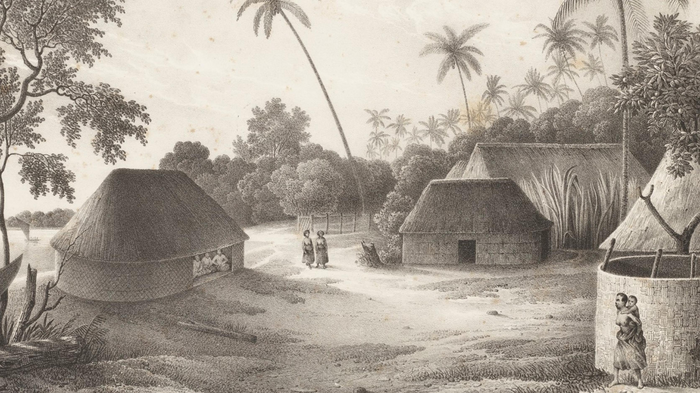
Credit: Collections of the State Library of New South Wales
Pacific island nations suffered severe depopulation from introduced diseases as a consequence of contact with European vessels, a new study from The Australian National University (ANU) shows.
The research, published in the Journal of Archaeological Science, indicates population declines were a lot larger than previously thought.
According to the study, the main island of Tonga had a population decline of between 70-86 per cent once Europeans made contact.
Researchers from the ANU School of Culture, History & Language, PhD candidate Phillip Parton and ARC Future Fellow Professor Geoffrey Clark, found there were between 100,000-120,000 people in Tonga prior to European contact.
“I and my co-author used aerial laser scanning data to map residences on the main island of Tonga and then used archaeological data I collected as part of my PhD to estimate the population,” Mr Parton said.
“This improved understanding of the past has allowed us to show a significant population decline from 50,000-60,000 to 10,000 during a 50-year period on the main island of Tongatapu in the Kingdom of Tonga.
“Because this number is so much larger than anything anyone had previously considered, I used shipping and missionary data to check my estimates and found they were plausible.
“Obviously, this shows a big reassessment of the impact of globalisation in the 19th century.
“As in many parts of the world, the population of Pacific islands suffered severe declines after contact when Europeans introduced new pathogens.”
The research has been published in the Journal of Archaeological Science.
Journal
Journal of Archaeological Science
DOI
10.1016/j.jasrep.2022.103610
Method of Research
Meta-analysis
Subject of Research
People
Article Title
Using lidar and Bayesian inference to reconstruct archaeological populations in the Kingdom of Tonga
Article Publication Date
23-Sep-2022
COI Statement
The authors declare that they have no known competing financial interests or personal relationships that could have appeared to influence the work reported in this paper.