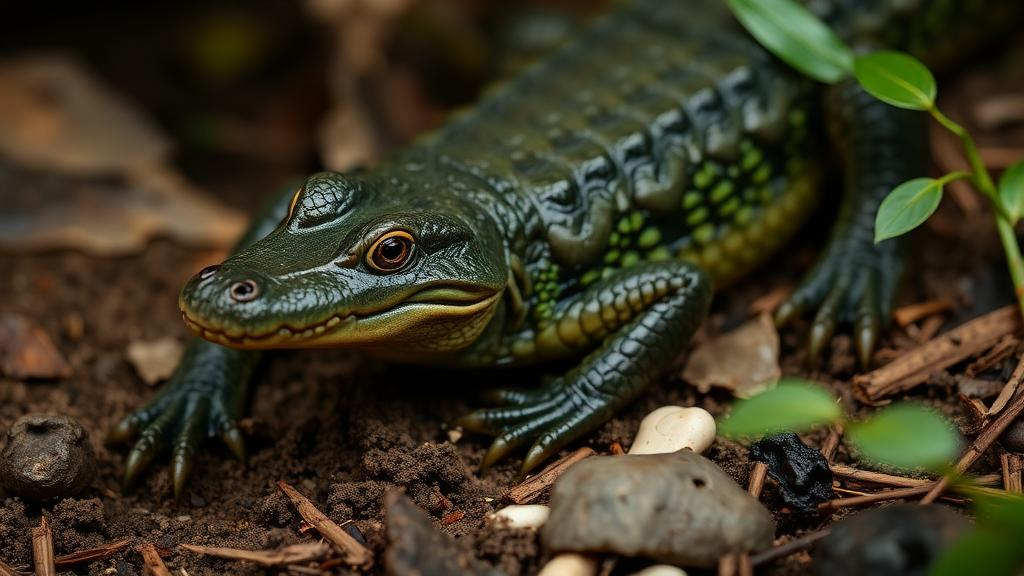
Deep in the misty forests of the Gaowangjie National Nature Reserve in Hunan Province, China, a team of researchers has uncovered a salamander that no one knew existed. The animal, a crocodile newt with a dark body and striking orange-red markings, has now been formally described as Tylototriton gaowangjienensis, a new species of the Asian newt genus Tylototriton. The discovery, published in the journal Herpetozoa, was based on evidence from molecular identification and detailed morphological comparisons, and it adds a surprising new branch to a family tree that scientists thought they had mapped fairly well.
The genus Tylototriton, commonly known as crocodile newts because of their ridged, knobby appearance, is distributed across eastern, southern, and southeastern Asia. The genus was established in 1871 based on the species Tylototriton verrucosus, collected from Longchuan County in Yunnan Province, China. Phylogenetic studies have consistently shown that Tylototriton is monophyletic and forms a sister group to the genus Echinotriton, while the previously recognized genus Yaotriton is now considered a subgenus within Tylototriton. Species of the genus have traditionally been divided into two groups, the T. verrucosus group and the T. asperrimus group, corresponding to the two subgenera Tylototriton and Yaotriton respectively.
With the increase in field investigations and the advancement of molecular technology, more and more species of Tylototriton have been discovered in recent years, indicating that the species diversity of this genus was previously underestimated. Currently, there are 40 known species of Tylototriton worldwide, with 22 species recorded in China. Recent molecular studies have also indicated that our understanding of Tylototriton taxonomy is far from complete. For instance, Grismer et al. revealed several mysterious lineages that may represent undescribed species, and Wang et al. showed the existence of three cryptic species within T. wenxianensis, distributed in the Dabie Mountains in Anhui, Wufeng County in Hubei, and Libo County in Guizhou Province respectively. Putative cryptic species from the Dabie Mountains and Libo County have since been described as two new species, T. anhuiensis and T. maolanensis, but individuals from Wufeng County, Hubei Province, have not been thoroughly investigated and further examined.
During an amphibian survey and monitoring project, several Tylototriton specimens were collected in the Hunan Gaowangjie National Nature Reserve, an area previously not known to harbor any salamander species. In May 2021, thirteen individuals of the newt species were collected in the reserve. Of these, six were deposited as type specimens, and one was used for making a skeleton specimen, while remaining individuals were measured for morphological data and molecular samples were collected before release. Additionally, three fertilized females were supplementary collected for reproduction and juvenile observations. All type specimens were fixed in formalin and then preserved in 80% alcohol, and deposited at the animal museum in Jishou University. The permissions for field surveys for scientific purposes were approved by the local Bureau of the National Nature Reserve, and the sample collections and experiment protocols were approved by the Biomedical Ethics Committee of Jishou University, adhered to the relevant laws and guidelines of China.
Morphological studies were conducted by descriptions and measurements following established methods, with measurements taken point-to-point with a vernier caliper by a single measurer to the nearest 0.01 mm. For several morphometric characters, Kruskal-Wallis tests were conducted to test the significance of differences between various species in the T. asperrimus species group at a significance level of P = 0.05. Furthermore, principal component analyses were conducted to determine whether the different species were separated in morphometric combinations, using the R software. After preliminary diagnosis, the species in Gaowangjie National Nature Reserve showed similar features to the T. asperrimus species group. Therefore, T. wenxianensis, T. dabienicus, T. broadoridgus, T. anhuiensis, T. maolanensis, T. daloushanensis, and T. tongziensis, which belong to the T. asperrimus species group in the surrounding areas, were selected for in-depth morphological comparison and statistical analysis. The data of other species of Tylototriton were obtained from available literature.
The new species can be distinguished from other members of Tylototriton by a combination of characteristics: a medium-sized body; finger tips extending beyond the snout while forelimbs stretched forward; tips of forelimbs and hindlimbs reaching and overlapping when folded towards the body; snout edge round; absence of small papillae in the male cloacal fissure; dorsal ridges narrow, with width smaller than the eye diameter; head length greater than head width, with a ratio of 1.04 to 1.22; orange markings absent on the parotoid; nodule-like warts on body sides continuous; and vomerine teeth not connected at the tip, extending to the occipital bone at the posterior end. The holotype, an adult male, measures 123.69 mm in total length, 67.20 mm in snout-vent length, and 56.06 mm in tail length. The head length is greater than head width, with a ratio of 1.13. The snout is short and blunt, longer than the eye diameter, and extends beyond the lower lip from dorsal view. The eyes are relatively large at 3.8 mm, laterally oriented but visible in dorsal view, with nearly round eyelids. The vomerine teeth are arranged linearly in a chevron shape, separated at the anterior end, located between the choanas, and extending to the posterior edge of the orbit. The tongue is oval-shaped, slightly concave in the center, with the bottom fixed and side edges free. Head ridges are prominent, extending from snout to back head, forming a longitudinal approximation shape. Bone ridges form a weak v-shape at the head, with the edge relatively smooth and basically connected to the middle ridge.
The skin is rough, with small granules present on the dorsal surfaces of the head and dorsum, the lateral sides of the body and tail. On both sides of the trunk, a row of rib nodules is composed of numerous slightly thick warts, slightly protruding outward but relatively flat. The limbs are relatively slender, with the hind limbs slightly longer than the forelimbs. There are four fingers, with comparative finger length III greater than II, greater than IV, greater than I, and five toes, with comparative toe length III greater than IV, greater than II, greater than V, greater than I. All fingers and toes are slightly flattened, with blunt ends and no fins. The tail height exceeds the width at the tail base, with thin and lower dorsal fin folds. The caudal dorsal fin originates from the upper middle section of the tail, connected to the middle ridge of the back, without obvious segmentation. The ventral tail fin folds are short and thick, starting from the tail base, with a small gap from the posterior edge of the cloacal fissure. The cloacal region is notably swollen, with the vent as a longitudinal slit. The skin is mostly black or dark gray. The ventral surface, distal ends of digits, peripheral area of the cloaca, and ventral edge of the tail are orange-red, with the orange-red region between the tail’s ventral edge and the cloaca’s periphery connected. After alcohol preservation, the orange-red fades to milky white.
Five tissue samples were utilized for molecular phylogenetic analysis. DNA extraction was carried out using the Animal Genome DNA Extraction Kit from Sangon Biotech. The mitochondrial 16S rRNA and NADH dehydrogenase subunit 2 genes were amplified using specific primer pairs, and the PCR products were detected by 1% agarose gel electrophoresis and then sequenced. All sequences obtained have been deposited in GenBank. For phylogenetic analysis, 94 sequences of 53 Tylototriton species, including the new species, were downloaded and incorporated as ingroup datasets, while 6 sequences of 3 species in Salamandridae, namely Echinotriton chinhaiensis, Pachytriton granulosus, and Pleurodeles waltl, were selected and downloaded as outgroups. Both the 16S rRNA and ND2 genes were aligned using MAFFT and manually checked for accuracy. Subsequently, the aligned sequences were combined to construct a concatenated sequence. The uncorrected pairwise distances were calculated using MEGA11. IQ-TREE was utilized to conduct the maximum likelihood analysis under the best-fit model TN+F+I+G4 selected by Modelfinder according to the Bayesian Information Criterion. Ultrafast bootstrap approximation was assessed using 20,000 ultrafast bootstrap replicates, and nodes with UFB values of 95 or higher were considered significantly supported. For Bayesian inference analysis, the best-fitting model GTR+F+G4 was selected by Modelfinder according to the BIC. The Markov Chain Monte Carlo method was applied in MRBAYES, with four chains run for 20 million generations, sampled every 1000 generations, and the first 25% of samples discarded as burn-in. Nodes with Bayesian posterior probabilities of 0.95 or higher were considered well supported.
The final alignment of the combined 16S rRNA and ND2 sequence dataset was 1925 bp in length. Both the ML and BI analyses yielded essentially identical topologies. The monophyly of Tylototriton was strongly supported, with the 53 nominal species or populations mainly divided into two clades, corresponding to the subgenus Tylototriton and Yaotriton respectively. The subgenus Yaotriton further divided into two subclades, namely the T. wenxianensis species subclade and the T. asperrimus species subclade. The four individuals of the new species formed a monophyletic group, showing as a sister species to T. dabienicus. The p-distance values of 16S rRNA between the new species and other congeners ranged from 1.57% to 13.55%. The lowest value, 1.57%, was observed between it and T. dabienicus, while the values between it and other species in the T. asperrimus species group were 2.69%, 3.65%, 3.85%, 3.85%, 3.85%, and 4.81% relative to T. tongziensis, T. anhuiensis, T. broadoridgus, T. maolanensis, T. daloushanensis, and T. wenxianensis respectively. The p-distance values of the ND2 sequence between the new species and other congeners ranged from 1.7% to 13.27%, with the lowest value of 1.7% still observed between it and T. dabienicus. The p-distance values indicated that the degrees of differentiation between the new species and its sister species T. dabienicus were larger than some other known sister species pairs, such as the p-distances between T. sparreboomi and T. pasmansi, and between T. verrucosus and T. shanjing. It is of similar differentiation to that between T. shanorum and T. ngarsuensis.
In the principal component analysis, the total variation of the first principal component was 67.7% and the second was 15.8%, which, when combined, explained how the variations exceed 80%. The two-dimensional plots of PC1 versus PC2 showed that the new species could be distinguished from its closely related species T. dabienicus and T. tongziensis. Results from the Kruskal-Wallis test also indicated that the new species was significantly different from T. tongziensis, T. maolanensis, T. daloushanensis, T. anhuiensis, T. dabienicus, and T. wenxianensis in specific morphometric characters, especially in males, with P-values below 0.05. These findings demonstrated that the new species is morphologically distinct from all other known congeners. The new species is named after its type locality, with the suggested Chinese name Gaowangjie warts newt and the English name Gaowangjie crocodile newt. The breeding season of T. gaowangjienensis lasted from April to June, with a peak period from late April to early May. In late March, the population gradually ended hibernation, and in early April, the males began to migrate to the breeding ground, usually pools or shallow waters, to await breeding opportunities. The females then entered the breeding ground about a week later. In late May, the females usually left the breeding ground after laying eggs, showing no protective behavior. After the females laid eggs and left, the males still stayed in the breeding ground for a period of time, and then left in mid to early June. With that, the breeding season ended, and the newts returned to a terrestrial preferred life in the forest. The juvenile’s body is slender, with head length exceeding width. The eyes are large, rounded, laterally oriented but still visible in dorsal view. The front end of the three outer gills is obtuse. The skin is smooth, fingers and toes are light yellow, and body color ranges from light black to brown. Dorsal fin folds are relatively high, occurring from about 35% of the total body length. Ventral fin folds are short and thick, extending from the cloaca to the end of the tail. T. gaowangjienensis is only known from Gaowangjie National Nature Reserve in Hunan Province, China. It was primarily distributed in natural broad-leaved or coniferous broad-leaved mixed forests at altitudes of 500 to 700 meters. During the breeding season, the habitats featured water and could be categorized into three types: seasonal roadside ponds, small creek ponds, and rice fields. The main vegetation types in the breeding areas were evergreen broad-leaved forests, evergreen coniferous broad-leaved mixed forests, and bamboo forests. The environment was lush with high humidity, and the ground was covered with a thick layer of fallen leaves and humus. Based on field observations, one of the primary breeding areas of T. gaowangjienensis identified was that in the rice field, yet this habitat is increasingly facing challenges due to human activities. While it remains unclear whether this habitat selection was actively or passively chosen by the species in response to rapid environmental disturbances, it serves as a reminder to prioritize attention to these special habitats of such amphibians. Therefore, it is imperative to conduct more investigations and monitoring in the future to better understand and protect the species in the face of ongoing environmental changes.
Subject of Research: Description of the new crocodile newt species Tylototriton gaowangjienensis from Hunan Province, China, based on molecular phylogenetics and morphological comparisons.
Article Title: Description of a new species of the Asian newt genus Tylototriton ( Amphibia , Urodela , Salamandridae ) from Hunan Province, China
Article References: Huang, J., Xiang, Y., Wu, T., Zhang, Y.-X., Zhang, Z.-L., Wang, B.-Z., Lan, X.-Y., Huang, Y.-P., Jiang, H.-J., & Jiang, W.-S. (2024). Description of a new species of the Asian newt genus Tylototriton (Amphibia, Urodela, Salamandridae) from Hunan Province, China. Herpetozoa, 37, 327-338. https://doi.org/10.3897/herpetozoa.37.e135222
Image Credits: AI Generated
DOI: 10.3897/herpetozoa.37.e135222
Keywords: Tylototriton, new species, salamander, Hunan Province, China, Herpetozoa, amphibian taxonomy, molecular phylogenetics, crocodile newt, biodiversity, Description, species
News Source: Margaret Porter. (October 19, 2026). New crocodile newt species discovered hiding in Hunan nature reserve. Scienmag.