A study by SISSA provides important information on its composition and on its interaction with luminous matter
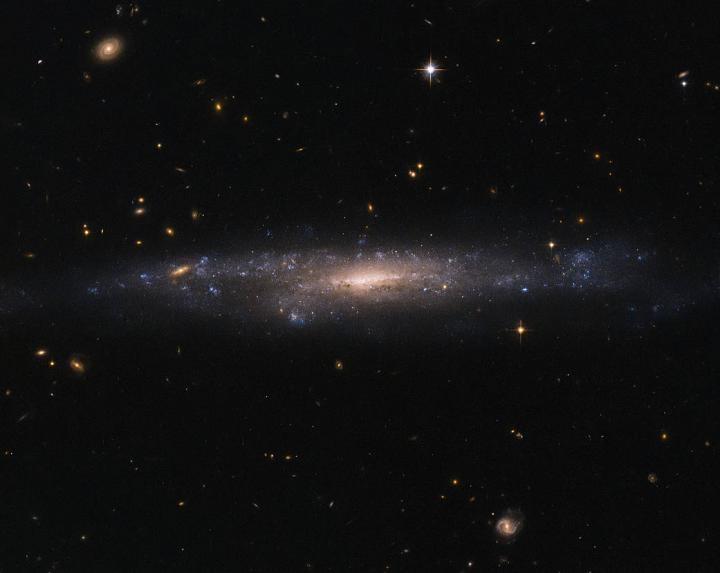
Credit: ESA/Hubble & NASA
Acknowledgement: Judy Schmidt
They are called low-surface-brightness galaxies and it is thanks to them that important confirmations and new information have been obtained on one of the largest mysteries of the cosmos: dark matter. “We have found that disc galaxies can be represented by a universal relationship. In particular, in this study we analysed the so-called Low-Surface-Brightness (LSB) galaxies, a particular type of galaxy with a rotating disc called this way because they have a low-density brightness “says Chiara di Paolo, astrophysicist at SISSA and lead author of a study recently published in MNRAS together with Paolo Salucci (astrophysicist at SISSA) and Erkurt Adnan (Istanbul University).
The researchers analysed the speed at which the stars and gases that compose the galaxies subject matter of the study rotate, noting that the LSBs also have a very homogenous behaviour. This result consolidates several clues on the presence and behaviour of dark matter, opening up new scenarios on its interactions with bright matter.
Lights and shadows on matter
It is there but you cannot see it. Dark matter appears to account for approximately 90% of the mass of the Universe; it has effects that can be detected on the other objects present in the cosmos, and yet it cannot be observed directly because it does not emit light (at least for the way in which it has been searched for to date). One of the methods for studying it is that of rotation curves of the galaxies, systems that describe the trend of the speed of stars based on their distance from the centre of the galaxy. The variations observed are connected to the gravitational interactions due to the presence of stars and to the dark component of matter. Consequently, the rotation curves are a good way to have information on the dark matter based on its effects on what it is possible to observe. In particular, the analysis of the rotation curves can be conducted individually or on groups of galaxies that share similar characteristics according to the universal rotation curve (URC) method.
The novelty of the research lies in having applied the URC method for the first time, already used for other types of galaxies, to a large sample of low-surface-brightness galaxies, obtaining similar results. “We have compared rotation curves of various LSB galaxies finding that there is no discontinuity but gradual and ordered variations starting from the small to the large. Something similar was also observed for spiral galaxies,” explains Salucci, the other author of the study: “This method was applied for the first time in 1996, and to date it has shown that all disc, spiral, dwarf and now also the LSB galaxies can be represented by a universal relationship. This means that we are able to express an ordered trend through a formula which, keeping account of very few parameters, describes how dark matter and luminous matter are distributed”.
New possible scenarios
As it often happens in scientific research, the study has revealed further surprising and unexpected results. “We have discovered relationships of scale between the properties of the stellar disc and those of the dark matter halo, for example a relationship between the dimensions of the stellar discs and the dimensions of the internal region with a constant density of the dark matter halo” explains Chiara Di Paolo. “Furthermore, by comparing the relationships found in the LSB with those obtained in different types of galaxies, we have found that they are all almost coincidental. And it has been a great surprise to verify that galaxies with a very different morphology and history show the same relationships between the properties of dark matter and those of luminous matter”. This result, together with some specific features of LSB galaxies, opens up a new series of scenarios including that of the existence of another type of direct interaction, in addition to the gravitational one, between the two types of matter that form galaxies. A fascinating idea to be verified by new observations.
###
Media Contact
Marina D’Alessandro
[email protected]
0039-349-288-5935
Related Journal Article
http://dx.