Tensile strength is one of the most important parameters in rock mechanics and rock engineering, and the direct tensile test is widely regarded as the most accurate way to measure it. Yet the standard method carries a demanding requirement: specimens must be long enough, carefully prepared and firmly bonded to loading fixtures so that force is transmitted uniformly along the sample axis. In many practical situations those conditions simply cannot be met, for example when available core material is too short or when the sample contains an interface or weak plane running along its length. A team of researchers has now presented a clamp-based testing approach designed specifically for these difficult cases, and they report that the procedure has been verified by numerical simulations and validated on both a homogeneous sandstone and a composite salt rock–concrete sample.
The work, published as an open access research article in the journal GeoEnergy Communications, was carried out by M. Friedel, Y. Dong, H. Konietzky and A. Morgenstern together with T. Wilsnack. The authors describe their method as a practical extension of the established direct tension concepts codified in the ISRM suggested methods and the ASTM D2936-20 standard, rather than a replacement for them. Their explicit aim is to handle two specimen constellations that defeat conventional setups: short cylindrical cores with length-to-diameter ratios close to one, and composite specimens containing an axial interface where end-capping and alignment would be impractical or would constrain the intended failure plane.
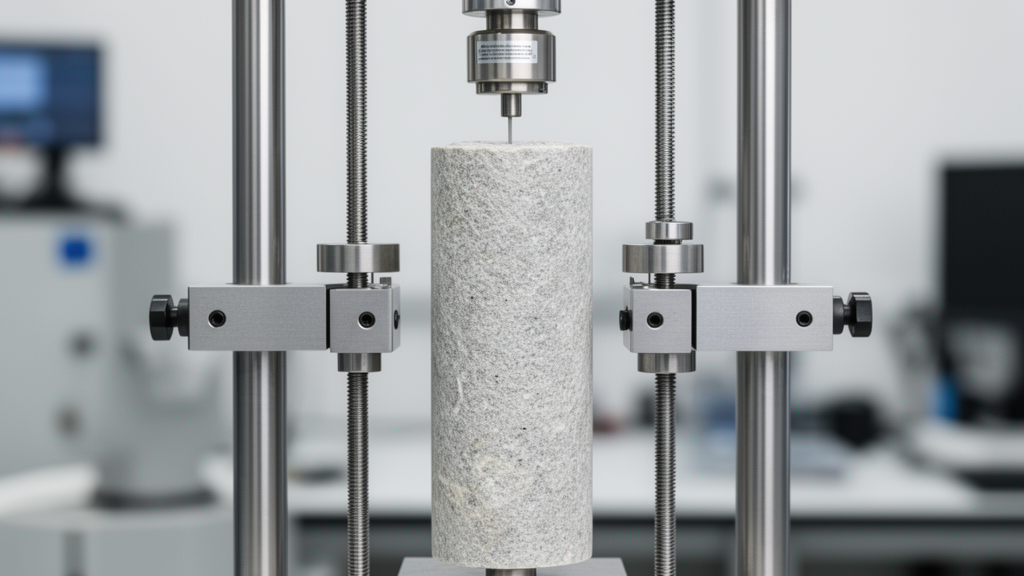
The core of the innovation lies in the load-transfer path. Instead of bonding end caps to the flat ends of a cylinder and pulling through a linkage system, the researchers use two symmetrical metal clamps, each machined with a semi-circular groove that securely holds the cylindrical specimen from the sides. During loading, this geometry is intended to ensure stable and uniform tensile force transmission and to reduce end effects compared with direct gripping. The semi-circular groove design also minimizes potential specimen misalignment and provides a large bonding area with identical adhesive tensile strength. The inner radius of the metal clamps is set about one millimetre larger than the rock sample radius, which fixes the glue thickness at roughly one millimetre along the load path.
The adhesive itself is treated as an integral part of the load-transfer chain. For the reported experiments the team selected Hysol 9466, a two-component industrial epoxy that cures at room temperature to form a tough, off-white bondline with high peel resistance and high shear strength. Its specified properties include a tensile strength above 40 megapascals, a shear strength above 25 megapascals, a curing time of 24 to 48 hours, an operating temperature range from minus 40 to plus 150 degrees Celsius, a Young’s modulus of 3.2 gigapascals and a shear modulus of 1.1 gigapascals. The authors stress that the bonding strength of the glue must be significantly higher than the strength of the rock being tested, and that careful control of bonding procedure, curing conditions and alignment is essential for reproducible results, because variations in adhesive thickness and stiffness mismatch can influence stress transfer and the magnitude of end effects.
The clamps are fabricated from high-strength alloy steel chosen for its mechanical performance and corrosion resistance, with an elastic modulus of 200 gigapascals and a yield strength above 1000 megapascals to prevent plastic deformation under maximum load. The testing machine used in the study is a combined compression and tensile system, the TIRAtest-2800, offering an adjustable tensile speed between 0.001 and 5 millimetres per minute, a maximum tensile force of 100 kilonewtons and a measurement accuracy of plus or minus 0.5 percent of full scale. The specimens tested had a diameter of 100 millimetres. After bonding, samples are cured for at least 24 hours, and the specimen–clamp assembly is then installed in the machine using ball-bearing mounted bolts so that the loading direction aligns precisely with the specimen axis, a step the authors identify as critical for eliminating bending or torsional loads. A small pre-load seats the assembly before monotonic tensile loading begins. Once a test is complete, the fixtures can be reused: residual epoxy is degraded in a furnace at 230 degrees Celsius for three hours and then removed by non-abrasive manual scraping without damaging the metal surface.
To analyse how stresses develop inside the specimen, the team built three-dimensional numerical models in FLAC3D that replicate the full experimental arrangement, including the sample, the metal clamps, the glue layer and, optionally, a central material interface. Interface elements between the clamps and the rock represent the mechanical behaviour of the bonding layer, while additional interface elements can be placed centrically between two materials to represent, for instance, a rock–concrete contact. The rock was described with a Mohr–Coulomb model including a tensile cut-off, which the authors describe as a pragmatic engineering representation to capture brittle tensile failure at the specimen scale and to reproduce the peak load, failure location and stress heterogeneity seen in the experiments. They are careful to note the model’s limits: it does not explicitly represent fracture-energy-controlled crack propagation or post-peak softening, so the simulations are used primarily to interpret stress distribution and failure initiation rather than detailed fracture mechanics. The clamps themselves were modelled as isotropic elastic, since plastification or failure of the steel can be excluded.
Validation for homogeneous material used a well-investigated Postaer Sandstone whose uniaxial tensile strength had previously been measured at 1.6 plus or minus 0.6 megapascals across 47 samples in classical direct tensile tests following the ISRM suggested methods of 1978. In the new procedure, three specimens were pulled to failure, producing peak loads of 17.64 kilonewtons for Sample A, 18.15 kilonewtons for Sample B and 15.69 kilonewtons for Sample C. The nominal tensile strength is calculated by dividing the peak force by the final fracture area measured after testing, and all three resulting values fell within the previously established range of 1.6 plus or minus 0.6 megapascals, indicating consistency with the sandstone’s reported mechanical properties. Crack propagation in these homogeneous samples initiated near the clamps, producing nearly horizontal fractures driven by stress concentrations in the rock adjacent to the fixtures.
That stress concentration is the key caveat of the method for intact rock. Numerical results show that the tensile stress distribution along the final fracture plane is not homogeneous: local peaks occur close to the clamps and trigger crack initiation there. This inhomogeneity makes the determination of tensile strength less accurate than in an ideally uniform uniaxial test. The authors argue that for practical applications, and considering the general scatter of rock mechanical data, this level of accuracy may still be sufficient, but they are explicit that for homogeneous specimens the obtained value should be interpreted as a conservative estimate, a lower bound, under the present boundary conditions rather than an exact representation of the true uniaxial tensile strength.
For composite materials the picture is more favourable. The team determined the tensile strength of the interface between salt rock and an MgO-based special concrete using the new procedure, with the numerical model duplicating the laboratory test. Because the interface is much weaker than either of the two materials in contact, tensile failure developed along the interface in both the lab and the simulation. The numerical analysis showed that tensile stresses developing along a central weak plane are nearly perfectly homogeneous, in contrast to the homogeneous case where peak stresses cluster near the clamps, and that the orientation of maximum tensile stress along the interface is vertical, in agreement with the loading direction. The interface tensile strength is then simply the peak force divided by the final fracture area. Comparing lab tests and simulations for the composite interface, the authors report deviations of only 0.8 percent and 3.7 percent respectively, and the force–displacement curves show a sudden drop at peak stress, indicating abrupt brittle failure. The authors emphasize an important precondition: the approach is reliable for interface testing only when the interface tensile strength is significantly lower than that of the adjacent materials. If the interface is comparable in strength to the bulk materials, failure may shift into the bulk or into regions influenced by end effects, and the peak-load-based nominal strength should then not be interpreted as an interface property.
The authors position the study as a technical guideline and proof-of-concept rather than a finished standard method, noting that broader validation, repeatability assessment and bias quantification remain for future work, and that the present dataset for interface testing is limited. Within those limits, the conclusions are concrete: the procedure is well suited to determining the direct tensile strength of interfaces located centrically inside a sample, and it yields a conservative lower-bound value for homogeneous materials, in both cases by dividing the measured peak load by the final fracture area. Because the clamps can be redesigned for other diameters, the tests are easy to perform and the sample holders can be reused repeatedly, the method offers rock mechanics laboratories a practical route to direct tensile data precisely where the classical ISRM and ASTM geometries fall short: on short cores and on layered or bonded composite specimens whose weakest plane is the very property that matters.
Subject of Research: A clamp-based laboratory method for direct tensile strength testing of short cylindrical rock samples and composite samples with interfaces
Article Title: A novel approach to measure direct tensile strength on short-length cylindrical samples
Article References: Friedel, M., Dong, Y., Konietzky, H., Morgenstern, A., & Wilsnack, T. (2026). A novel approach to measure direct tensile strength on short-length cylindrical samples. GeoEnergy Communications, 2(1), Article 8. https://doi.org/10.1007/s44421-026-00019-4
Image Credits: AI Generated
DOI: 10.1007/s44421-026-00019-4
Keywords: rock mechanics, tensile strength, direct tensile test, sandstone, salt rock, MgO-based concrete, interface strength, FLAC3D, numerical simulation, epoxy adhesive, ISRM suggested methods, composite specimens
News Source: Denise Maddox. (October 28, 2026). New Clamp Method Measures Direct Tensile Strength in Short Rock Cores. Scienmag.