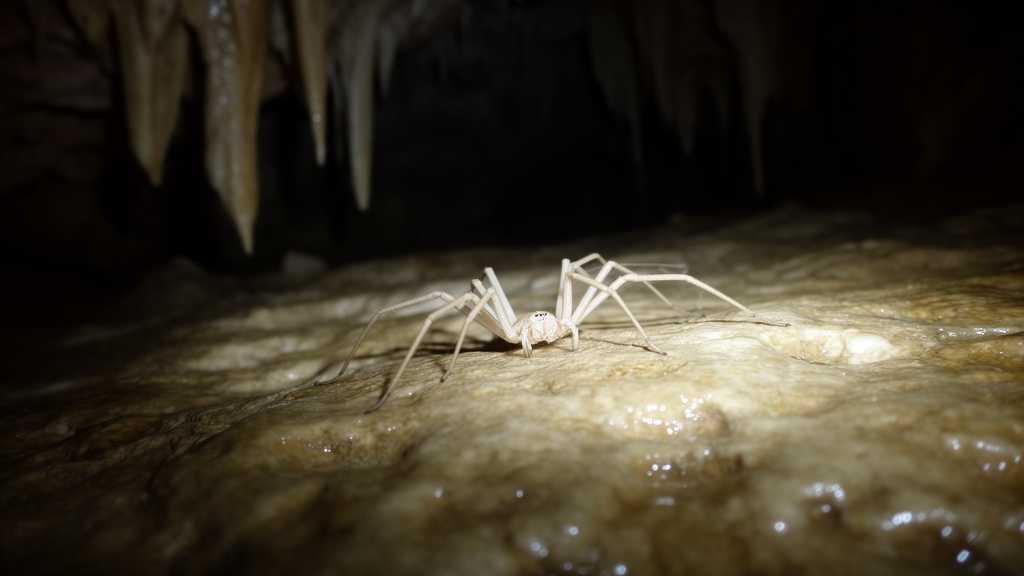
Deep inside a humid limestone cave in eastern Spain, a tiny arachnid no more than two millimetres long has rewritten what scientists thought they knew about how life adapts to permanent darkness. The creature, a member of the enigmatic arachnid order Palpigradi, has been described as a new species, Eukoenenia serrana, after the municipality of Serra in Valencia where it was discovered. Its formal description, published in the journal Subterranean Biology, is paired with the first systematic morphometric comparison of cave-dwelling and soil-dwelling species within its lineage, and the results reveal a strikingly uneven, mosaic-like pattern of evolutionary change underground.
Palpigrades, sometimes called microwhip scorpions, remain among the least studied of all arachnid orders. They are minute, ranging from 0.7 to 2.0 millimetres in body length, generally rare, and confined to very specific habitats, usually damp soil, leaf litter, or caves. Only 138 species have been described worldwide, and most are known from just one or a few specimens. The first species, Eukoenenia mirabilis, was described from Europe in the late nineteenth century, and today 35 species are known from the continent, all within the family Eukoeneniidae. On the Iberian Peninsula and the Balearic Islands, eleven species had been recorded before this discovery, occupying a wide ecological range from endogean life under rocks and in soil to strictly subterranean existence in caves.
The new species was collected in December 2021 from Sima de Pla de les Llomes, a 220-metre-long epigenetic vadose cave developed in Middle Triassic dolomites at 570 metres above sea level. The cave is entered through an eleven-metre vertical shaft that opens into a labyrinth of crawl spaces, shafts and pseudo-galleries aligned along the region’s dominant north-south fracturing. The specimen was found in the last chamber on the southern side of the cave, in the deep zone where moisture condenses on the walls. That chamber is already famous among subterranean biologists: it also hosts three other troglobitic species of special interest, including the silverfish Coletinia longitibia, known exclusively from this single cave, the cicada Valenciolenda fadaforesta, and the dipluran Paratachycampa penyoensis.
The holotype, a single male specimen, was collected with a small brush, preserved in 70 percent ethanol, cleared in lactic acid and mounted on slides in Hoyer’s medium for microscopic study. Its body measures 1596 micrometres without the flagellum, and the detailed description records an intricate anatomy: a frontal organ with two pointed branches, chelicerae with nine serrated teeth, a precise arrangement of setae across the coxae of all four leg pairs, and a male genitalia structure with three lobes bearing characteristic setal patterns. The species name honours the municipality where the cave lies, and the type specimen is deposited in the Scientific Collections Centre of the University of Almeria.
What makes Eukoenenia serrana remarkable is not merely that it is new, but how strongly it displays the classic hallmarks of cave adaptation. It is large for a palpigrade, and its appendages, particularly the first pair of legs, are dramatically elongated. Yet it retains a diagnostic feature of its species group, the Eukoenenia mirabilis-berlesei group: a lateral organ on the prosoma with only a single blade. That combination of pronounced troglomorphy with a primitive sensory configuration turned out to be the key to the study’s most surprising finding.
To understand how cave life reshapes these animals, the researchers compiled morphometric data from published descriptions of all eight species in the E. mirabilis-berlesei group, comparing four species traditionally regarded as soil-dwelling, or endogean, with four cave-adapted, or hypogean, relatives. Using linear measurements and derived ratios, along with two-tailed Welch’s t-tests that account for unequal variances and sample sizes, they quantified the percentage of elongation for each character. The results were unambiguous: cave species show significantly larger values for nearly every appendage measurement, with elongation concentrated in the limbs rather than the body.
The numbers tell a vivid story. Tibia I, the tibia of the first leg, increased by roughly 78 percent in hypogean species when comparing group means, and by about 85 percent when comparing medians, among the highest values recorded for any measured character. Tibia IV followed closely with a mean increase of about 78 percent, while the basitarsus of leg IV lengthened by roughly 64 percent and the combined tarsus-tibia segment of leg I by about 69 percent. The palpal tibia, though still significantly longer in cave species, showed a more modest mean increase of about 61 percent. By contrast, overall body length and prosomal shield length increased more moderately, by roughly 19 to 24 percent, suggesting that cave adaptation in this group favours stretching the limbs far more than enlarging the body.
One ratio, however, stubbornly refused to change. The proportion between the basitarsus and tibia of leg IV remained statistically indistinguishable between endogean and hypogean species, indicating that when leg IV elongates in cave-dwelling palpigrades of this group, both segments lengthen in concert. This finding partially contradicts earlier work from the 1990s, which had reported differences in this ratio between soil and cave species across palpigrades more broadly. The new analysis suggests that within the E. mirabilis-berlesei group specifically, proportional elongation of leg IV segments is the rule, and that the ratio is not a reliable marker of cave adaptation for this lineage.
Perhaps the most intriguing result concerns the lateral organ, a sensory structure on the anterior prosomal margin whose number of blades has long been used as an index of subterranean adaptation. In highly troglomorphic Eukoenenia species elsewhere, the organ can carry up to 16 elements on each side, and an increase in blade number has been interpreted as a hallmark of advanced cave life. Yet Eukoenenia serrana, despite its dramatically elongated limbs and large body, retains just a single blade on each side, as does the closely related cave-adapted E. indalica from southern Spain. This retention implies that sensory and appendicular traits can evolve independently, and that multiplying the blades of the lateral organ is neither a prerequisite nor a necessary companion of limb elongation in cave-dwelling palpigrades.
The broader significance of the study lies in its demonstration that troglomorphic evolution is not a uniform package of changes but a mosaic, with different characters responding to distinct functional pressures and evolutionary pathways. Leg I in palpigrades functions more like a sensory antenna than a walking limb, held aloft to probe the environment, while leg IV contributes more to support and locomotion. The pronounced elongation of tibia I suggests that tactile exploration in dark, crevice-rich microhabitats may have imposed particularly strong selective pressure on this sensory appendage. As the twelfth palpigrade species known from the Iberian Peninsula and the fourth troglomorphic member of its species group, Eukoenenia serrana adds a new piece to a puzzle that is only beginning to come into focus, reminding scientists that even the tiniest and most obscure arachnids can hold profound lessons about how evolution sculpts life in the planet’s most isolated habitats.
Subject of Research: Morphological adaptation of palpigrade arachnids to subterranean cave environments
Article Title: Troglomorphic trends of palpigrades in the Eukoenenia mirabilis-berlesei group, and discovery of a new cave-dwelling species from Spain ( Palpigradi , Eukoeneniidae )
Article References: Barranco, P., Sánchez-Camacho, F. J., & Mayoral, J. (2026). Troglomorphic trends of palpigrades in the Eukoenenia mirabilis-berlesei group, and discovery of a new cave-dwelling species from Spain (Palpigradi, Eukoeneniidae). Subterranean Biology, 57, 117-138. https://doi.org/10.3897/subtbiol.57.202620
Image Credits: AI Generated
DOI: 10.3897/subtbiol.57.202620
Keywords: Palpigradi, Eukoenenia serrana, troglomorphy, cave adaptation, Subterranean Biology, Spain, morphometrics, arachnology, endogean species, hypogean species, lateral organ, new species
News Source: Gavin Prescott. (October 16, 2026). New Cave-Dwelling Arachnid from Spain Reveals Mosaic Pattern of Underground Adaptation. Scienmag.