• HOME
  • NEWS
  • EXPLORE
    • CAREER
      • Companies
      • Jobs
    • EVENTS
    • iGEM
      • News
      • Team
    • PHOTOS
    • VIDEO
    • WIKI
  • BLOG
  • COMMUNITY
    • FACEBOOK
    • INSTAGRAM
    • TWITTER
Friday, September 4, 2026
BIOENGINEER.ORG
No Result
View All Result
  • Login
  • HOME
  • NEWS
  • EXPLORE
    • CAREER
      • Companies
      • Jobs
        • Lecturer
        • PhD Studentship
        • Postdoc
        • Research Assistant
    • EVENTS
    • iGEM
      • News
      • Team
    • PHOTOS
    • VIDEO
    • WIKI
  • BLOG
  • COMMUNITY
    • FACEBOOK
    • INSTAGRAM
    • TWITTER
  • HOME
  • NEWS
  • EXPLORE
    • CAREER
      • Companies
      • Jobs
        • Lecturer
        • PhD Studentship
        • Postdoc
        • Research Assistant
    • EVENTS
    • iGEM
      • News
      • Team
    • PHOTOS
    • VIDEO
    • WIKI
  • BLOG
  • COMMUNITY
    • FACEBOOK
    • INSTAGRAM
    • TWITTER
No Result
View All Result
Bioengineer.org
No Result
View All Result
Home NEWS Science News Biology

New catalyst upgrades carbon dioxide to fuels found by USTC

Bioengineer by Bioengineer
June 25, 2018
in Biology
Reading Time: 2 mins read
0
Share on FacebookShare on TwitterShare on LinkedinShare on RedditShare on Telegram
IMAGE

Credit: ZHUANG Taotao

Liquid multi-carbon alcohols such as ethanol and n-propanol are desired as renewable transportation fuels. They offer high energy densities, ease of long-range transport, and direct drop-in usage in existing internal combustion engines. Engineering catalysts that favor high-value alcohols is desired.

A research team led by professor YU Shuhong from University of Science and Technology of China of Chinese Academy of Sciences and Edward H. Sargent from University of Toronto has uncovered a catalysis strategy intermediates during CO2 electrochemical reduction reaction, which sheds new lights on upgrading CO2 to engine fuels.

When it comes to designing catalysts for CO2 conversion, many researches on the C-C coupling step have been done; while little attention has been paid to post-C-C coupling reaction.

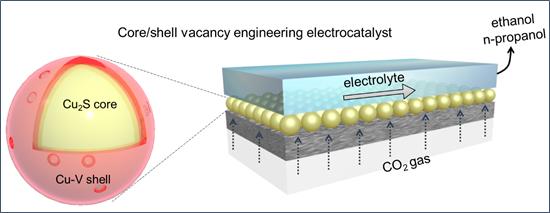
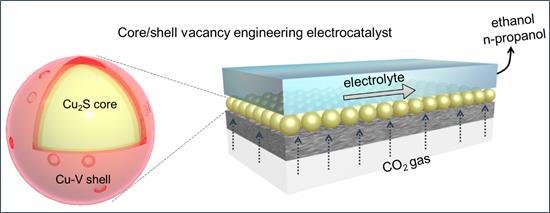
By deliberately incorporating sulfur atoms into the catalyst core and copper vacancies in its shell, researchers realized Cu2S-Cu-V core-shell nanoparticles that enhance CO2 reduction to ethanol and propanol. Structural characterization, x-ray studies, and electrochemical measurements were utilized to illustrate how good this new catalyst is in improving catalytic performance.

This discovery will inspire the design of efficient catalysts that produce higher-carbon liquid alcohols. In addition to address the need for long-term storage of renewable electricity and decarbonization of the transportation sector via electrocatalytic reduction of CO2 to chemical feedstocks. And the results were published in Nature Catalysis on Jun 11th.

###

This work was supported by Foundation for Innovative Research Groups of the National Natural Science Foundation of China, the National Natural Science Foundation of China and other foundations and institutions.

Media Contact

FAN Qiong
[email protected]
86-636-07280

http://en.ustc.edu.cn

Related Journal Article

http://dx.doi.org/10.1038/s41929-018-0084-7

Share12Tweet8Share2ShareShareShare2

Related Posts

Cyclin gene evolution in Arabidopsis and Brassica links polyploid duplication to flowering time

Cyclin gene evolution in Arabidopsis and Brassica links polyploid duplication to flowering time

September 3, 2026
Genetic Structure and Environment-Linked Loci in a Resilient Coral Along Eutrophication Gradient

Genetic Structure and Environment-Linked Loci in a Resilient Coral Along Eutrophication Gradient

September 3, 2026

Genome Analysis Identifies Multi-Epitope Vaccine Targets Against Drug-Resistant Enterobacter

September 3, 2026

Loneliness drives depression and poor health among older European adults, study finds

September 3, 2026
Please login to join discussion

POPULAR NEWS

  • Attributed hypergraphs capture structure and attributes realistically, beyond binary links

    29 shares
    Share 12 Tweet 7
  • α-Synuclein curbs glioma growth via CDH13–JNK/c-Jun signaling pathway

    29 shares
    Share 12 Tweet 7
  • DDOI: A Decomposed Approach to Discovering Object Interaction Skills

    29 shares
    Share 12 Tweet 7
  • Targeted nutrition during oesophageal cancer treatment preserves muscle and aids recovery

    29 shares
    Share 12 Tweet 7

About

We bring you the latest biotechnology news from best research centers and universities around the world. Check our website.

Follow us

Recent News

Attributed hypergraphs capture structure and attributes realistically, beyond binary links

α-Synuclein curbs glioma growth via CDH13–JNK/c-Jun signaling pathway

DDOI: A Decomposed Approach to Discovering Object Interaction Skills

Subscribe to Blog via Email

Enter your email address to subscribe to this blog and receive notifications of new posts by email.

Join 85 other subscribers
  • Contact Us

Bioengineer.org © Copyright 2023 All Rights Reserved.

Welcome Back!

Login to your account below

Forgotten Password?

Retrieve your password

Please enter your username or email address to reset your password.

Log In
No Result
View All Result
  • Homepages
    • Home Page 1
    • Home Page 2
  • News
  • National
  • Business
  • Health
  • Lifestyle
  • Science

Bioengineer.org © Copyright 2023 All Rights Reserved.