• HOME
  • NEWS
  • EXPLORE
    • CAREER
      • Companies
      • Jobs
    • EVENTS
    • iGEM
      • News
      • Team
    • PHOTOS
    • VIDEO
    • WIKI
  • BLOG
  • COMMUNITY
    • FACEBOOK
    • INSTAGRAM
    • TWITTER
Wednesday, May 27, 2026
BIOENGINEER.ORG
No Result
View All Result
  • Login
  • HOME
  • NEWS
  • EXPLORE
    • CAREER
      • Companies
      • Jobs
        • Lecturer
        • PhD Studentship
        • Postdoc
        • Research Assistant
    • EVENTS
    • iGEM
      • News
      • Team
    • PHOTOS
    • VIDEO
    • WIKI
  • BLOG
  • COMMUNITY
    • FACEBOOK
    • INSTAGRAM
    • TWITTER
  • HOME
  • NEWS
  • EXPLORE
    • CAREER
      • Companies
      • Jobs
        • Lecturer
        • PhD Studentship
        • Postdoc
        • Research Assistant
    • EVENTS
    • iGEM
      • News
      • Team
    • PHOTOS
    • VIDEO
    • WIKI
  • BLOG
  • COMMUNITY
    • FACEBOOK
    • INSTAGRAM
    • TWITTER
No Result
View All Result
Bioengineer.org
No Result
View All Result
Home NEWS Science News Health

New cancer treatment uses enzymes to boost immune system and fight back

Bioengineer by Bioengineer
August 28, 2018
in Health
Reading Time: 2 mins read
0
Share on FacebookShare on TwitterShare on LinkedinShare on RedditShare on Telegram
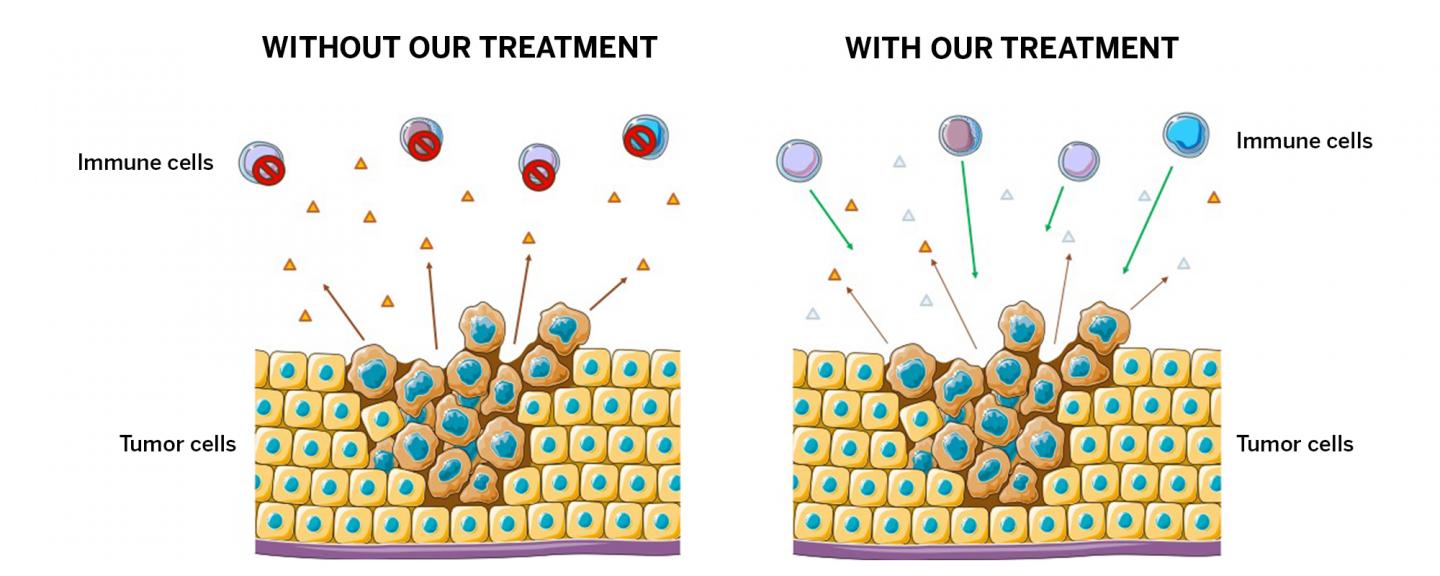
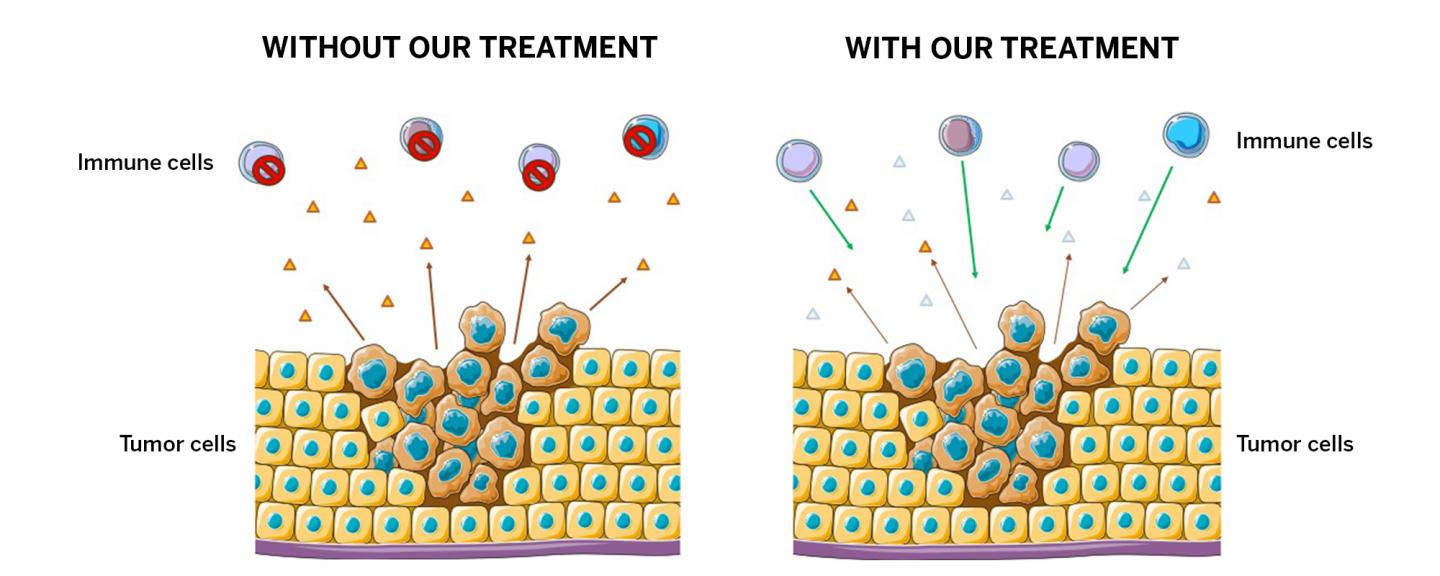
IMAGE

Credit: Norah Ashoura Graduate student Molecular Biology College of Natural Sciences, UT.

AUSTIN, Texas — Researchers at The University of Texas at Austin have developed a new approach to treating cancer using enzyme therapy.

The enzyme, PEG-KYNase, does not directly kill cancer cells but instead empowers the immune system to eradicate unwanted cells on its own. PEG-KYNase is designed to degrade kynurenine, a metabolite produced by numerous tumors that suppresses the immune system. The UT team's findings were published in a recent issue of Nature Biotechnology.

A healthy, fully functioning immune system can combat the spread of cancer cells and eliminate tumors by itself. However, tumors have evolved in multiple ways to suppress the immune system, leading to the growth and metastasis of cancer cells.

"Our immune system constantly polices the body and normally recognizes and eliminates cancerous cells," said Everett Stone, research assistant professor in the College of Natural Sciences' Department of Molecular Biosciences and co-author of the study. "Kynurenine acts as a roadblock to immune cells that impedes normal surveillance; our drug removes this obstacle."

Enzymes have been used in specific treatments before, to treat cancers such as leukemia for example, but this is the first time one has been designed to take on the role of immune checkpoint inhibitor. The researchers are confident this approach could prove effective in treating a variety of different cancers.

The team, led by Stone and professor George Georgiou in the Cockrell School of Engineering, developed an enzyme therapy that stimulates a human immune system abnormally suppressed by cancer cells, unleashing the body's power to fight back against the disease.

Their next step is to initiate clinical trials to test the safety and efficacy of the enzyme.

"Our work presents a new therapeutic approach to overcoming the suppression of the immune system by cancer cells," said Georgiou, who is a professor in the Cockrell School's chemical and biomedical engineering departments, the College of Natural Sciences' molecular biosciences department and Dell Medical School's oncology department. "By relieving immune suppression, the immune system becomes primed to kill cancer cells and eradicate tumors."

###

The research was funded by the Cancer Prevention and Research Institute of Texas, the American Cancer Society and Kyn Therapeutics, the company that is pursuing the clinical development of this approach.

Media Contact

John Holden
[email protected]
512-529-6013
@UTAustin

http://www.utexas.edu

Original Source

https://news.utexas.edu/2018/08/28/new-cancer-treatment-uses-enzymes-to-boost-immune-system http://dx.doi.org/10.1038/nbt.4180


Share18Tweet8Share2ShareShareShare2

Related Posts

New Video Laryngoscope Boosts Safety for Tiny Infants

May 27, 2026

Nuclear OXCT1 Suppresses MHC-I via Histone Modification

May 27, 2026

Using Virtual Reality Path Integration to Predict Neurodegenerative Disease Risk

May 27, 2026

American Cancer Society Revises Colorectal Cancer Screening Guidelines: Highlights Include Blood-Based and At-Home Stool Tests

May 27, 2026
Please login to join discussion

POPULAR NEWS

  • ESMO 2025: mRNA COVID Vaccines Enhance Efficacy of Cancer Immunotherapy

    317 shares
    Share 127 Tweet 79
  • New Study Reveals Plants Can Detect the Sound of Rain

    735 shares
    Share 293 Tweet 183
  • Common Food Preservatives Associated with Elevated Blood Pressure and Increased Heart Disease Risk

    56 shares
    Share 22 Tweet 14
  • AI-Powered Atlas Uncovers Extensive Whole-Body Damage Linked to Obesity

    53 shares
    Share 21 Tweet 13

About

We bring you the latest biotechnology news from best research centers and universities around the world. Check our website.

Follow us

Recent News

New Video Laryngoscope Boosts Safety for Tiny Infants

Nuclear OXCT1 Suppresses MHC-I via Histone Modification

Using Virtual Reality Path Integration to Predict Neurodegenerative Disease Risk

Subscribe to Blog via Email

Enter your email address to subscribe to this blog and receive notifications of new posts by email.

Join 82 other subscribers
  • Contact Us

Bioengineer.org © Copyright 2023 All Rights Reserved.

Welcome Back!

Login to your account below

Forgotten Password?

Retrieve your password

Please enter your username or email address to reset your password.

Log In
No Result
View All Result
  • Homepages
    • Home Page 1
    • Home Page 2
  • News
  • National
  • Business
  • Health
  • Lifestyle
  • Science

Bioengineer.org © Copyright 2023 All Rights Reserved.