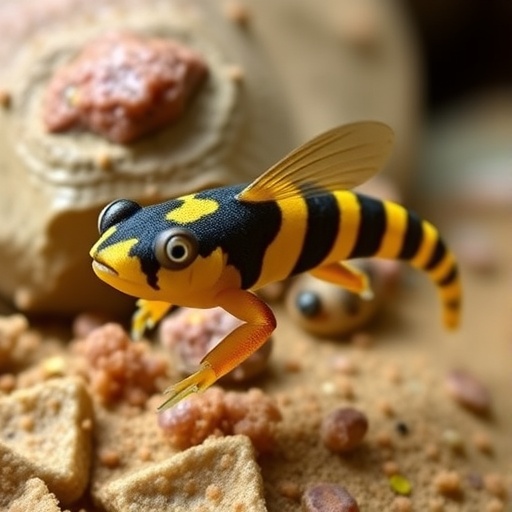
A groundbreaking discovery has emerged from the subtropical mangrove wetlands of Hengqin Island, Guangdong Province, where a team of researchers from Sun Yat-sen University, in collaboration with other institutions, has identified a new species of bumblebee goby, Brachygobius jennie. This finding not only extends the known geographical distribution of the genus Brachygobius northeastward but also documents the first recorded presence of this group of small, estuarine fishes in China. The discovery was published in the prestigious journal Zoosystematics and Evolution, shedding light on a species that challenges conventional understanding of biodiversity in well-studied regions.
During routine fieldwork in the Zhujiang River Estuary wetlands, Jiangyan Tian, a postgraduate student at SYSU, was captivated by the presence of diminutive fishes inhabiting shallow waters near the substrate. Initially mistaken for juveniles of known species, these tiny organisms intrigued Tian due to their distinctive body markings, which deviated from any documented regional fish species. This unexpected observation prompted a deep dive into integrative taxonomic methods that combined morphological examination with genetic analyses, facilitated by her supervisor Jianrong Huang and colleagues Chunliu Lan and Jianyong Wu.
The integration of genetic sequencing and morphological diagnostics was pivotal in delineating Brachygobius jennie as a novel species. The comprehensive study leveraged molecular phylogenetics to affirm the genetic distinctiveness of the new goby relative to its congeners. Morphologically, B. jennie displays a unique pattern of four narrow body bars located behind the head, a trait not observed in related species. Notably, the presence of a chevron-shaped second bar that extends fully to the midventral line provides a striking visual marker distinguishing this species, alongside two additional bars positioned posterior to the anal fin base.
This species’ extraordinary small stature sets it apart within its genus and the broader ichthyofauna of China. Reaching a maximum standard length of under nine millimeters, Brachygobius jennie may be the smallest fish species known in China, and among the tiniest vertebrates worldwide. Such extreme miniaturization necessitates profound anatomical and physiological adaptations, which remain fertile ground for future biological investigation. These evolutionary modifications induced by size constraints offer critical insight into developmental biology and ecological specialization within aquatic vertebrates.
Co-author Sébastien Lavoué from Universiti Sains Malaysia expressed enthusiasm for the collaboration, highlighting the novelty and distinctiveness of Brachygobius jennie. His involvement underscores the international scientific interest in this diminutive and unique goby, bridging expertise across countries and disciplines. The interdisciplinary approach adopted by the research team exemplifies modern taxonomy’s reliance on cross-border cooperation and advanced methodologies, crucial for uncovering concealed biodiversity even in well-explored ecosystems.
The nomenclature of this newly described species holds particular cultural significance. The fish is named in honor of Jennie Ruby Jane, a prominent South Korean singer, whose music served as a beacon of inspiration for Jiangyan Tian during the demanding phases of the research. This homage illustrates the interplay between science and personal experience, enriching the narrative of scientific discovery by acknowledging influences beyond the laboratory or field site.
Brachygobius jennie inhabits estuarine environments characterized by subtropical mangrove wetlands, a habitat typified by dynamic salinity gradients, rich organic substrates, and ecological complexity. These environments are increasingly under anthropogenic threat from urbanization, pollution, and climate change, putting endemic and specialized species at risk. The identification of B. jennie brings attention to the biodiversity value of estuarine ecosystems in Asia, which remain insufficiently described and often overlooked in conservation planning, despite their ecological significance.
The discovery also contributes fundamentally to ichthyology by exemplifying how miniaturized vertebrates negotiate constraints imposed by limited body size. These fishes exhibit adaptations in skeletal morphology, sensory systems, and reproductive strategies that infer evolutionary trade-offs and developmental constraints relevant to vertebrate biology at large. As such, Brachygobius jennie represents a valuable model organism for future studies aiming to unravel these complex biological phenomena.
This finding challenges the assumption that the fish fauna of the Zhujiang River Estuary is exhaustively cataloged. Instead, it reveals that even in relatively well-studied geographic regions, cryptic biodiversity continues to exist, underscoring the infinite complexity and richness of aquatic life. It advocates for continuous exploration and integrative taxonomic research employing advanced tools like molecular genetics to unmask hidden species diversity.
Moreover, the use of integrated genetic and morphological approaches exemplifies modern taxonomic standards, enhancing the accuracy and robustness of species identification. This comprehensive methodology is essential for avoiding taxonomic ambiguities and misidentifications, which can have far-reaching implications for biodiversity assessment, ecological research, and conservation strategies focused on protecting vulnerable taxa and their habitats.
Brachygobius jennie’s diminutiveness invites biologists to probe evolutionary scenarios of size reduction among fishes, including mechanisms such as heterochrony, paedomorphosis, and resource-driven selective pressures. Examining how these tiny organisms maintain viability and reproductive success could uncover key insights into vertebrate life history evolution, with potential applications extending beyond ichthyology into broader evolutionary and developmental biology fields.
In conclusion, the discovery of Brachygobius jennie advances the scientific community’s understanding of fish diversity, biogeography, and evolutionary biology. It also emphasizes the enduring value of meticulous fieldwork, integrative taxonomy, and interdisciplinary collaboration for uncovering the hidden facets of biodiversity. As environmental threats loom over estuarine ecosystems globally, such findings highlight the urgency of documenting and conserving even the smallest and least conspicuous of species, which may hold profound biological and ecological importance.
Subject of Research: Animals
Article Title: Brachygobius jennie, a new bumblebee goby (Teleostei, Oxudercidae) from Hengqin Island, Guangdong Province, China
News Publication Date: 17-Jun-2026
Web References:
http://dx.doi.org/10.3897/zse.102.184142
Image Credits: Jiangyan Tian et al. (2026)
Keywords: Brachygobius jennie, Bumblebee goby, New species, Extreme miniaturization, Estuarine fish, Molecular phylogenetics, Morphology, Guangdong Province, Hengqin Island, Ichthyology, Biodiversity, Mangrove wetlands
Tags: Brachygobius jennie taxonomyexpansion of Brachygobius geographical rangegenetic sequencing in fish identificationGuangdong Province aquatic faunaHengqin Island mangrove biodiversityintegrative taxonomic methods in ichthyologymorphological analysis of gobiesnew bumblebee goby species discoverynovel species naming in honor of Jennie Ruby Janesubtropical estuarine fish speciesSun Yat-sen University fish researchZhujiang River Estuary wildlife