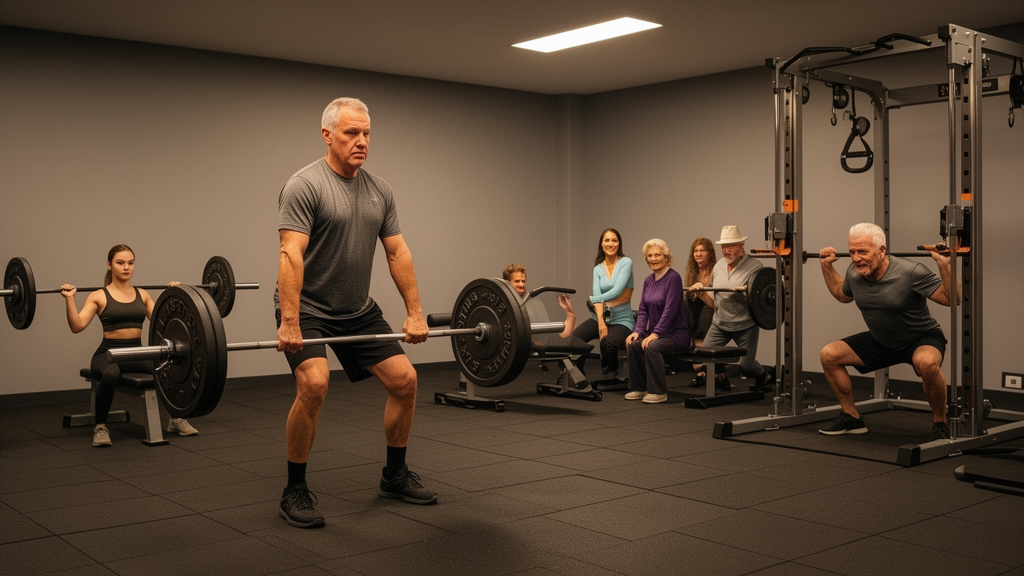
Researchers have published new reference values for the squat, bench press and deadlift among recreationally trained and strength-interested individuals aged 12 to 79 years, offering contemporary benchmarks for three of the most widely performed barbell exercises. The study, published in BMC Sports Science, Medicine and Rehabilitation, was led by Michael Clark, Christopher Latella and Daniel van den Hoek and appeared online on 23 October 2026.
The work was designed to develop reference values for the three lifts and to describe how estimated relative strength varies by sex and age.
The study was cross-sectional and analysed user-reported data collected between 1 January and 31 December 2024 by Strength Level Limited. Submissions included the lifter’s sex, age, body mass, the load lifted and the number of repetitions completed. To be included, participants had to be at least 12 years old, to have entries for all three lifts logged on the same day from the same hashed IP address, and to have performed no more than 15 repetitions per set.
From these submissions the researchers calculated estimated one-repetition maximums, or e1RMs, using the Brzycki and Epley equations, with interpolation applied between 8 and 10 repetitions. Relative strength was then expressed as the estimated one-repetition maximum divided by body mass, in kilograms per kilogram of body mass, and percentile norms were generated separately for males and females across age groups.
The distribution of all three lifts was right-skewed, meaning that most lifters clustered at lower values while a smaller number achieved much higher results. Males showed both higher estimated one-repetition maximums and greater variability in performance than females.
Age patterns differed between the sexes. In males, relative strength was greater in young adulthood than in adolescence, and lower values were observed in middle-aged and older adults. In females, relative strength was similar in adolescence and young adulthood, with lower values again seen in middle-aged and older adults.
The reported medians illustrate these patterns. Median relative squat strength was 1.77 kilograms per kilogram of body mass in young males compared with 1.38 in older males, while in females the corresponding figures were 1.30 in young adults and 0.99 in older adults. Because these are cross-sectional data, the age differences reflect comparisons between people of different ages at a single point in time rather than changes tracked within individuals over their lives.
The authors note that the findings provide contemporary benchmarks for squat, bench press and deadlift strength among recreational and strength-interested individuals.
Several limitations follow from the study design. The data were self-reported by users of a single platform, so loads, body masses and repetitions were not independently verified, and the sample included far more males than females. The one-repetition maximum values are estimates derived from submaximal repetitions rather than directly measured maximal lifts, and the inclusion criteria required entries for all three lifts on the same day, which may shape who is represented in the dataset.
By covering ages from 12 to 79 and reporting results separately for males and females, the reference values document how estimated relative strength in the three major lifts is distributed across a wide span of the recreational training population, from adolescence through older adulthood.
Subject of Research: Reference values for squat, bench press and deadlift strength in recreationally trained individuals aged 12 to 79 years
Article Title: Reference values for the squat, bench press and deadlift in recreationally trained and strength-interested individuals aged 12–79 years
Article References: Clark, M., Latella, C., & van den Hoek, D. (2026). Reference values for the squat, bench press and deadlift in recreationally trained and strength-interested individuals aged 12–79 years. BMC Sports Science, Medicine and Rehabilitation. https://doi.org/10.1186/s13102-026-02195-6
Image Credits: AI Generated
DOI: 10.1186/s13102-026-02195-6
Keywords: strength training, powerlifting, squat, bench press, deadlift, one-repetition maximum, relative strength, reference values, percentile norms, cross-sectional study, sex differences, ageing
News Source: Beatrice Stafford. (October 29, 2026). New benchmarks reveal how squat, bench press and deadlift strength varies from age 12 to 79. Scienmag.