


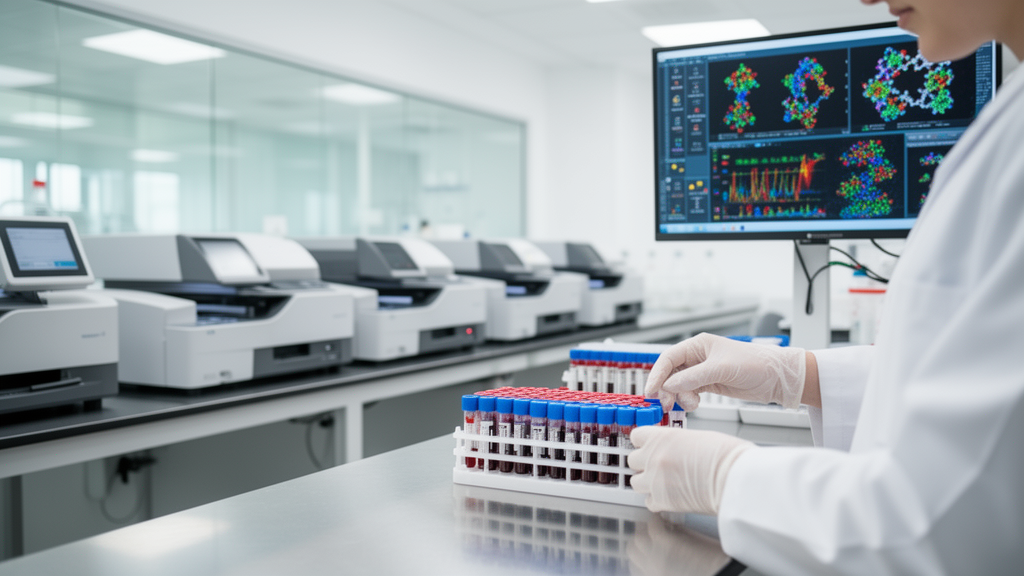
Clinical biochemistry supplies roughly 70 percent of the objective data used in medical decision-making, yet the integration of artificial intelligence, machine learning, and large language models into laboratory operations remains fragmented. A new open-access paper in BMC Health Services Research introduces the biochemistry–AI Stewardship Maturity (BASM) framework, a system-level maturity model designed to link laboratory analytics, AI governance, and health-service outcomes in a single structured roadmap.
The framework was developed by Mobin Sokhanvar and Alireza Nourazarian through a scoping review conducted according to PRISMA-ScR guidance. The review searched six databases—MEDLINE, Embase, Scopus, Web of Science, IEEE Xplore, and Cochrane—covering January 2022 to July 2026. From 1,482 records identified, 29 sources were retained after dual-independent screening, with an inter-rater agreement of Cohen’s kappa equal to 0.86.
The authors argue that existing digital-health maturity constructs, including HIMSS EMRAM, HITI, and CAMM, do not jointly address analytical metrology, algorithmic lifecycle governance, and clinical outcome accountability. Without a model that spans all three, laboratories lack a structured way to plan, benchmark, and audit AI-augmented diagnostic stewardship, the paper states.
BASM resolves maturity across seven dimensions: analytical foundations, data infrastructure, algorithmic lifecycle governance, diagnostic stewardship, workforce competency, equity and safety, and outcome accountability. These dimensions are resolved into five ordinal tiers, labeled BASM-1 through BASM-5, each accompanied by transition milestones set at 12 to 24 months.
A distinctive feature of the model is its chain of custody aggregation rule, which prevents high analytical scores from masking governance or equity deficits. In other words, a laboratory cannot reach a high overall maturity rating on the strength of strong analytical performance alone if its algorithmic oversight or equity safeguards fall short.
Alignment with established reporting standards is embedded at the upper tiers.
The development process included face validation of the framework with five laboratory directors, alongside structural comparisons against four precedent maturity models. Charted evidence from the review was triangulated with position statements from IFCC, ADLM, CAP, and CLSI, and consolidated into the seven-dimension rubric that underpins the final model.
According to the authors, BASM offers laboratories, health systems, and regulators an actionable, standards-aligned instrument for planning, benchmarking, and auditing AI-augmented diagnostic stewardship.
The authors are explicit that the current work is a development and face-validation study, not a full validation. A multi-institutional modified-Delphi validation is identified as the priority next step, meaning the framework’s practical performance across institutions has yet to be tested. The article was published on 23 October 2026 and is available open access.
Subject of Research: Development of the BASM maturity framework for AI-augmented clinical biochemistry laboratories
Article Title: A maturity model for AI-augmented clinical biochemistry: the BASM framework for diagnostic stewardship, algorithmic governance, and health-service outcomes
Article References: Sokhanvar, M., & Nourazarian, A. (2026). A maturity model for AI-augmented clinical biochemistry: the BASM framework for diagnostic stewardship, algorithmic governance, and health-service outcomes. BMC Health Services Research. https://doi.org/10.1186/s12913-026-15923-y
Image Credits: AI Generated
DOI: 10.1186/s12913-026-15923-y
Keywords: clinical biochemistry, artificial intelligence, maturity model, BASM framework, diagnostic stewardship, algorithmic governance, laboratory medicine, health services research, scoping review, TRIPOD + AI, machine learning, large language models
News Source: Blake Davidson. (October 29, 2026). New BASM framework charts a maturity path for AI in clinical biochemistry labs. Scienmag.



