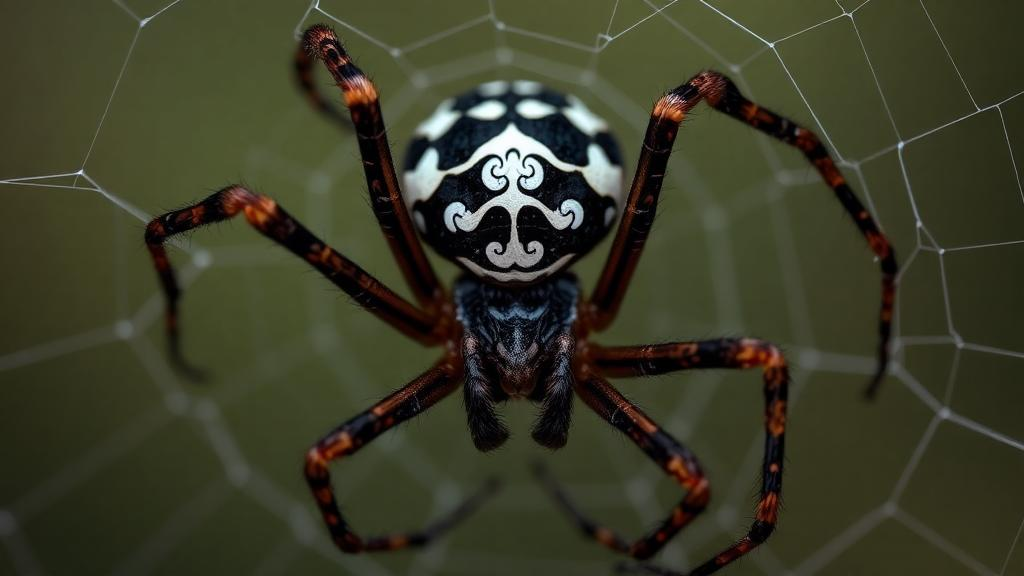
A striking new genus of orb-weaving spider from southern Australia has been formally described, and it comes with a pop-culture twist: the spider’s black-spotted abdomen reminded its discoverers of the head of Venom, the Marvel Comics antihero, so the genus has been named Venomius. The type species, Venomius tomhardyi, carries a second tribute in its species epithet, honouring the English actor Tom Hardy, who plays Eddie Brock and his alien alter ego in the Venom films. The description, published in the journal Evolutionary Systematics, is the work of arachnologists conducting an ongoing revision of Australia’s orb-weaver fauna, and it documents a spider so anatomically unusual that it could not be placed in any existing genus.
The orb-weaver family Araneidae is the third-largest spider family in Australia, with 223 described species in 41 genera, and it ranks similarly on the world stage, where 3,125 species in 189 genera are recognised. Despite this diversity, the family’s delimitation remains controversial, particularly with respect to its basal clades. Genus-level diversity is high, and many Australian araneid genera contain only a handful of species. Fifteen of the country’s araneid genera include five or fewer species, and before this study four were monotypic: Abba, Cyrtobill, Lariniophora and Quokkaraneus. Venomius now becomes the fifth monotypic araneid genus in Australia, a decision the authors say was made only after careful consideration and an extensive examination of material in Australian and overseas collections.
The study rests on an enormous foundation of prior work. Since 2005, the researchers have been revising Australian Araneidae, and the new description draws on the examination of more than 12,000 araneid records, or vials, in museum collections. Although the new species had already been known from a few museum records, the project was triggered by specimens collected during a recent field trip targeting orb-weaving spiders in southern Australia. There, the team encountered large numbers of an unusual species that displayed none of the diagnostic features, or synapomorphies, of any recently revised genus, nor of any other genus known to them.
Somatically, the new spider resembles the leaf-curling orb-weavers of the genera Phonognatha and Leviana, thanks to a similar elongate, cylindrical abdomen without humeral or posterior humps, and a comparable colouration of dark brown to black markings on a paler background. But the resemblance ends there. The genital morphology of both sexes is vastly different from any of these genera, and, tellingly, the new species was never observed to include a rolled leaf in its web, the behaviour that gives leaf-curling spiders their name. Because of its highly derived characters, the authors were unable to place the species in any established subfamily of orb-weavers or any of the informal clades proposed in recent phylogenetic work on the family.
The technical diagnosis hinges on several remarkable features of the male pedipalp, the modified limb that spiders use to transfer sperm. Most unusual are two strong, elongated macrosetae on the pedipalp tibia, a modification that is exceedingly rare in araneids. Indeed, the authors know of only one other araneid with tibial modifications, the New Zealand species Courtaraneus orientalis, which bears two complex, basally articulated tibial apophyses that may be homologous to the macrosetae of the new genus. The male pedipalp sclerites are also complex, with two newly recognised structures on the stipes: a transverse median keel and a rounded basal protrusion. Other diagnostic characters include a conspicuous finger-like paracymbium and a strongly sclerotised, canoe-shaped median apophysis. In females, the epigyne is wholly covered by a broad scape bearing a short median process, a shape unlike that of any related Australian genus.
The methods behind these observations reflect the precision of modern spider taxonomy. Male pedipalps were expanded by alternately submerging them in 10 percent potassium hydroxide and distilled water for around ten minutes until fully expanded, and female epigynes were cleared in the same solution. Because the araneid pedipalp is twisted so that the cymbium sits mesally, the full view of the bulb is described as retrolateral, a convention the authors follow in their terminology. Microscopic photographs were taken at different focal planes with a Leica DMC4500 digital camera mounted on a Leica M205C stereomicroscope and combined using Leica Application Suite X, with plates edited in Photoshop. Measurements were recorded in millimetres to an accuracy of one tenth of a millimetre, except for eye and labium measurements, which were taken to one hundredth of a millimetre. Distribution maps were compiled in QGIS, with coordinates for field-collected specimens approximated in Google Earth Pro and museum data extracted from original labels or registration records.
Morphologically, Venomius tomhardyi is a medium-sized orb-weaver with pronounced sexual dimorphism. Males measure roughly 5.5 to 6.4 millimetres in total length, while females reach 9.1 to 11.7 millimetres. The carapace is considerably longer than wide and pear-shaped, ranging from orange-brown in males to entirely black in females. The abdomen is elongate and cylindrical, somewhat narrower at the front, and carries three pairs of conspicuous black sigillae, with the median pair somewhat larger. Dorsally, the abdomen shows a pale yellow background, coated by three large longitudinal black streaks in males, that expands to a large black patch posteriorly in both sexes. It is this pattern of black spots and streaks on the male holotype that evoked the head of the character Venom, with its conspicuous black markings, and inspired the generic name.
The species has so far been found in northern Tasmania, Victoria, south-eastern South Australia and south-western Western Australia, revealing a broad distribution across southern Australia. The holotype, a male, was collected in January 2023 at the Trevallyn Nature Recreation Area in Launceston, Tasmania. There is no clear phenological pattern in the collection data, with mature males and females recorded in October, December, January, April and June. Colour varies slightly among specimens, particularly females, with the carapace ranging from dark brown to black and the posterior black abdominal field varying in size.
The life history of the new spider is as distinctive as its anatomy. Most specimens were found in vertical, circular orb-webs at about one to two metres above the ground in bushland or forest habitat, often near the coast. The webs were found at night, most of them on exposed branches of trees, especially dead branches or fallen trees, but sometimes near trunks inside the leaf cover. The webs typically had a signal line connecting the hub to the supporting branches, and sometimes to silk-lined holes in the branches, particularly in the case of females and large juveniles. When disturbed, the spiders quickly followed the signal line and disappeared into these holes. During the day, they were found hiding inside the holes or on tree branches after absorbing their webs, and males were spotted at the silk scaffolding of female webs at night.
This retreat behaviour may explain the spider’s peculiar body shape. The authors hypothesise that the elongate cylindrical abdomen of Venomius tomhardyi, which it shares with leaf-curling spiders despite not building a leaf retreat, is an adaptation to the restricted space of the silk-lined hollows in branches that it occupies, a behaviour similar to that of some members of the genus Paramatachia in the family Desidae, which occupy vacated hollows of wood-boring insects. If correct, this would mean the abdominal shape has evolved convergently in at least three different araneoid lineages. The highly derived characters of the new genus, including the tibial macrosetae, the unique median keel and basal protrusion on the stipes, and the distinctive female epigyne, justify the erection of a new genus and will improve its diagnosability in future identification keys of Australian orb-weaving spiders. The authors will explore the phylogenetic relationships of Venomius and Courtaraneus in an upcoming molecular phylogenetic study focused on Australasian orb-weavers, ensuring that this Venom-inspired spider will have a starring role in the evolutionary story of its family.
Subject of Research: Taxonomy and systematics of Australian orb-weaving spiders
Article Title: Venomius , a new monotypic genus of Australian orb-weaving spiders ( Araneae , Araneidae )
Article References: Rossi, G. D. F., Castanheira, P. D. S., Baptista, R. L. C., & Framenau, V. W. (2023). Venomius, a new monotypic genus of Australian orb-weaving spiders (Araneae, Araneidae). Evolutionary Systematics, 7(2), 285-292. https://doi.org/10.3897/evolsyst.7.110022
Image Credits: AI Generated
DOI: 10.3897/evolsyst.7.110022
Keywords: Venomius, Araneidae, orb-weaving spiders, Australia, taxonomy, new genus, Tom Hardy, Venom, spider morphology, Evolutionary Systematics, monotypic, genus
News Source: Drew Townsend. (October 19, 2026). New Australian orb-weaver genus Venomius named after Marvel’s Venom. Scienmag.