• HOME
  • NEWS
  • EXPLORE
    • CAREER
      • Companies
      • Jobs
    • EVENTS
    • iGEM
      • News
      • Team
    • PHOTOS
    • VIDEO
    • WIKI
  • BLOG
  • COMMUNITY
    • FACEBOOK
    • INSTAGRAM
    • TWITTER
Thursday, September 24, 2026
BIOENGINEER.ORG
No Result
View All Result
  • Login
  • HOME
  • NEWS
  • EXPLORE
    • CAREER
      • Companies
      • Jobs
        • Lecturer
        • PhD Studentship
        • Postdoc
        • Research Assistant
    • EVENTS
    • iGEM
      • News
      • Team
    • PHOTOS
    • VIDEO
    • WIKI
  • BLOG
  • COMMUNITY
    • FACEBOOK
    • INSTAGRAM
    • TWITTER
  • HOME
  • NEWS
  • EXPLORE
    • CAREER
      • Companies
      • Jobs
        • Lecturer
        • PhD Studentship
        • Postdoc
        • Research Assistant
    • EVENTS
    • iGEM
      • News
      • Team
    • PHOTOS
    • VIDEO
    • WIKI
  • BLOG
  • COMMUNITY
    • FACEBOOK
    • INSTAGRAM
    • TWITTER
No Result
View All Result
Bioengineer.org
No Result
View All Result
Home NEWS Science News

New approach to exotic quantum matter

Bioengineer by Bioengineer
September 22, 2020
in Science News
Reading Time: 2 mins read
0
IMAGE
Share on FacebookShare on TwitterShare on LinkedinShare on RedditShare on Telegram

IMAGE

Credit: ICFO

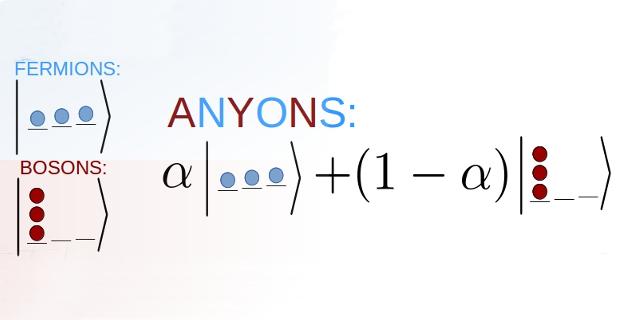
While in a three-dimensional world, all particles must be either fermions or bosons, it is known that in fewer dimensions, the existence of particles with intermediate quantum statistics, known as anyons, is possible. Such fascinating objects are strongly believed to exist as emerging quasiparticles in fractional quantum Hall systems, but despite great efforts, experimental evidence of anyons has remained very limited. Since quantum statistics is defined through the behavior of the phase of the wave function, when two identical particles are exchanged, early attempts of anyon detection have been based on interferometric measurements using Fabry-Perot interferometry or beamsplitter experiments.

So far, there have been many efforts to improve the experimental evidence of anyons by searching for ways to study the FQH effect and understand its underlying physics in highly controllable quantum systems such as cold atoms or photonic quantum simulators. There are studies that have shown that light-matter interactions can create and trap fractional quasiparticles in atomic gases or electronic systems and measure, through time-of-light imaging, signatures of fractional statistics carried by the total angular momentum of a fractional quantum Hall system.

In a recent study published in Physical Review Letters, ICFO researchers Tobias Grass, Niccolo Baldelli, and Utso Bhattacharya, led by ICREA Prof. at ICFO Maciej Lewenstein, and in collaboration with Bruno Julia-Díaz, from the University of Barcelona, describe a new approach towards anyon detection, which is a crucial element for increasing our knowledge of exotic quantum matter.

Contrary to earlier detection schemes, the study authored by the researchers opens up a new possibility which requires neither particle exchange nor interferometry. Instead, the authors suggest to trace the behavior of the anyons by binding impurity particles to them. Specifically, the average angular momentum of a single impurity is shown to take characteristic values that are possibly fractional. For a system of multiple impurities, the total angular momentum should then depend on how these effective single-impurity levels are filled. Strikingly, the value obtained by the authors corresponds neither to the filling of a Fermi sea nor to the condensation of a bosonic mode. Instead, the impurity angular momentum interpolates between these limiting cases, and the fractional statistical parameter of the anyons can be straightaway inferred from this interpolation.

Their detection scheme only requires density measurements and might be applicable to Abelian quantum Hall phases in electronic materials as well as in photonic or atomic quantum simulators. The authors discuss also possible generalizations towards non-Abelian anyons. Since the impurities realize a non-interacting gas of anyons, their work also poses the possibility of studying the intricate thermodynamics of anyonic systems.

###

Media Contact
Alina Hirschmann
[email protected]

Related Journal Article

http://dx.doi.org/10.1103/PhysRevLett.125.136801

Tags: Chemistry/Physics/Materials SciencesNanotechnology/MicromachinesNuclear PhysicsOptics
Share12Tweet8Share2ShareShareShare2

Related Posts

How Tumor Metabolism Decides Whether Colorectal Cancer Immunotherapy Works

September 24, 2026
MicroRNA miR-196a Clears Toxic Huntington’s Protein Clumps by Suppressing Rad23b

MicroRNA miR-196a Clears Toxic Huntington’s Protein Clumps by Suppressing Rad23b

September 24, 2026

Stem Cell Screening Platform Hunts for Drugs to Halt Cardiac Fibrosis

September 24, 2026

Sierra Leone finds outbreak response, not detection, is where precious days are lost

September 24, 2026
Please login to join discussion

POPULAR NEWS

  • How Tumor Metabolism Decides Whether Colorectal Cancer Immunotherapy Works

    29 shares
    Share 12 Tweet 7
  • MicroRNA miR-196a Clears Toxic Huntington’s Protein Clumps by Suppressing Rad23b

    29 shares
    Share 12 Tweet 7
  • Stem Cell Screening Platform Hunts for Drugs to Halt Cardiac Fibrosis

    29 shares
    Share 12 Tweet 7
  • Sierra Leone finds outbreak response, not detection, is where precious days are lost

    29 shares
    Share 12 Tweet 7

About

We bring you the latest biotechnology news from best research centers and universities around the world. Check our website.

Follow us

Recent News

How Tumor Metabolism Decides Whether Colorectal Cancer Immunotherapy Works

MicroRNA miR-196a Clears Toxic Huntington’s Protein Clumps by Suppressing Rad23b

Stem Cell Screening Platform Hunts for Drugs to Halt Cardiac Fibrosis

Subscribe to Blog via Email

Enter your email address to subscribe to this blog and receive notifications of new posts by email.

Join 85 other subscribers
  • Contact Us

Bioengineer.org © Copyright 2023 All Rights Reserved.

Welcome Back!

Login to your account below

Forgotten Password?

Retrieve your password

Please enter your username or email address to reset your password.

Log In
No Result
View All Result
  • Homepages
    • Home Page 1
    • Home Page 2
  • News
  • National
  • Business
  • Health
  • Lifestyle
  • Science

Bioengineer.org © Copyright 2023 All Rights Reserved.