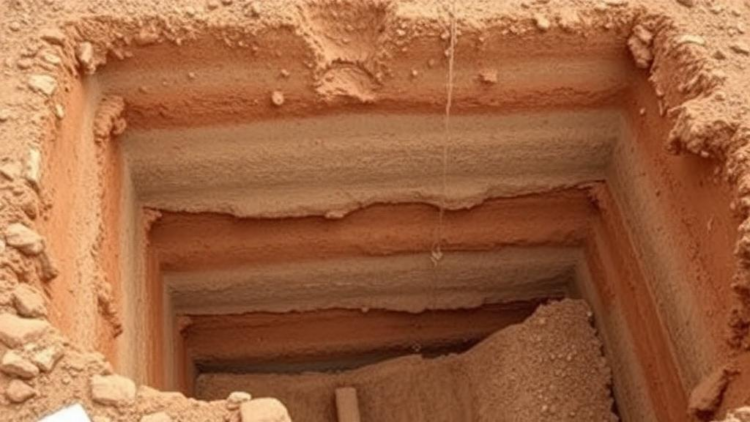
As cities run out of room at the surface, engineers are digging ever deeper, carving out metro stations, basements and utility galleries tens of metres below crowded streets. The deeper the pit, the harder it becomes to predict how the retaining walls that hold back the ground will bend and shift, and a miscalculation can crack roads, damage neighbouring buildings or worse. A team of Chinese researchers has now unveiled an analytical method that promises markedly more accurate forecasts of wall movement in these extreme conditions, and their results, published in the journal Results in Engineering, show predictions that track field measurements to within about five percent.
The challenge begins with the ground itself. Deep urban excavations rarely pass through uniform soil. Instead, a wall might thread through soft clay sandwiched between dense sands and stiff silts, and at each interface the earth pressure pushing on the structure can change abruptly. Soft layers tend to let the wall bulge outward and concentrate bending moments, while hard layers push back with strong constraint reactions. Traditional design models, which typically assume a smooth, linearly distributed pressure, simply cannot capture these jumps, and the discrepancies between calculated and observed deformation grow most pronounced precisely where projects are deepest and most demanding.
A second blind spot concerns the walls themselves. To resist enormous pressures at depth, engineers build ever thicker diaphragm walls, and thick structures do not behave the way classical beam theory assumes. Conventional models idealise the retaining wall as an Euler-Bernoulli beam, which accounts only for bending-induced rotation and ignores shear deformation, the internal sliding of one cross-section past another. For slender walls in shallow pits this simplification is harmless, but for the massive walls of deep excavations it introduces real error. Earlier work on shear effects had focused on buckling and boundary conditions rather than on the coupled bending-shear response of braced retaining structures in layered ground.
The research team, led by Jun Guan, Zejia Wu and Yanbin Fu, built a model that tackles both problems at once. Above the excavation level, the wall is loaded by an active earth pressure that depends on the wall’s own displacement, so the pressure redistributes as the wall moves, a feedback loop that conventional approaches freeze out. Below the excavation level, the embedded portion of the wall is treated as a Timoshenko beam resting on a Winkler elastic foundation, with soil resistance described by the widely used m-method, in which the ground’s reaction stiffness grows linearly with depth. Internal struts are represented as elastic supports whose reaction depends on their pre-applied force and stiffness, and the wall is sliced into computational segments at every strut location, soil-layer interface and current excavation level so that each segment sits within a single soil layer with a definite set of parameters.
Assembling these ingredients yields a fourth-order nonhomogeneous linear differential equation with variable coefficients for the wall’s horizontal displacement, an equation far too unwieldy for closed-form treatment by standard techniques. Rather than resorting to finite element modelling, which demands fresh meshing and re-analysis for every new project and excavation stage, the researchers turned to a power series method. They expressed the deflection of each wall segment as an infinite series, substituted it into the governing equation, and matched coefficients of like powers of the depth coordinate to derive a constructive analytical solution. Boundary conditions at the wall ends, together with deformation compatibility and force equilibrium between adjacent segments, pin down the unknown coefficients, and the same procedure is applied below the excavation level with the appropriate foundation reaction terms.
A crucial theoretical step was proving that the resulting series actually converges. Using the ratio test, the team showed that the limit of the ratio of successive terms falls below one, guaranteeing convergence, and they demonstrated that a ten-term expansion already satisfies engineering accuracy requirements. This matters practically: once the governing equations and solution are established, engineers can analyse different excavation stages, stratigraphic conditions and boundary conditions simply by updating input parameters, with no repeated mesh generation or staged numerical modelling, making the method especially convenient for the multi-scenario and parametric studies that dominate real design workflows.
To test the model, the researchers turned to an ultra-deep excavation in Hangzhou, a rectangular pit 22.40 metres long and 10.80 metres wide, retained by a cast-in-place diaphragm wall 800 millimetres thick and embedded to a depth of 60.37 metres, with its toe socketed into weathered rock. Excavation proceeded in eleven stages down to a final depth of 46.2 metres, threading through eleven distinct strata ranging from fill and sandy silts to a very soft muddy clay, rounded gravel and argillaceous siltstone. The team validated their predictions against measured wall displacements during the final four excavation stages, when the wall was working hardest.
The results were striking. In stage 8, the measured maximum wall displacement was 43.14 millimetres; the new model predicted 45.76 millimetres, an error of 6.07 percent, while a conventional Euler-Bernoulli benchmark predicted 40.60 millimetres, off by 12.7 percent. In stage 9 the new model erred by only 4.67 percent against the benchmark’s 11.9 percent; in stage 10 by 5.02 percent against 12.9 percent; and in stage 11 by 4.03 percent against 11.4 percent. Even more impressive was the prediction of where the maximum displacement occurs, the depth that most concerns designers deciding where to place struts. The new model located the critical depth within two metres of the measured value in every stage, and in stage 10 it was off by just 0.07 metres, whereas the benchmark consistently placed the bulge several metres too deep.
The parametric studies added further insight. Comparing simulations at excavation depths from 31 to 37 metres, the team found that shear deformation matters most in the segment between the lowest strut and the excavation surface, where it can account for up to 9.6 percent of total displacement when the ratio of that segment’s length to the wall thickness falls between roughly 0.85 and 4.17. Outside that range the shear effect fades to near insignificance, meaning the classical model remains a useful simplification for overall trends but must be supplemented in the critical zone. A separate comparison showed why accounting for layered ground is essential: when the model was reduced to assume homogeneous, linearly distributed earth pressure, it placed the maximum displacement depth 10 percent away from the field measurement, while the full heterogeneous model was within 2 percent. A scenario in which the properties of the soft sixth soil layer were modified shifted the maximum displacement magnitude by 12.13 percent and moved its depth upward by 8.03 percent, underscoring how sensitive deep walls are to local stratigraphic changes.
The authors are careful to note the model’s scope. It addresses monotonic inward wall movement during normal staged excavation and does not yet explicitly capture reversed wall movement, unloading-reloading behaviour, soil-structure separation or the progressive mobilisation of ultimate passive resistance, and the independent effects of individual soil parameters such as unit weight, cohesion and friction angle call for further controlled-variable study. Even so, the combination of displacement-dependent earth pressure, layered-strata handling and Timoshenko shear coupling, delivered as a fast, convergent analytical formula rather than a bespoke numerical model, offers deep-urban projects something they have lacked: a rigorous first-pass tool that tells engineers not just how far a wall will move, but exactly where it will move most, and therefore where to concentrate the bracing that keeps a city’s underground ambitions safe.
Subject of Research: Analytical prediction of lateral displacement of retaining structures in deep urban excavations
Article Title: Analytical formulation for lateral displacement of retaining structures in deep underground space and its application
Article References: Guan, J., Wu, Z., Zhang, B., Gu, J., Chen, F., Yelv, G., Zhou, Y., & Fu, Y. (2026). Analytical formulation for lateral displacement of retaining structures in deep underground space and its application. Results in Engineering, 32, Article 113205. https://doi.org/10.1016/j.rineng.2026.113205
Image Credits: AI Generated
DOI: 10.1016/j.rineng.2026.113205
Keywords: deep excavation, retaining structures, Timoshenko beam, earth pressure, soil-structure interaction, diaphragm wall, power series solution, shear deformation, underground space, geotechnical engineering, Hangzhou case study, deformation prediction
Cite Scienmag News
APA MLA Chicago
Denise Maddox. (October 3, 2026). New Analytical Model Predicts Wall Movement in Ultra-Deep Urban Excavations. Scienmag. https://scienmag.com/new-analytical-model-predicts-wall-movement-in-ultra-deep-urban-excavations/
Denise Maddox. “New Analytical Model Predicts Wall Movement in Ultra-Deep Urban Excavations.” Scienmag, 3 October 2026, https://scienmag.com/new-analytical-model-predicts-wall-movement-in-ultra-deep-urban-excavations/. Accessed 3 October 2026.
Denise Maddox. “New Analytical Model Predicts Wall Movement in Ultra-Deep Urban Excavations.” Scienmag. October 3, 2026. https://scienmag.com/new-analytical-model-predicts-wall-movement-in-ultra-deep-urban-excavations/
Copy citation Download RIS
Tags: accuracy of excavation wall displacement forecastsadvanced earth pressure modeling in deep excavationsanalytical model for deep excavation stabilitydeep excavationdeep metro station construction geotechnical challengesDeep urban excavation wall movement predictiondeformation predictiondiaphragm wallearth pressurefield measurement validation of engineering modelsgeotechnical engineeringground soil heterogeneity impact on retaining wallsHangzhou case studyimpact of soft and hard soil interfaces on retaining structuresinnovations in underground excavation safety analysisnon-uniform soil layers influence on wall deformationpower series solutionretaining structuresshear deformationsoil-structure interactionTimoshenko beamultra-deep underground construction engineeringunderground spaceurban underground utility gallery design considerations