• HOME
  • NEWS
  • EXPLORE
    • CAREER
      • Companies
      • Jobs
    • EVENTS
    • iGEM
      • News
      • Team
    • PHOTOS
    • VIDEO
    • WIKI
  • BLOG
  • COMMUNITY
    • FACEBOOK
    • INSTAGRAM
    • TWITTER
Friday, September 25, 2026
BIOENGINEER.ORG
No Result
View All Result
  • Login
  • HOME
  • NEWS
  • EXPLORE
    • CAREER
      • Companies
      • Jobs
        • Lecturer
        • PhD Studentship
        • Postdoc
        • Research Assistant
    • EVENTS
    • iGEM
      • News
      • Team
    • PHOTOS
    • VIDEO
    • WIKI
  • BLOG
  • COMMUNITY
    • FACEBOOK
    • INSTAGRAM
    • TWITTER
  • HOME
  • NEWS
  • EXPLORE
    • CAREER
      • Companies
      • Jobs
        • Lecturer
        • PhD Studentship
        • Postdoc
        • Research Assistant
    • EVENTS
    • iGEM
      • News
      • Team
    • PHOTOS
    • VIDEO
    • WIKI
  • BLOG
  • COMMUNITY
    • FACEBOOK
    • INSTAGRAM
    • TWITTER
No Result
View All Result
Bioengineer.org
No Result
View All Result
Home NEWS Science News Chemistry

New aluminium hydroxide stable at extremely high pressure

Bioengineer by Bioengineer
December 10, 2019
in Chemistry
Reading Time: 2 mins read
0
IMAGE
Share on FacebookShare on TwitterShare on LinkedinShare on RedditShare on Telegram

IMAGE

Credit: Ehime Univeristy


Hydrogen is the most abundant element in the universe and it plays important roles in the structure, dynamics, and evolution of the planets. Hydrogen is transported into deep mantle regions as a hydrous mineral via the subduction of oceanic plates. To better understand the global hydrogen circulation in the Earth’s mantle, a number of high-pressure experiments were conducted on the stability of hydrous phases under lower mantle conditions. Recent discoveries of new high-pressure hydrous minerals have extended the stability field of hydrous phases toward wider pressure, temperature and compositional ranges, suggesting the existence and the important roles of water in the deepest region of the Earth’s mantle. However, there have been few studies on hydrous minerals in the multicomponent system relevant to the actual subducting slabs under the pressure and temperature conditions of the lower parts of the Earth’s mantle and of those in other planetary interiors.

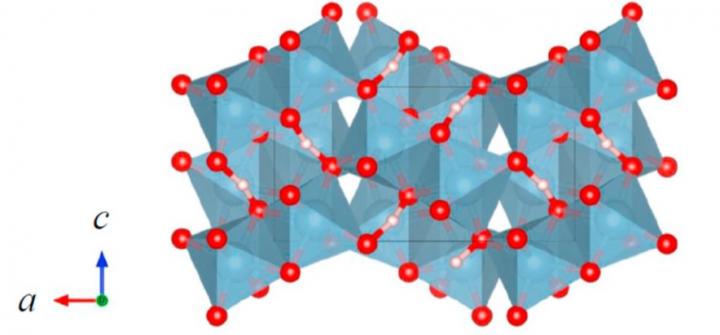
We conducted in-situ X-ray diffraction experiments on major hydrous phases in the Earth’s lower mantle, CaCl2-type ?-AlOOH, and its solid solutions with FeOOH and MgSiO4H2 at pressures up to ~270 GPa, far higher than those of the Earth’s mantle. High pressure-temperature (P-T) conditions were achieved by techniques using a multianvil (MA) apparatus and a laser-heated diamond anvil cell (DAC) in a wide range of pressures of up to 270 GPa and temperatures of up to 2,500 K (Table S1).

Above 190 GPa at 2500 K, we observed that ?-AlOOH transitioned to a new phase, named ?-AlOOH. We also found that hydroxides formed solid solutions over a wide composition range in the

AlOOH-FeOOH-MgSiO4H2 system, which accommodates the major elements in terrestrial rocks. Thus water could be stored in these hydroxides in the deep interiors of the Earth, terrestrial super-Earths, and the rocky cores of some icy planets, irrespective of their composition models.

###

Reference URL:

https://agupubs.onlinelibrary.wiley.com/doi/full/10.1029/2019JB018146

https://www.sciencedirect.com/science/article/pii/S0019103518306274

Media Contact
Public Relations Division
[email protected]

Related Journal Article

http://dx.doi.org/10.1029/2019JB018146

Tags: Geophysics/GravitySpace/Planetary Science
Share12Tweet8Share2ShareShareShare2

Related Posts

How AI Is Speeding the Hunt for Cheaper, Safer Sodium-Ion Battery Materials

How AI Is Speeding the Hunt for Cheaper, Safer Sodium-Ion Battery Materials

September 25, 2026
Forever chemicals found in Vietnam’s fish, but regulation has yet to catch up

Forever chemicals found in Vietnam’s fish, but regulation has yet to catch up

September 25, 2026

Chemists Use Vibrational Fingerprints to Sieve Carbon-13 Straight from CO2

September 25, 2026

Hidden Oxygen Vacancies at Chromium–Zinc Oxide Interfaces Drive Syngas-to-Olefins Catalysis

September 25, 2026
Please login to join discussion

POPULAR NEWS

  • AI Listens for Depression: Hybrid Speech Model Hits 95% Accuracy in Screening Study

    29 shares
    Share 12 Tweet 7
  • Transparent AI Model Hits 95% Accuracy in Choosing Immunotherapy for Head and Neck Cancer

    29 shares
    Share 12 Tweet 7
  • Immune Cell Fat Switch: Losing RORα Worsens Blinding Eye Disease in Mice

    29 shares
    Share 12 Tweet 7
  • Gene Networks Point to Interferon Decline as Driver of Severe Dengue in India

    29 shares
    Share 12 Tweet 7

About

We bring you the latest biotechnology news from best research centers and universities around the world. Check our website.

Follow us

Recent News

AI Listens for Depression: Hybrid Speech Model Hits 95% Accuracy in Screening Study

Transparent AI Model Hits 95% Accuracy in Choosing Immunotherapy for Head and Neck Cancer

Immune Cell Fat Switch: Losing RORα Worsens Blinding Eye Disease in Mice

Subscribe to Blog via Email

Enter your email address to subscribe to this blog and receive notifications of new posts by email.

Join 85 other subscribers
  • Contact Us

Bioengineer.org © Copyright 2023 All Rights Reserved.

Welcome Back!

Login to your account below

Forgotten Password?

Retrieve your password

Please enter your username or email address to reset your password.

Log In
No Result
View All Result
  • Homepages
    • Home Page 1
    • Home Page 2
  • News
  • National
  • Business
  • Health
  • Lifestyle
  • Science

Bioengineer.org © Copyright 2023 All Rights Reserved.