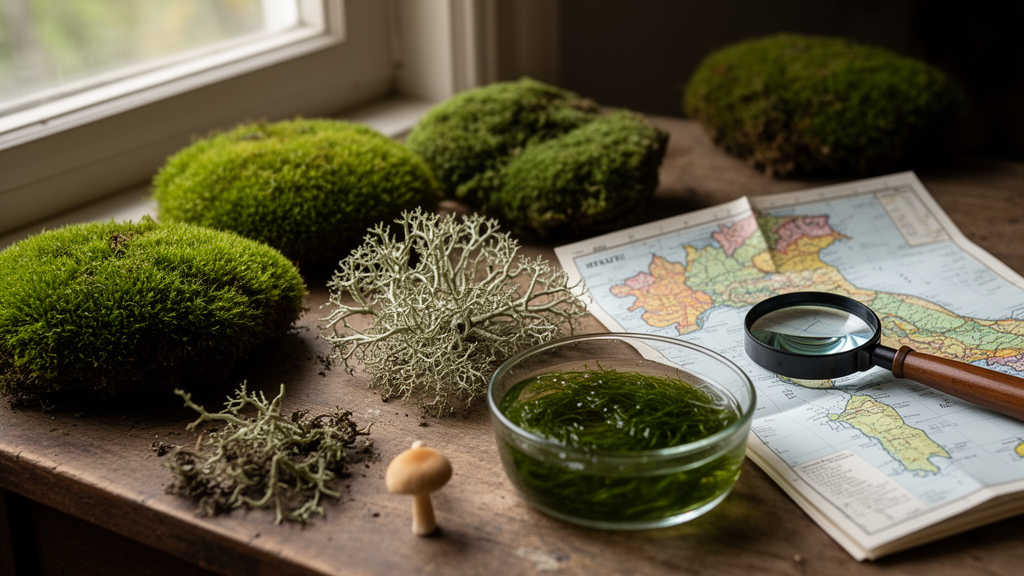
Italy’s botanical map has just been redrawn at its smallest scale. The twentieth installment of the Notulae to the Italian flora, published in Italian Botanist on 15 December 2025, assembles dozens of verified records for algae, bryophytes, fungi and lichens, including species new for entire regions, long-lost confirmations and a handful of exclusions. The contribution covers the algal genera Chara, Hildenbrandia, Pleurotaenium and Spirogyra, the bryophyte genera Braunia, Buxbaumia, Crossidium, Dicranum, Flexitrichum, Tortella and Ulota, the fungal genera Agaricus, Coltricia, Cortinarius, Gliophorus, Leucocoprinus, Leucotelium, Microbotryum, Phaeocalicium, Phragmidium and Polycoccum, and the lichen genera Anisomeridium, Arthonia, Chaenotheca, Cladonia, Graphis, Leptochidium, Melanelia, Rinodina, Scoliciosporum, Synalissa, Toninia and Trapelia. Each record is documented with locality, altitude, substrate, date and herbarium voucher, the technical backbone that makes these notulae more than a checklist.
The stonewort Chara gymnophylla is a headline for Calabria, where a small population was found in June 2023 along a disturbed trail in the Parco della Biodiversità Mediterranea near Catanzaro, at 260 metres. The plants were heavily incrusted with calcite and showed a condensed habit with shortened internodes, dense ecorticate branchlets bearing long unilateral bract-cells and conjoined gametangia. According to the current taxonomic treatment, the species is distinct from Chara vulgaris in having corticate branchlets with bract-cells and gametangia only between and at the top of the upper corticate segments, and distinct from Chara squamosa in having a tylacanthous axial cortex with short solitary spine cells. Previously known in Italy from Veneto, Liguria, Umbria, Lazio, Toscana, Sicilia and recently Abruzzo, the species now extends its regional footprint to the far south.
Chara squamosa itself delivered a broader surprise: a June 2025 population in a temporary alkaline oligotrophic pond at 1853 metres in Stelvio National Park, Valdidentro, in Sondrio, is the first record for Lombardia and, more broadly, for central-northern Italy. The pond sits on silty substrate of a fluvial terrace along the stream Acqua del Gallo, in contact with alpine pioneer Caricion bicoloris-atrofuscae formations characterized by Carex microglochin and Carex simpliciuscula. Until now the species was known in Italy only from Sicilia, Sardegna and Calabria. Two records of the red alga Hildenbrandia rivularis add Trentino-Alto Adige and Emilia-Romagna to its map, one in the River Brenta at Novaledo and one at the spring Nove Fontane on Monte Nero near Bedonia at 1509 metres. This shade-loving, epilithic red alga tolerates oligo- to eutrophic and saprobically unaffected to moderately affected waters, and historical records from Veneto, Toscana, Lake Garda and the central Apennines had never been formally published for the two new regions despite earlier spring surveys.
The desmid Pleurotaenium trabecula and the filamentous green alga Spirogyra neglecta are both new for Calabria and, in the case of the desmid, for southern Italy as a whole. Pleurotaenium trabecula turned up in August 2025 in a pond within a Calabrian pine forest in the Aspromonte at 1320 metres, used for the repopulation of the Apennine yellow-bellied toad. Spirogyra neglecta was collected in September 2025 in a puddle-fed pond at the base of a fountain near Pellaro, at 120 metres. The species is distinguished from the similar Spirogyra ternata by zygospore orientation and carries three chloroplasts making 2.5 turns of the cell. It is widespread across Europe from Britain to Ukraine, but in Italy only a pre-twentieth-century herbarium specimen from Piemonte existed on GBIF; the new collection is the first preserved specimen entirely in alcohol and therefore suitable for modern evaluation.
Among the bryophytes, the most emotionally resonant record concerns Buxbaumia viridis, the green shield-moss, a small epixylic species protected in Europe under Annex I of the Bern Convention and Annex II of the Habitat Directive 92/43/CEE. New collections on dead and rotting wood of Norway spruce and silver fir in the Modena Apennines and around Abetone in Pistoia confirm the species for Emilia-Romagna and Toscana after roughly 140 years, since the last original findings date to the nineteenth century. All more recent citations in older literature proved to be non-original references to those same nineteenth-century records. The rediscovery, driven by systematic survey of rotting conifer logs between roughly 1196 and 1545 metres, shows how dormant regional records can hide genuinely persisting populations.
Other mosses tell stories of rarity and taxonomy in flux. Braunia alopecura, classified as Vulnerable in the recent Italian Red List, was confirmed for Piemonte with abundant populations on sunny mafic granulite outcrops in the Ossola Valley, in geographical continuity with Swiss populations in Ticino and Graubünden. Crossidium squamiferum, a submediterranean species with no confirmations in Veneto and Molise since 1968, was refound on a sunny basaltic outcrop near Trissino and on a Molise road embankment; the Swiss Red List estimates a decline of more than 30 percent, although Italy currently classifies it as Least Concern. Dicranum flagellare, a saproxylic moss of rotting stumps, is new for Emilia-Romagna from a chestnut stump in the Modena Apennines and represents the southernmost record in Italy. Flexitrichum gracile, long confused with the related Flexitrichum flexicaule, is new for Abruzzo from plentiful limestone-outcrop populations in the Marsica mountains. In the Dolomites, three recent segregates of the Tortella tortuosa complex, Tortella angustifolia, Tortella commutata var. commutata and the cryophilous Tortella fleischeri, are all new for Veneto from limestone sites between 1870 and 2265 metres, while Ulota coarctata was confirmed for Trentino-Alto Adige on grey alder branches in the cold microclimate of the Lona-Lases valley, a first finding there since a 1904 historical report.
The fungal records combine classical morphology with molecular confirmation. Agaricus boisseletii, a rare species typically associated with cypress litter, was found in November 2023 in a graveyard garden at Arpaise in Benevento beneath Cupressus sempervivens; basidiomes turned wine-red on sectioning, and microscopic examination revealed distinctive catenulate cheilocystidia, making this the first record for Campania and for southern Italy. Coltricia cinnamomea, a funnel-shaped stipitate polypore with a rusty poroid hymenophore, was new for Calabria from the rocky vault of a mine near Mammola among holm oak roots. Cortinarius biriensis, previously known from Estonia and Norway, is new for Liguria from calcareous soil under white hornbeam and hazel; a newly generated nrITS sequence from the voucher shared 651 of 651 nucleotides, 100 percent identity, with the holotype sequence, and a BLAST analysis on the UNITE database returned an environmental sequence with 100 percent identity suggesting the species also occurs in Sicilia. Gliophorus irrigatus, formerly Hygrocybe unguinosa, is new for Calabria from the University of Calabria Botanical Garden among downy oak litter, and the greenhouse-familiar Leucocoprinus birnbaumii, the plant-pot dapperling with tropical origin, was formally recorded for Calabria at the base of an olive bonsai.
Rust and smut fungi added their own southern records. Leucotelium cerasi, a heteroecious rust with a hetero-macrocyclic life cycle, is new for Calabria from winter aconite leaves at Civita; Eranthis hyemalis hosts the haploid spermogonial and dikaryotic aecial stages, while uredia and telia form on Prunus species. Microbotryum majus, an anther smut of Silene otites, is new for Calabria from the Pollino National Park, where it replaces pollen with a powdery black-purple spore mass. Phragmidium sanguisorbae, monophagous on salad burnet, is new for Calabria from leaves collected in January 2025. The non-lichenized ascomycete Phaeocalicium compressulum, a minute stalked colonizer of alder twigs with laterally compressed capitula and no visible thallus, is new for Valle d’Aosta, Piemonte and Liguria from collections on grey alder in the western Alps, its distribution roughly tracking that of its phorophytes. Two lichenicolous Polycoccum species expanded their maps: Polycoccum pulvinatum, a gall-inducer specialized on Physcia dubia and Physcia caesia, is new for Piemonte, while Polycoccum sporastatiae, specialized on Sporastatia lichens of alpine rock faces, is new for Valle d’Aosta and Sardegna and confirmed for Trentino-Alto Adige, Lombardia and Piemonte, with most Italian reports dating back to the nineteenth century.
The lichen records carry both conservation weight and a citizen-science flourish. Arthonia granosa, a rare Mediterranean-Atlantic species doubtfully lichenized and mostly found on cork oak, is new for Toscana from the Lago di Burano reserve at sea level and is assessed as Vulnerable in the national Red List. Scoliciosporum pruinosum, an epiphyte of old oaks in humid forests with very low eutrophication, is new for Toscana and listed as Endangered in the Italian Red List of epiphytic lichens. Toninia plumbina, lichenicolous on the lichen Pectenia plumbea with a temperate-Atlantic to humid-Mediterranean distribution concentrated around the Tyrrhenian Sea, is new for Sicilia from the Ficuzza woods and classified as Near-Threatened. Leptochidium albociliatum, a gelatinous small-foliose lichen with white-haired lobes and granular isidia, is new for Toscana from ancient chestnut forest at the foot of Monte Amiata. Melanelia stygia, a circumpolar arctic-alpine lichen of siliceous rocks near and above the treeline, is new for Basilicata from Monte Volturino, as is Synalissa ramulosa from damp limestone at Monte Castello and Cladonia ramulosa from Monte S. Croce. Chaenotheca chrysocephala and Chaenotheca ferruginea, both previously known in Piemonte only from an 1880 record, were confirmed on larch bark in the Graian Alps. Anisomeridium polypori, identifiable in the field by pycnidia bearing a long thin appendage, is new for Campania, and Graphis pulverulenta is provisionally treated as distinct within the uncertain Graphis scripta complex. Rinodina albana is new for Calabria from beech bark, and Trapelia coarctata, a Holarctic early colonizer of siliceous pebbles, is new for Abruzzo thanks to a Facebook photograph spotted by lichenologist Pier Luigi Nimis, who requested a sample to confirm the identification, a vivid example of how citizen science now feeds formal floristic records.
Subject of Research: Notulae to the Italian flora of algae, bryophytes, fungi and lichens: 20
Article Title: Notulae to the Italian flora of algae, bryophytes, fungi and lichens: 20
Article References: Ravera, S., Vizzini, A., Cogoni, A., Totti, C., Agostini, M., Aleffi, M., Benesperi, R., Boccardo, F., Bonanno, R., Bonini, I., Cantonati, M., Capuano, A., Catalano, I., D’Aleo, F., De Giuseppe, A. B., Di Donatantonio, M., Di Nuzzo, L., Dose, S., Dovana, F., … Zotti, M. (2025). Notulae to the Italian flora of algae, bryophytes, fungi and lichens: 20. Italian Botanist, 20, 125-148. https://doi.org/10.3897/italianbotanist.20.177501
Image Credits: AI Generated
DOI: 10.3897/italianbotanist.20.177501
Keywords: Notulae, Italian, flora, algae, bryophytes, fungi, lichens, scientific research
News Source: Margaret Porter. (October 17, 2026). New algae, moss, fungal and lichen records reshape Italy’s hidden flora map. Scienmag.