

• HOME
  • NEWS
  • EXPLORE
    • CAREER
      • Companies
      • Jobs
    • EVENTS
    • iGEM
      • News
      • Team
    • PHOTOS
    • VIDEO
    • WIKI
  • BLOG
  • COMMUNITY
    • FACEBOOK
    • INSTAGRAM
    • TWITTER
Thursday, April 16, 2026
BIOENGINEER.ORG
No Result
View All Result
  • Login
  • HOME
  • NEWS
  • EXPLORE
    • CAREER
      • Companies
      • Jobs
        • Lecturer
        • PhD Studentship
        • Postdoc
        • Research Assistant
    • EVENTS
    • iGEM
      • News
      • Team
    • PHOTOS
    • VIDEO
    • WIKI
  • BLOG
  • COMMUNITY
    • FACEBOOK
    • INSTAGRAM
    • TWITTER
  • HOME
  • NEWS
  • EXPLORE
    • CAREER
      • Companies
      • Jobs
        • Lecturer
        • PhD Studentship
        • Postdoc
        • Research Assistant
    • EVENTS
    • iGEM
      • News
      • Team
    • PHOTOS
    • VIDEO
    • WIKI
  • BLOG
  • COMMUNITY
    • FACEBOOK
    • INSTAGRAM
    • TWITTER
No Result
View All Result
Bioengineer.org
No Result
View All Result
Home NEWS Science News Health

New advances in understanding and treating intellectual disorder

Bioengineer by Bioengineer
May 23, 2018
in Health
Reading Time: 2 mins read
0
Share on FacebookShare on TwitterShare on LinkedinShare on RedditShare on Telegram
IMAGE

Credit: Norifumi Shioda

Researchers at Tohoku University in Japan have investigated an intellectual disorder (ATR-X) syndrome to reveal its cause, mechanism and a potential therapeutic strategy to decrease associated cognitive impairment.

"Disease related neurodevelopmental disorders are rare and there is still a lack of therapy to treat the various syndromes," said Professor Kohji Fukunaga at the Graduate School of Pharmaceutical Studies, who led the study.

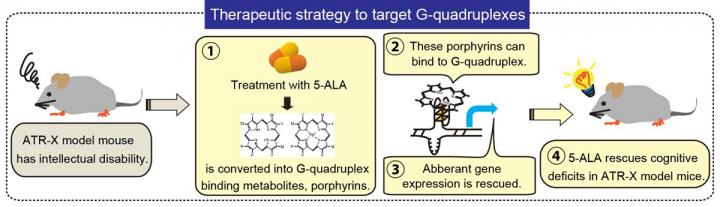
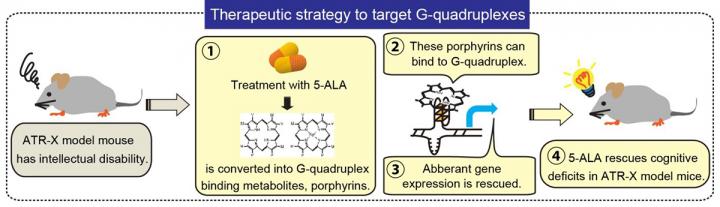
Alpha-thalassemia X-linked intellectual disability (ATR-X) syndrome is a severe intellectual disability caused by ATRX gene mutations. The researchers found that treatment with 5-aminolevulinic acid (5-ALA), which is converted into G-quadruplex-binding metabolites, rescues decreased synaptic plasticity and cognitive deficits seen in ATR-X model mice.

The findings suggest a potential therapeutic strategy to target G-quadruplexes and decrease cognitive impairment associated with ATR-X syndrome.

Among candidate ligands, 5-ALA has been applied clinically with minimal risk and approved for use following intracranial tumor resection in Europe, Canada, and Japan, where it has been used as a photosensitizer in photodynamic diagnostics applied in neurosurgery. These clinical applications potentially reduce the required approval time and cost of clinical trials, as pre-existing absorption, distribution, metabolism, excretion (ADME) and toxicity data are readily available.

The risk of failure is reduced as data relevant to 5-ALA safety and pharmacology is also available. The G-quadruplexes are involved in the pathology of other diseases and this discovery is expected to contribute to the possibility of new drug targets.

"5-aminolevulic acid is proven to be safe and is already used in supplements in Japan, so we are ready to begin clinical trials," says Fukunaga. "There is also evidence that it may improve autism spectrum disorders which is a common disease in Japanese children."

###

Media Contact

Kohji Fukunaga
[email protected]
@TohokuUniPR

http://www.tohoku.ac.jp/en/

Original Source

https://www.tohoku.ac.jp/en/press/treating_intellectual_disorder.html http://dx.doi.org/10.1038/s41591-018-0018-6


Share12Tweet8Share2ShareShareShare2

Related Posts

Brainwide Blood Volume Reveals Opposing Neural Activity

April 16, 2026

Oral Frailty in Seniors: Risks, Outcomes, Solutions

April 16, 2026

Foxes and Birds as Early Indicators for Tracking Antibiotic Resistance Spread in Ecosystems

April 16, 2026

Pink-1 Mutation Sparks Gut, Brain Cell Damage

April 16, 2026
Please login to join discussion

POPULAR NEWS

  • Scientists Investigate Possible Connection Between COVID-19 and Increased Lung Cancer Risk

    61 shares
    Share 24 Tweet 15
  • Boosting Breast Cancer Risk Prediction with Genetics

    47 shares
    Share 19 Tweet 12
  • Popular Anti-Aging Compound Linked to Damage in Corpus Callosum, Study Finds

    45 shares
    Share 18 Tweet 11
  • NSF funds machine-learning research at UNO and UNL to study energy requirements of walking in older adults

    95 shares
    Share 38 Tweet 24

About

We bring you the latest biotechnology news from best research centers and universities around the world. Check our website.

Follow us

Recent News

Brainwide Blood Volume Reveals Opposing Neural Activity

TLR7 Signature Uncovers Two Triple-Negative Breast Cancer Paths

Monolithic 3D Tantalum Pentoxide Nonlinear Photonics

Subscribe to Blog via Email

Enter your email address to subscribe to this blog and receive notifications of new posts by email.

Join 79 other subscribers
  • Contact Us

Bioengineer.org © Copyright 2023 All Rights Reserved.

Welcome Back!

Login to your account below

Forgotten Password?

Retrieve your password

Please enter your username or email address to reset your password.

Log In
No Result
View All Result
  • Homepages
    • Home Page 1
    • Home Page 2
  • News
  • National
  • Business
  • Health
  • Lifestyle
  • Science

Bioengineer.org © Copyright 2023 All Rights Reserved.
