


Credit: Fletcher/Queensland Brain Institute
Researchers at the University of Queensland have discovered that the thickness of the brain's outer layer influences how individual neurons process information.
The findings challenge the understanding of how brain circuits function throughout the brain.
The outer layer of the brain (the cortex), is made up of many smaller 'microcircuits' of brain cells, each consisting of around 10,000 neurons interacting in a space as small as 1 square millimeter. There is a longstanding theory that the neurons in these microcircuits function and interact in a very standard way so, by extension, all microcircuits must operate in largely the same way.
If this is the case, then if you can understand how one microcircuit works, then you can understand the rest.
Professor Stephen Williams and researcher Lee Fletcher of the Queensland Brain Institute (QBI) at UQ wanted to know if this is really true: does a defined class of neuron work the same no matter where they are located in the cortex?
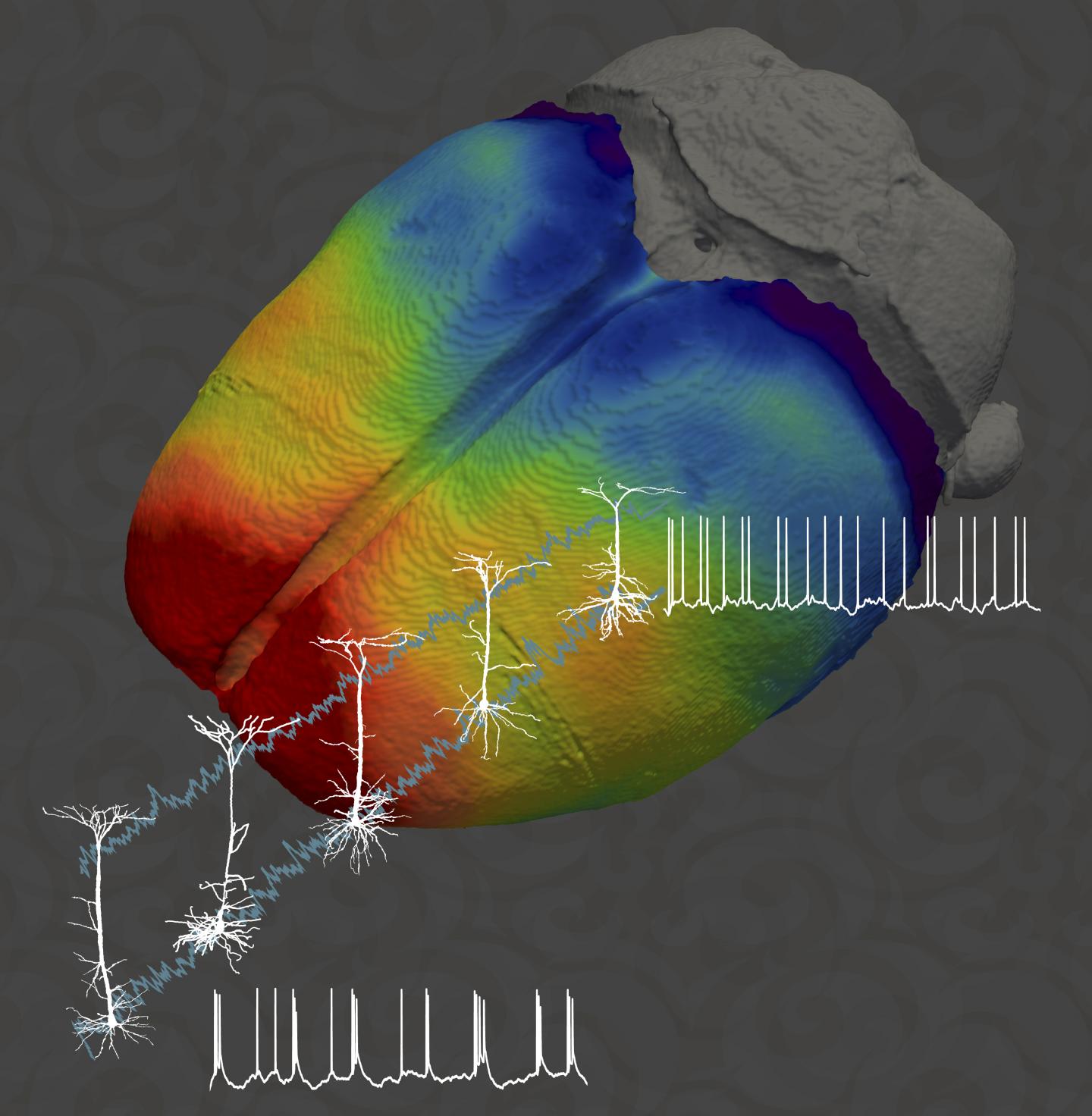
Using high resolution MRI imaging of the rodent brain they examined the structure of the cortex, and found that the thickness gradually increases up to 3-fold from the back of the brain to the front.
They also discovered gradual changes in thickness can be found even within a single functional area of the brain. For example, the front of the visual processing region is thicker than the back.
When Williams and Fletcher took an even closer look, they discovered that the thickness of the cortex directly relates to the length of individual neurons: a neuron in a thicker area of the cortex is more elongated than a neuron in a thinner area. This, in turn, raises a critical question, says Williams, "do they still work the same?"
He explains that to understand this, we need to take a step back and look at how the brain processes information.
An Important Comparison
In addition to processing sensory input, the brain also generates an internal model of the world, he says. Moreover, the brain continuously compares sensory information to its internal model.
In fact, it's thought that such comparisons happen even at the level of individual neurons, says Williams.
For a neuron to be able to compare information coming from two very different sources — the internal model and the senses — it needs two 'integration zones' that interact with each another.
One area of the neuron integrates information arriving from the internal model, and another integrates information coming in from the senses. Because they are separate, and interact, it's possible for a comparison to be made between the two types of information.
Williams and Fletcher examined the function of longer neurons from the thicker end of the visual cortex they found these neurons were operating as expected — they possessed two integration zones.
But this wasn't the case for the shorter neurons.
"It turns out that they work quite differently," says Williams. "Electrically they're even more distinct than we thought".
Indeed, the shorter neurons only have one integration zone for processing sensory information and the internal model. Consequently, they can't compare the two different types of input.
"One can perform comparative integration, the other can't," says Williams.
Thus, depending on which part of the cortex these neurons are found – thicker areas versus thinner areas – these neurons function very differently.
"Our work demonstrates that the thickness of the neocortex governs not only the anatomical structure of neurons, but also their electrical properties," says Fletcher.
"The findings reveal the complexity of computational strategies employed in neocortex, and suggests the neocortex is composed of computationally flexible circuits."
Williams adds, "These findings challenge foundation theories of the operation of the neocortex and set the stage for future research into how networks of these brain circuits operate."
The next step is to explore how these differences drive cognition and behavior, says Fletcher.
After all, given the importance of maintaining and updating our internal model of the world, why do some neurons opt out of this?
A High Speed System for Fast Reactions?
Williams says there are clues in the way rodents react to certain visual stimuli.
Different areas of the visual cortex survey distinct areas of visual space, he explains. The front of the visual cortex processes visual information coming from the space in front of the rodent, whereas the rear part of the visual cortex processes visual information from above and slightly behind the rodent.
Moreover, it's been shown that rodents are super sensitive to visual stimuli from above, as this tends to be where the predators are. If a shadow passes overhead, they freeze or run.
"Information processing may not be useful in such a system, rather what may be required is instinctive reaction," says Williams. "To detect and react to predators, a hardwired system that works efficiently and very fast may be of survival value."
"So one idea is that these small neurons are supersensitive to inputs coming in," says Williams, "that information will spread directly down to action potential output without the need for any further integration, forming a high speed system."
Indeed, the area of the visual cortex sensitive to stimuli from above is the thinner area, exactly where the shorter neurons are.
In other words, computationally flexible circuits that enable the brain to make comparisons between an internal model of the world and the senses, yet provide short cuts when needed are probably very useful for how animals can interact with a complex environment, but can react fast to survive.
###
The research has been published in the journal Neuron. https://doi.org/10.1016/j.neuron.2018.10.048
Media Contact
Dr Fiona McMillan
[email protected]
61-435-293-544
@uq_news
http://www.uq.edu.au
Related Journal Article
http://dx.doi.org/10.1016/j.neuron.2018.10.048

