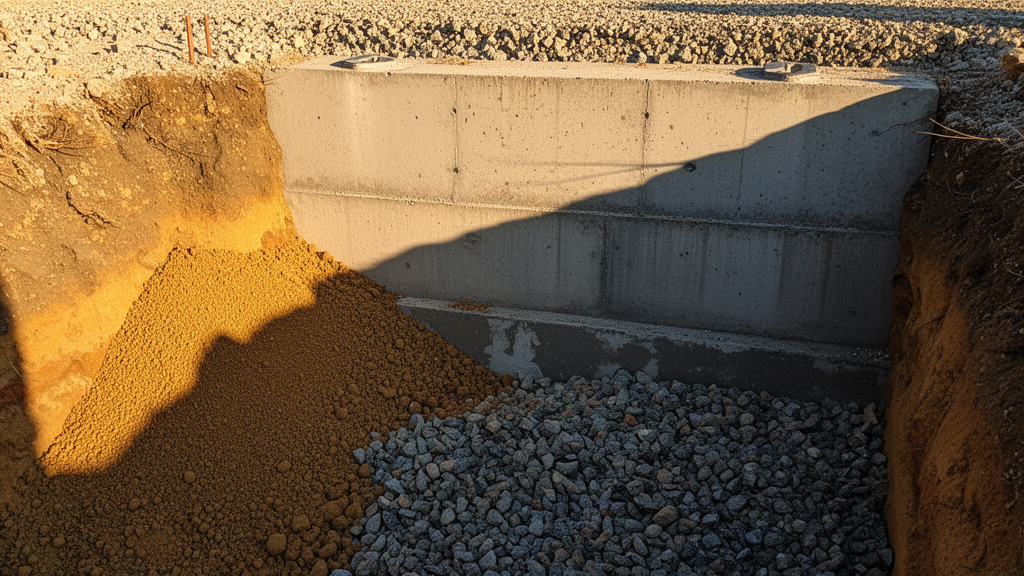
Civil and geotechnical engineering researchers have introduced a deep learning framework based on the multi-input neural operator architecture to rapidly and accurately evaluate the mechanical behavior of shallow strip foundations under vertical loads. Developed by investigators Tongtong Niu, Maosong Huang, and Jian Yu, the computational model leverages an enhanced Deep Operator Network, known as MIONet, to simultaneously predict entire non-linear load-displacement curves and two-dimensional vertical soil displacement fields across diverse soil and geometric configurations. Unlike conventional numerical simulations that demand extensive processing time for individual design variations, the trained neural operator completes inference in less than three seconds while delivering an overall relative L2 error of only 0.66 percent on unseen testing cases. By bypassing the computational bottleneck of iterative finite element remeshing, this offline learning framework provides structural and geotechnical engineers with an efficient mathematical surrogate capable of capturing complex high-dimensional deformations and soil-structure interactions without sacrificing ultimate bearing capacity accuracy.
Shallow foundations represent one of the most critical structural elements in civil engineering, serving the essential function of transferring architectural and superstructure loads directly onto near-surface ground formations. Among the various configurations of shallow foundations, strip footings are extensively deployed in low-rise residential and commercial buildings due to their comparatively modest construction costs, simplified technical requirements, and straightforward geometric placement. However, the safe and economical structural design of these systems hinges fundamentally on understanding how underlying soils deform and mobilize resistance beneath imposed structural weights. Foundation engineering problems inherently involve complex, interdependent phenomena where progressive downward foundation displacement induces lateral and vertical shear deformations throughout the adjacent soil mass. Consequently, establishing dependable computational tools that evaluate these continuous mechanical responses under varying geotechnical conditions remains an enduring research imperative.
Historically, geotechnical engineers have evaluated foundation stability through traditional ultimate bearing capacity formulas, beginning with the classical theoretical formulations pioneered by Karl Terzaghi in 1943. These conventional analytical frameworks, subsequently refined by researchers such as Meyerhof, Shield, and Chen, rely on standardized bearing capacity factors governed by soil internal friction angles to compute limit equilibrium thresholds. Furthermore, classical bearing capacity factor methods yield only a single ultimate failure threshold, leaving engineers without quantitative information regarding how ground reactions evolve as settlement progresses toward collapse. To overcome these analytical shortcomings, practitioners frequently turn to advanced numerical approaches, including finite element and finite difference methods. Yet numerical modeling carries significant computational burdens: whenever foundation burial depths, footing widths, surface surcharges, soil cohesion, or friction angles vary across design alternatives, numerical models require labor-intensive manual reconfiguration and complete computational remeshing.
To circumvent the repetitive expense of numerical simulations, engineering researchers have increasingly explored data-driven machine learning algorithms to model complex relationships between soil parameters and mechanical responses. Concurrently, physics-informed neural networks emerged as an alternative that trains networks by embedding governing partial differential equations, boundary conditions, and initial states directly into optimization loss functions via automatic differentiation. Although physics-informed networks avoid large labeled simulation datasets, they frequently encounter severe optimization non-convexity when applied to complex physical geometries. More critically, whenever geometric dimensions, boundary values, or load distributions change, physics-informed architectures must undergo complete retraining, severely diminishing their operational utility for real-time exploratory engineering analysis. Consequently, data-driven operator learning frameworks that directly map continuous functional parameter spaces to solution fields have emerged as an indispensable paradigm for simulating highly non-linear geotechnical mechanics.
The foundational architecture underlying the researchers’ new framework is the Deep Operator Network, or DeepONet, initially formulated by Lu and colleagues based on the universal approximation theorem for non-linear continuous operators. Unlike traditional deep neural networks that map finite-dimensional vector spaces, DeepONet approximates non-linear continuous mathematical operators that map infinite-dimensional input function spaces to infinite-dimensional output function spaces. The final scalar prediction is synthesized through an inner product of the branch and trunk network outputs combined with a trainable scalar bias. To accommodate independent physical parameters, the authors adopted MIONet, an advanced multi-input extension proposed by Jin and colleagues. MIONet incorporates multiple specialized branch networks whose separate output feature vectors undergo element-wise multiplication before matrix-multiplying the transposed coordinate encodings of the trunk network.
To establish an expansive parametric training dataset, the research team constructed a two-dimensional plane strain finite element simulation program within the commercial engineering software Abaqus. The mechanical model simulated a rigid strip footing resting upon a drained soft clay foundation characterized by varying cohesion and internal friction angle properties. To eliminate potential boundary constraint interference, lateral and bottom model boundaries were extended to distances exceeding five times the foundation width. Symmetrical domain partitioning was applied to reduce computational demands, and four-node bilinear plane strain quadrilateral elements were selected for spatial discretization. The contact interface between footing base and soil surface was modeled as completely rough to constrain lateral interface slip, matching classical Terzaghi assumptions. A uniform forced vertical displacement of one meter was imposed to ensure the soil mobilized its complete ultimate plastic failure capacity. Across three hundred automated simulation runs, foundation burial depth, footing width, soil cohesion, and friction angle were randomized, with soil unit weight held at eighteen kilonewtons per cubic meter and elastic modulus fixed at thirty megapascals.
The deep learning architecture was implemented using DeepXDE, an open-source library designed by Lu and colleagues for operator learning and differential equation solving. Within this framework, the authors extended the built-in operator module into an operational MIONet comprising four parallel branch networks and one shared trunk network. Each branch network accepted a single normalized scalar parameter: foundation burial depth, foundation width, soil cohesion, or soil internal friction angle. The trunk network processed sensor coordinates consisting of imposed vertical foundation displacement values and two-dimensional spatial soil coordinates. Guided by prior structural studies indicating that fully connected feedforward networks outperform convolutional configurations in operator learning, the researchers implemented fully connected architectures using rectified linear unit activation functions across all sub-networks. Hyperparameters were systematically optimized through grid search, identifying an optimal configuration featuring four hidden layers with three hundred neurons per layer, yielding 1,357,501 trainable network parameters. Optimization was conducted using the Adam algorithm with a fixed learning rate of 0.001 minimizing mean squared error loss over one hundred thousand iterations on an NVIDIA GeForce RTX 4090 graphics processing unit.
Empirical training and testing demonstrated remarkable computational speed and high predictive precision across the synthetic dataset. Training the 1.35-million-parameter MIONet required between 125 and 175 seconds, whereas subsequent inference on test cases was executed in less than three seconds. The authors noted that extending optimization iterations to 150,000 produced observable overfitting in the loss trajectories, validating the selection of 100,000 iterations. When evaluated on the independent test partition of one hundred simulations, the model attained a training mean squared error of 2.17 and a testing mean squared error of 14.6, corresponding to a relative L2 error of 0.66 percent. The neural operator successfully traced continuous non-linear load-displacement curves from initial elastic response through plastic yield.
In spatial displacement field evaluations, the neural operator demonstrated strong capabilities in predicting two-dimensional vertical soil movement patterns beneath the loaded footing. Normalized displacement fields predicted by the model closely mirrored finite element verification baselines, with absolute discrepancies approaching zero in spatial zones characterized by dense coordinate sensor sampling. While minor localized deviations were detected in peripheral zones where sensor points were more sparsely distributed, the absolute vertical displacements in those outer regions were inherently small and positive, ensuring overall structural deformation accuracy remained robust. To benchmark predictive prowess, the investigators compared MIONet against established scikit-learn machine learning algorithms, including Random Forest regression, Support Vector Machine regression, and XGBoost. While traditional regression algorithms achieved reasonable fits when constrained strictly to scalar ultimate bearing capacity values, their predictive efficacy collapsed when applied to continuous high-dimensional mappings. When tasked with directly mapping input parameters and displacement vectors to continuous loads, classical machine learning models exhibited relative prediction errors exceeding thirty percent, underscoring the neural operator’s superior multi-dimensional mapping capacity.
Despite its proven computational efficiency, the authors identified several technical limitations inherent to current data-driven neural operator methodologies. Foremost among these constraints is the prerequisite for aligned training data characterized by consistent sampling grids, which can complicate model training when experimental or field measurements are non-uniformly distributed. Furthermore, non-uniform spatial coordinate sampling directly influenced localized inference precision, generating observable deviations across sparsely sampled soil coordinates experiencing significant mechanical gradients. Crucially, the authors underscored that because testing simulations were drawn from the identical parametric distribution used during training, the present model demonstrates validated interpolation rather than unconstrained out-of-distribution extrapolation. Future research initiatives must focus on strengthening model robustness and generalization when confronting unseen parameter ranges beyond original training boundaries, incorporating physical conservation constraints to govern neural operator predictions, and enhancing architectural flexibility to accommodate unaligned datasets without degradation. Nevertheless, the offline MIONet framework establishes a highly promising foundation for real-time geotechnical foundation assessment.
Subject of Research: Deep learning neural operator model for predicting strip foundation bearing capacity and displacement fields
Article Title: Parametric deep learning model for predicting bearing capacity of strip foundation via neural operator
Article References: Niu, T., Huang, M., & Yu, J. (2025). Parametric deep learning model for predicting bearing capacity of strip foundation via neural operator. AI in Civil Engineering, 4(1), Article 11. https://doi.org/10.1007/s43503-025-00056-8
Image Credits: AI Generated
DOI: 10.1007/s43503-025-00056-8
Keywords: DeepONet, MIONet, strip foundations, shallow foundations, bearing capacity, load-displacement curves, vertical displacement fields, finite element method, Abaqus, DeepXDE, geotechnical engineering, neural operators, plane strain analysis, soil mechanics, cohesion, internal friction angle, ultimate bearing capacity, machine learning regression
News Source: Cassandra Pierce. (November 11, 2026). Neural Operator Predicts Strip Foundation Bearing Capacity in Under Three Seconds. Scienmag.