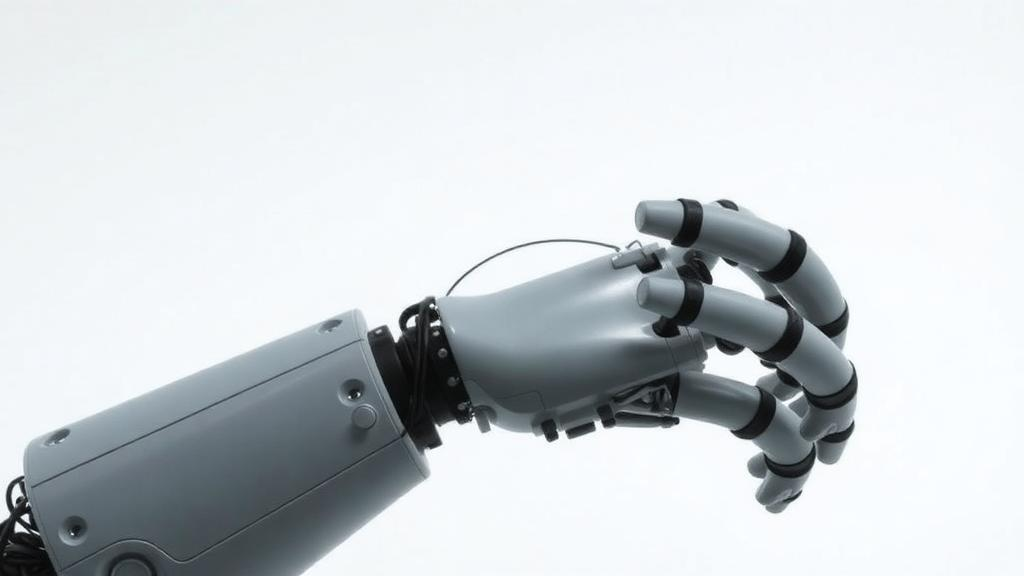
Industrial robots are masters of repetition, but only when everything goes exactly as planned. In the real world, a robotic arm faces shifting payloads, worn gears, unpredictable friction in its joints, and external forces it never anticipated. For collaborative robots like the widely used UR10, which share workspaces with human workers and must move smoothly and safely, these uncertainties can mean the difference between flawless precision and dangerous jitter. Now, a team of researchers at Henan University of Technology in Zhengzhou, China, has unveiled a composite control strategy that promises to make six-joint robot arms track their intended paths with remarkable accuracy while eliminating the notorious high-frequency vibration that plagues conventional controllers. The study, published in the journal Mechanical Sciences, combines an online-learning neural network with a mathematically elegant robust control technique known as the super-twisting algorithm, and the simulation results are striking.
The core challenge the researchers tackled is one that has haunted robotics engineers for decades. A robotic manipulator is a strongly coupled, nonlinear system: moving one joint changes the forces acting on every other joint, and the equations governing its motion involve inertia, Coriolis and centrifugal effects, gravity, and friction that all shift as the arm moves through space. When the actual mass or inertia of a link differs from the values in the controller’s internal model, when Coulomb and viscous friction resist motion in ways that are hard to characterize, or when external torques push on the arm, tracking accuracy degrades and stability can be compromised. The team, led by Xiaole Ma and corresponding author Chenghu Jing, built their approach on a rigorous mathematical model of the UR10 that explicitly accounts for these perturbations, lumping all the unknown dynamics into a single disturbance term that their controller must confront head-on.
Their solution rests on a division of labor between two complementary technologies. The first is a radial basis function neural network, a lightweight learning architecture prized for its simple structure and its ability to approximate any continuous nonlinear function within a defined region. Placed in the feedforward path of the controller, the network observes the robot’s state in real time and learns to predict the lumped unknown dynamics, from friction quirks to inertia mismatches. By absorbing the dominant nonlinearities before they can corrupt the motion, the network dramatically shrinks the size of the residual disturbance that the robust part of the controller must handle. This matters because the size of that residual directly determines how aggressive, and how energy-hungry, the robust control term needs to be.
That robust term is where the super-twisting algorithm enters the picture. Sliding-mode control is a classic robust technique: it drives the system’s tracking error onto a carefully chosen sliding surface and then uses aggressive switching to hold it there, making the system immune to a broad class of disturbances. The trouble is that conventional sliding-mode control relies on discontinuous switching, which produces the infamous phenomenon of chattering, a high-frequency oscillation in the control torque that excites unmodeled vibrations, wastes energy, and accelerates wear on actuators and gears. The super-twisting algorithm, a second-order sliding-mode technique, solves this problem elegantly. Instead of switching the torque itself, it applies a continuous combination of a term proportional to the square root of the sliding variable’s magnitude and an integral term, achieving the same finite-time convergence and disturbance rejection while producing a smooth, continuous control signal.
The Chinese team’s contribution is a carefully engineered synthesis of these two elements, backed by a rigorous stability proof. They defined a linear sliding surface based on the tracking error and its derivative, then constructed a control law with three modules: a nominal dynamic compensation term built from the robot’s known model, the neural network feedforward term for online approximation of unknown dynamics, and the super-twisting robust term to suppress residual disturbances. To keep the neural network’s weights from drifting to unbounded values, a common failure mode of adaptive schemes, they introduced a projection-based adaptive law that mathematically guarantees the weight estimates never exceed a preset safety boundary. Using Lyapunov stability theory, the researchers proved that both the sliding variable and the tracking error converge in finite time, with explicit gain conditions relating the super-twisting parameters to the disturbance bound.
The proof framework itself represents a departure from conventional practice. Rather than using the adaptive law to exactly cancel uncertainty terms, which can lead to gain drift and complicated derivations, the team adopted a decoupled design in which the neural network physically reduces the total disturbance bound. This allows the super-twisting gains to be substantially relaxed, cutting energy consumption and further suppressing chattering while preserving the finite-time stability guarantee. It is a design philosophy that treats the neural network and the robust controller as partners rather than competitors, each doing the job it is best suited for.
To test the approach, the researchers ran simulations on a full six-degree-of-freedom UR10 model using experimentally identified nominal parameters. They deliberately made the task hard: the masses of joints two and three were increased by twenty percent, centers of mass were shifted, inertias were perturbed by five percent, and a smooth sigmoidal friction model captured Coulomb and viscous effects in every joint. A sinusoidal external disturbance of 0.5 newton-meters was applied to all joints, and a fixed-gain study showed the method maintained tracking errors below 0.005 radians even when disturbances reached 2.0 newton-meters. The robot was commanded to move from one pose to another along a fifth-order polynomial trajectory over ten seconds, with a control period of one millisecond.
The results were emphatic. Under pure neural network control, lacking any robust term, the steady-state errors of the wrist joints ballooned to as much as 0.82 radians, with maximum errors exceeding one radian, an unacceptable failure. Conventional sliding-mode control fared far better, reducing steady-state errors to the thousandth-of-a-radian range, but the proposed composite controller cut them further still: joints four and five achieved steady-state errors of 0.0005 and 0.0017 radians, improvements of more than fifty percent and seventy-eight percent over pure sliding-mode control. All joints except one achieved steady-state errors better than one-thousandth of a radian. Measured by the integral of time-weighted absolute error, a standard metric combining response speed and steady-state accuracy, the composite controller outperformed pure sliding-mode control by 86.1 percent and pure neural network control by 99.7 percent. In Cartesian space, the end effector’s steady-state error shrank to 0.0002 meters, compared with 0.0007 meters for sliding-mode control and a disastrous 0.1031 meters for the network alone.
Just as important as the accuracy is the character of the control signals. The composite controller produced continuous, smooth torques free of the high-frequency chattering that traditional sliding-mode schemes generate, with peak torques around 62 newton-meters at joint two, comfortably below actuator saturation limits. The neural network’s weights, rather than growing without bound as they did under pure network control, stabilized at a low value after a brief transient, confirming that the super-twisting term was shouldering the main disturbance rejection burden while the network handled fine compensation. The method also proved its generality on continuous sinusoidal trajectories simulating industrial operation, with all joint root-mean-square errors below 0.003 radians. The authors note that future work will focus on experimental validation on a physical UR10 platform, adaptive optimization of the network structure, and integration of iterative learning with neural sliding-mode control. If hardware trials confirm the simulation results, this hybrid of learning and robust control could find a home in precision assembly, medical assistance, and any application where a robot arm must move exactly where it is told, even when the world pushes back.
Subject of Research: Composite neural network and super-twisting sliding-mode control for high-precision trajectory tracking of the UR10 robotic manipulator
Article Title: Trajectory-tracking control of the UR10 manipulator based on radial basis function neural network and super-twisting sliding mode
Article References: Ma, X., Jing, C., Zhang, K., Chen, C., & Wang, Y. (2026). Trajectory-tracking control of the UR10 manipulator based on radial basis function neural network and super-twisting sliding mode. Mechanical Sciences, 17(2), 759-767. https://doi.org/10.5194/ms-17-759-2026
Image Credits: AI Generated
Keywords: robotics, UR10 manipulator, trajectory tracking, sliding-mode control, super-twisting algorithm, radial basis function neural network, chattering suppression, adaptive control, Lyapunov stability, finite-time convergence, collaborative robots, nonlinear friction
News Source: Denise Maddox. (October 10, 2026). Neural Network Meets Super-Twisting Control to Make Robot Arms Move With Unprecedented Precision. Scienmag.