


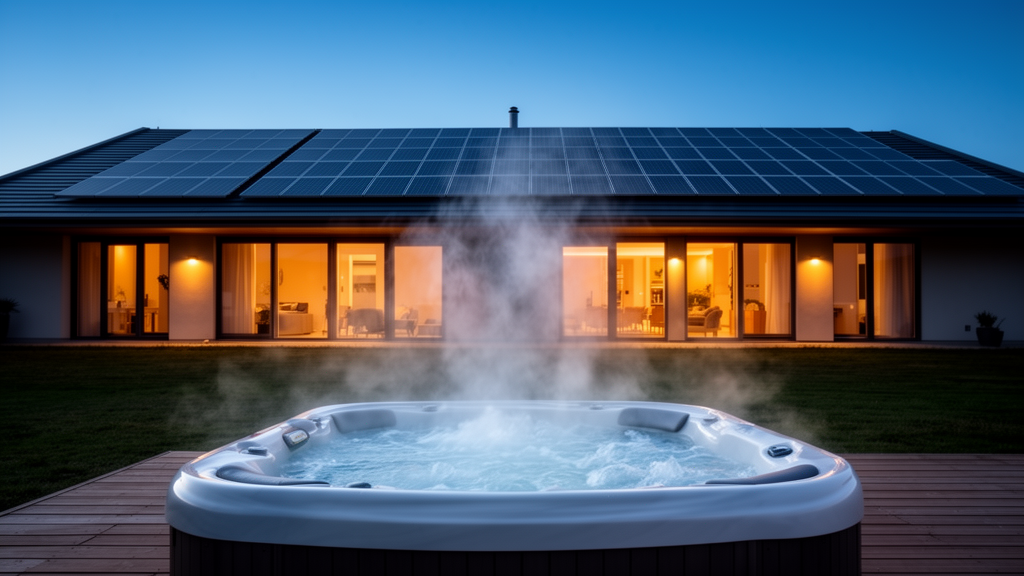
A carefully designed net-zero energy house in Strathroy, Ontario, could not live up to its label once real occupants moved in. The shortfall was driven largely by an outdoor electric hot tub that nobody had included in the design-stage energy model, along with underestimated heating demand and lower-than-expected photovoltaic output. The team concluded that, despite meeting Ontario Building Code and Energy Star requirements, the house cannot honestly be called a net-zero energy home.
The Strathroy House was built as a net-zero energy house, or NZEH, intended to generate as much energy on site each year as it consumes. Its roof carries 33 photovoltaic modules rated at 260 watts each, for a total capacity of 8.745 kilowatt-peak, with an estimated annual generation of 11,471 kilowatt-hours. Heating and cooling come from a hybrid system pairing an air source heat pump with a natural gas furnace, supplemented by an energy recovery ventilator. Natural gas also serves domestic hot water, the cooking range and a fireplace. The occupants, a retired couple, use an outdoor electric hot tub year-round, more heavily in winter.
To evaluate the house, the research team installed a full monitoring and data acquisition system recording natural gas consumption, electricity use, photovoltaic generation, indoor and outdoor temperatures, humidity, solar radiation and wind conditions. They began with an ASHRAE Level III energy audit, including combustion tests, thermal imaging and a blower door depressurization test, and documented the owners’ thermostat set-points of 20 degrees Celsius in winter and 24 in summer. Notably, the air conditioner was barely needed, since the house stayed comfortably below the cooling set-point. The audit data fed into calibrated TRNSYS building simulations used throughout the analysis.
The photovoltaic system itself underperformed its design estimate. The initial prediction of 10,636 kilowatt-hours per year ignored real-world losses from dirt, debris, snow cover and wiring, and the installed inverter caps output at 7.6 kilowatts, below the array’s 8.745 kilowatt-peak rating, clipping generation during peak hours. Measured annual generation came in at 9,746 kilowatt-hours against household consumption of 10,375 kilowatt-hours. When the natural gas used for space heating, water heating and other purposes, equivalent to 8,228 kilowatt-hours of electricity, is added to the load, the analysis shows the house would need an additional 8,857 kilowatt-hours of on-site generation to reach true net-zero status.
The hot tub emerged as the single most striking discrepancy. Set in standby mode, it cycles on several times a day to maintain water temperature, drawing spikes of nearly 6 kilowatts lasting about twenty minutes each, with rare events stretching to 6.6 hours. Each spike consumes roughly 1.7 kilowatt-hours, and these loads, absent from the original HOT2000 design model, significantly widened the gap between electrical demand and generation. The researchers found that discretionary baseloads of this kind, particularly during winter months, represent a dominant and previously unaccounted-for demand, and that reducing them offers the highest impact per unit cost without major capital investment.
Heating demand was also badly underestimated at the design stage. The discrepancy reflects differences in weather data, house specifications, operating assumptions and modelling methodology, plus the fact that the original model was built before occupancy and relied on estimated internal gains. It also omitted the natural gas stove and fireplace entirely.
The hybrid heating hardware itself performed largely as specified. Combustion testing showed the natural gas furnace operating at an average efficiency of 89 percent. The air source heat pump, which cannot operate below minus 15 degrees Celsius, delivered a maximum heating capacity of 10,814 watts at 8 degrees Celsius, falling to 5,920 watts at minus 15. An experimentally derived coefficient-of-performance curve matched the manufacturer’s laboratory curve closely, though the laboratory conditions flatter real-world performance. Domestic hot water use, at 85 litres per day for two occupants, came in at less than half the 188 litres per day the IEA Annex 42 benchmark would predict for the household.
A central contribution of the study was testing the Smart Dual Fuel Switching System, an intelligent predictive controller that chooses between the heat pump and the gas furnace using time-of-use electricity prices, outdoor temperature, heat pump coefficient of performance and furnace efficiency. Against conventional natural gas heating it delivered roughly 3 percent lower operating costs and a 40 percent reduction in greenhouse gas emissions.
Whether the house counts as net zero depends on the accounting method. Applying source-to-site energy ratios, which account for generation and transmission losses and average around 3 for grid electricity, the analysis found the house had a negative net-zero balance. Under the Canadian ratio of 1.96, the pre-occupancy HOT2000 model suggested the building was nearly net zero, but the measured data contradicted that, with electrical baseloads higher than modelled and ventilation loads far above predictions. The authors conclude that achieving net zero here requires trade-offs among expanding on-site photovoltaic capacity, cutting electrical baseloads and improving the envelope, with load reduction first and PV expansion second, given roof space constraints and seasonal variation.
The team is candid about the study’s limits. It covers a single owner-occupied dwelling, so findings may not generalize to other climates, building types or occupancy patterns. The 295-day campaign captured only one heating season, late-winter energy use was extrapolated, and inter-annual weather variability was not assessed. The calibrated TRNSYS model relies on idealized equipment curves and simplified zoning, with no stochastic occupant behaviour modelling, and the economic analysis excludes capital, maintenance and lifecycle costs. No formal uncertainty or probabilistic sensitivity analyses were performed. Future work, the authors write, should extend monitoring to multiple housing archetypes and climates, test thermal storage such as phase change materials and water tanks, and apply Monte Carlo uncertainty analysis to strengthen the quantitative conclusions.
Subject of Research: Monitoring and evaluation of an owner-occupied net-zero energy house with solar photovoltaics and a hybrid heating system in cold-climate Ontario
Article Title: Monitoring, analysis, and evaluation of an owner-occupied net-zero energy house with solar photovoltaics and a hybrid heating system in cold-climate Ontario, Canada
Article References: Tung, K., Demirezen, G., Fung, A. S., & Kumar, R. (2026). Monitoring, analysis, and evaluation of an owner-occupied net-zero energy house with solar photovoltaics and a hybrid heating system in cold-climate Ontario, Canada. City and Built Environment, 4(1), Article 5. https://doi.org/10.1007/s44213-026-00071-0
Image Credits: AI Generated
DOI: 10.1007/s44213-026-00071-0
Keywords: net-zero energy house, solar photovoltaics, air source heat pump, hybrid heating, Smart Dual Fuel Switching System, TRNSYS simulation, HOT2000, Strathroy Ontario, discretionary loads, greenhouse gas emissions, building energy monitoring, cold climate
News Source: Denise Maddox. (October 30, 2026). Net-zero dream home falls short as hot tub and design gaps drain its energy balance. Scienmag.



