A recent study, published in Current Biology, led by researchers at Stockholm University and Uppsala University, has shown that juvenile songbirds react to hearing the songs they will eventually produce as adults, even when they are as young as 12 days old. Experiments conducted on nestling pied flycatchers across Europe demonstrate that they preferentially respond to songs from their own species and, remarkably, their own population.
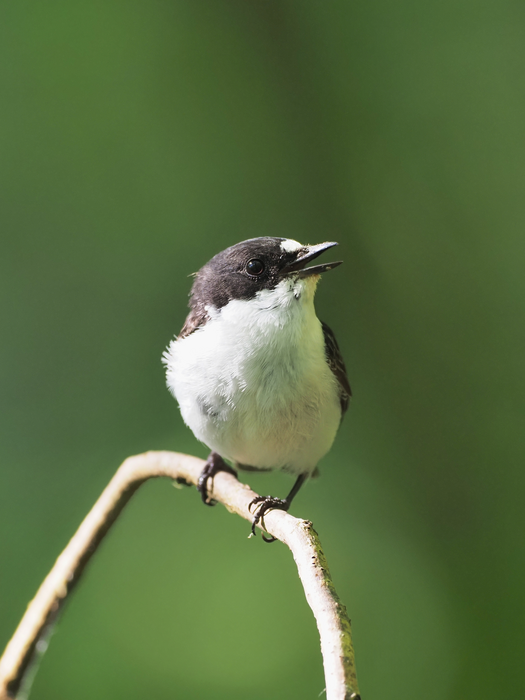
Credit: Photo: Tom Wallis
A recent study, published in Current Biology, led by researchers at Stockholm University and Uppsala University, has shown that juvenile songbirds react to hearing the songs they will eventually produce as adults, even when they are as young as 12 days old. Experiments conducted on nestling pied flycatchers across Europe demonstrate that they preferentially respond to songs from their own species and, remarkably, their own population.
Like human children learning language, juvenile songbirds learn their songs by listening to those produced by their parents and other adults. In both human language and songbird song, the learning process gives rise to small changes from one generation to the next, which leads to characteristic differences among populations, called dialects.
Broadcasted songs to nestlings
The study shows that pied flycatcher songs from 7 European populations form clearly defined dialects. By broadcasting songs to almost 2000 nestlings and observing their responses, the researchers demonstrate that young flycatchers respond to songs that are more similar to those from their own dialect by begging for food.
“These results establish that birds are ‘tuned’ from a young age to recognize their own populations’ songs, which focuses subsequent learning”, says David Wheatcroft, Associate Professor at the Department of Zoology, Stockholm University, who is the lead author of the study.
How are nestlings able to do this? One possibility is that nestling songbirds listen to their fathers’ songs and thereby learn about the local dialect. However, 100s of hours of recordings at flycatcher nests at Stockholm University’s Tovetorp Research Station revealed that nestlings hear extremely few songs, and, moreover, that nestlings whose fathers sing most often respond most weakly to the local dialect.
“An alternative is that nestlings recognize their own dialect innately”, says David Wheatcroft.
Local dialect helps attract partners
He hopes these results will lead to future studies investigating how these dialect-specific responses develop and their consequences.
“If differences in early song responses among populations are truly innate, it would suggest a remarkable co-evolution between a cultural trait and the genes underlying it. Singing the local dialect is thought to help adults attract appropriate mates.”
The researchers also found that dialect-specific responses may help prevent learning the songs of surrounding species. Pied flycatcher nestling responses to the songs of a closely related species, the collared flycatcher, were as weak as those to songs from other pied flycatcher dialects. Thus, the ability to discriminate against the songs of other species arises as a by-product of strong respondes to the local dialect.
These results demonstrate that even when behaviours, such as songs, are learned, they can be tuned in remarkably specific ways when there are benefits of getting it right.
More information
The article “Species-specific song responses emerge as a by-product of tuning to the local dialect” is published in the scientific journal Current Biology: https://doi.org/10.1016/j.cub.2022.09.063
In addition to Swedish researchers, this work involved collaborations with researchers from the Netherlands Institute of Ecology (the Netherlands), University of the Basque Country (Spain), University of Turku (Finland), Instituto de Investigación en Recursos Cinegéticos (Spain), University of Exeter (UK), and Instituto Pirenaico de Ecología (Spain).
Contact
David Wheatcroft, Associate Professor at the Department of Zoology, Stockholm University
Telephone: +46 7 222 38 327
E-mail: [email protected]
Journal
Current Biology
DOI
10.1016/j.cub.2022.09.063
Article Title
“Species-specific song responses emerge as a by-product of tuning to the local dialect”
Article Publication Date
25-Oct-2022