


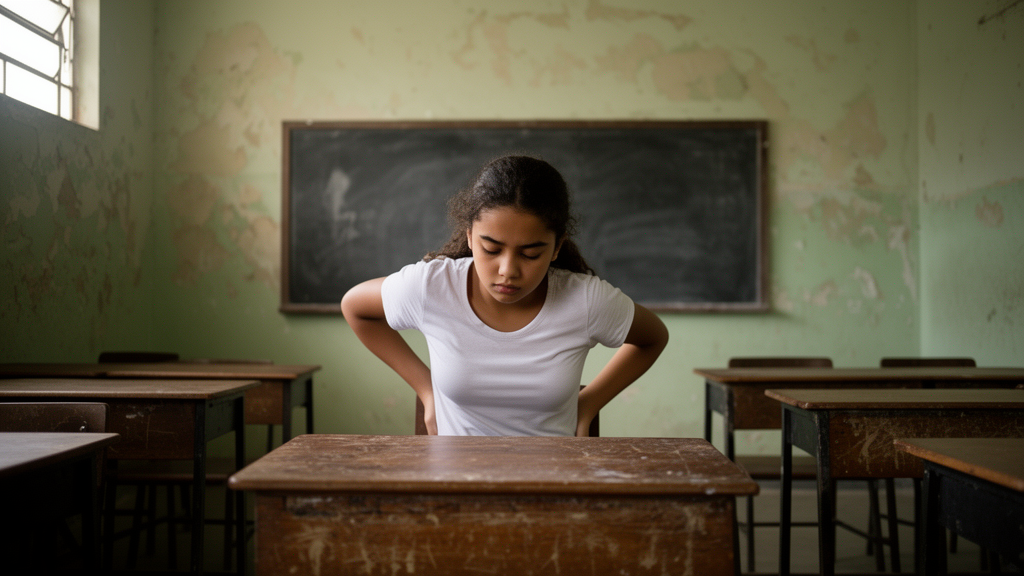
Nearly one in three adolescents attending public secondary schools in one of Fortaleza’s most deprived urban districts reported continuous musculoskeletal pain that had lasted more than three months, according to a cross-sectional study published in Frontiers in Pain Research. Among 296 students aged 14 to 18 years, 93 participants, or 31.4%, reported continuous chronic musculoskeletal pain, a proportion that exceeds the pooled global prevalence of chronic pain in children and adolescents of 20.8% estimated by a meta-analysis of 119 studies covering more than one million young people from 70 countries. The study was conducted in five public schools within Regional I of Fortaleza, Ceará, in northeastern Brazil, an area characterized by concentrated socioeconomic deprivation, neighborhood-level Human Development Index values below 0.499, and a homicide rate of 45.3 per 100,000 inhabitants.
The researchers, based at the State University of Ceará, the University of Fortaleza, and the University of Coimbra, assessed pain using the Presence and Impact of Pain in Kids questionnaire, an instrument translated and validated for Brazilian children and adolescents. Continuous chronic musculoskeletal pain was operationally defined as an affirmative response to a questionnaire item indicating the presence of continuous pain lasting longer than three months, a temporal criterion consistent with the standard definition of chronic pain as pain that persists or recurs for more than three months. Participants reporting pain secondary to trauma or fracture, neurological, oncological, or degenerative diseases, or other specific conditions that could explain their pain were excluded, as were pregnant adolescents and those with visual or hearing impairments that prevented completion of the study instruments.
Data collection took place between August and December 2025 in classrooms or private spaces provided by the schools, under the supervision of a previously trained research team. Schools were selected through two-stage stratified sampling, with the five educational territories of the administrative region serving as strata, and one school randomly selected from each territory before classes from all three secondary-school grades were randomly chosen. The final analytical sample of 296 adolescents exceeded the minimum required sample size of 293, which had been calculated for a finite population of 7,664 students using an expected musculoskeletal pain prevalence of 27.1%, a 5% margin of error, and a 95% confidence level. Parents or legal guardians provided written informed consent, and adolescents provided written assent, with the study approved by the Research Ethics Committee of the State University of Ceará.
The sample had a mean age of 16.2 years, with 48.6% female participants. Brown and White were the most frequently reported skin color categories, at 31.4% and 29.7% respectively. Most participants relied on public healthcare services, at 65.2%, while only 7.8% engaged in paid employment. Poor self-rated health was reported by 40.9% of participants. Anxiety symptoms were identified in 51.7% of adolescents and depressive symptoms in 34.8%, while 55.7% reported exposure to family violence and 39.2% reported school bullying. Behavioral and sleep-related measures painted a striking picture: 74.7% were classified as physically active, yet 81.8% reported poor sleep quality, and mean daily smartphone use reached 7.3 hours.
In the bivariate analysis, continuous chronic musculoskeletal pain was associated with female sex, anxiety symptoms, depressive symptoms, exposure to school bullying, poor sleep quality, and poor self-rated health. Mean daily smartphone use was higher among adolescents with continuous pain, at 8.43 hours per day, than among those without pain, at 7.02 hours per day. Public healthcare provision was associated with lower odds of continuous pain compared with private healthcare provision, although the authors note this finding should be interpreted cautiously. No statistically significant differences were observed for age, family violence, or physical activity level.
When the researchers moved to a multivariable binary logistic regression model that adjusted for multiple factors simultaneously, three variables remained independently associated with higher odds of continuous chronic musculoskeletal pain. Poor sleep quality, measured with the Pittsburgh Sleep Quality Index and defined as a global score above 5, carried an adjusted odds ratio of 2.49, meaning adolescents with poor sleep quality had roughly two and a half times the odds of reporting continuous pain compared with those with good sleep quality. Anxiety symptoms, assessed with the 21-item Depression Anxiety and Stress Scale, carried an adjusted odds ratio of 1.93. Each additional hour of daily smartphone use was associated with an 8.8% increase in the odds of pain, corresponding to an adjusted odds ratio of 1.09 per hour.
Notably, several factors that showed significant associations in the bivariate analysis lost statistical significance after adjustment. Female sex, depressive symptoms, school bullying, and poor self-rated health were no longer significantly associated with the outcome in the final model, with all adjusted p-values exceeding 0.05. The final model was statistically significant and showed adequate calibration, but its explanatory capacity was modest, with Nagelkerke’s pseudo-R-squared of 0.161 and overall classification accuracy of 69.3%. The authors explicitly interpret the model as an explanatory model of associations rather than a clinical prediction tool, a distinction that matters because the sensitivity at the prespecified classification threshold was only 22.6%, even though specificity reached 90.6%.
Among adolescents with continuous chronic musculoskeletal pain, medication use was more frequently reported than seeking professional advice or treatment. Of the 93 adolescents with the condition, 65, or 69.9%, reported taking medication to relieve pain, whereas only 21, or 22.6%, reported seeking health professional advice or treatment for pain. The authors caution that these were separate questionnaire items, and the study did not determine whether medications were prescribed, recommended by a health professional, obtained over the counter, or self-administered. They therefore warn that this difference should not be interpreted as evidence of self-medication or lack of access to professional care, noting that physician consultation and medication use represent distinct dimensions of healthcare utilisation influenced by different clinical and contextual factors.
The study’s findings sit within a broader pattern of elevated musculoskeletal pain estimates from low- and middle-income countries. A study in India reported nonspecific back pain in 38.5% of 1,225 adolescents attending urban and rural schools, with higher prevalence in urban students. In Nigeria, the 12-month prevalence of low back pain among secondary-school students was 43.8%. A recent study of Colombian adolescents reported musculoskeletal pain in 56.3% of participants over the previous six months. In Brazil, a study involving 2,688 schoolchildren reported a prevalence of 27.1% for disabling musculoskeletal pain during the preceding month, with pain most frequently affecting the back and lower limbs. The authors emphasize that these estimates are not directly comparable to their outcome because of differences in anatomical scope, pain definitions, and recall periods, but they reinforce the need for context-specific evidence on pediatric pain.
The authors are careful about what their cross-sectional design can and cannot establish. Because the data were collected at a single point in time, the direction of the relationships between pain, sleep, anxiety, and smartphone use cannot be determined. Sleep disruption may increase pain sensitivity and negatively affect emotional functioning, while persistent pain may itself disturb sleep continuity, and recent evidence supports a bidirectional relationship between sleep disturbance and pain during adolescence. Similarly, anxiety may intensify pain-related distress and functional difficulties, whereas persistent pain may contribute to the development or maintenance of anxiety symptoms. The authors note that these mechanisms are biologically and psychologically plausible but cannot be temporally ordered or tested as causal pathways using the present design. They also stress that the study did not assess individual socioeconomic circumstances or compare populations across different levels of territorial vulnerability, so its contribution lies in documenting chronic pain within a disadvantaged urban setting rather than estimating the effect of territorial vulnerability on pain. The study’s strengths include territory-stratified school sampling, validated instruments, and comprehensive assessment of biopsychosocial factors, while its limitations include reliance on self-reported data, the lack of detailed pain characteristics and individual socioeconomic indicators, and recruitment from a single urban district. The authors suggest that integrating pain assessment with psychological well-being, sleep, and everyday behaviors may facilitate the identification of adolescents with complex health needs in school and primary healthcare settings, though further investigation is needed to assess the feasibility and effectiveness of such approaches in resource-constrained settings.
Subject of Research: Occurrence and correlates of continuous chronic musculoskeletal pain among adolescents in a socially vulnerable urban setting in northeastern Brazil
Article Title: Continuous chronic musculoskeletal pain and its associated sociodemographic, psychosocial, and behavioral factors among adolescents living in a socially vulnerable urban setting in northeastern Brazil
Article References: Silva, F. V. M., Abdon, A. P. V., Ribeiro, A. S., Cestari, V. R. F., Carvalho, R. E. F. L. D., Anjos, S. D. J. S. B. D., & Siebra e Silva, A. V. (2026). Continuous chronic musculoskeletal pain and its associated sociodemographic, psychosocial, and behavioral factors among adolescents living in a socially vulnerable urban setting in northeastern Brazil. Frontiers in Pain Research, 7, 2009595. https://doi.org/10.3389/fpain.2026.2009595
Image Credits: AI Generated
DOI: 10.3389/fpain.2026.2009595
Keywords: adolescent health, chronic musculoskeletal pain, cross-sectional study, sleep quality, anxiety symptoms, smartphone use, social vulnerability, Brazil, pediatric pain, public health, health equity, Fortaleza
News Source: Phoebe Ingram. (October 30, 2026). Nearly one in three teens in Brazil’s poorest urban schools reports chronic musculoskeletal pain. Scienmag.



