New exploration in underwater navigation, a team from the Naval University of Engineering in Wuhan, China, has created novel algorithms that rectify inertial errors using sparse acoustic signals. This exploration offers novel method for the issue of underwater navigation , where traditional satellite systems are ineffective due to their signals’ inability to penetrate water effectively.
The increasing demand for precise underwater Positioning, Navigation, and Timing (PNT) due to expanding marine exploration and activities highlights the limitations of traditional Global Satellite Navigation Systems (GNSS) underwater. Various methods like Inertial/Dead Reckoning Navigation System (INS/DRNS), Acoustic Positioning Systems (APS), and Geophysical Matching Aided Navigation (GMAN) have been developed. However, these standalone systems often fall short, especially for long-duration and distance missions, due to issues like accumulating inertial navigation errors and the logistical challenges of deploying acoustic beacons.
On a recently published study (https://doi.org/10.1186/s43020-023-00123-4) in the journal Satellite Navigation, introduces two novel algorithms for underwater inertial error rectification – RMAN and VLBL – both of which exploit minimal acoustic beacon interactions to correct inertial navigation errors. Through extensive simulations and field experiments, these methods demonstrated remarkable improvements in accuracy and stability over existing systems.
The crux of this research lies in the development of the RMAN and VLBL algorithms, which leverage sparse acoustic beacon interactions to amend inertial navigation inaccuracies. RMAN, inspired by matching navigation without the need for reference maps, and VLBL, which adjusts for errors in relative position increments, are both novel approaches in this context. These methodologies were subjected to rigorous simulation and real-world testing, demonstrating a substantial enhancement in positioning precision. The results showcased an impressive reduction of inertial error by over 90% with single beacon and more than 98% with double beacon configurations, marking a significant improvement over traditional methods. This research not only addresses the persistent challenge of underwater navigation but also opens new avenues for oceanic exploration, environmental monitoring, and defense applications by providing a more reliable and efficient means of underwater positioning.
Dr. Fangneng Li, the lead researcher, highlighted, “Our techniques offer a paradigm shift in underwater navigation, providing over 90% reduction in inertial error with single and double beacon configurations, respectively.”
The study offered enhanced precision and reliability for positioning, navigation, and timing (PNT). These advancements hold great promise for a range of applications, from oceanic exploration to environmental surveillance and defense operations, marking a significant improvement in the functionality and dependability of underwater navigational technologies.
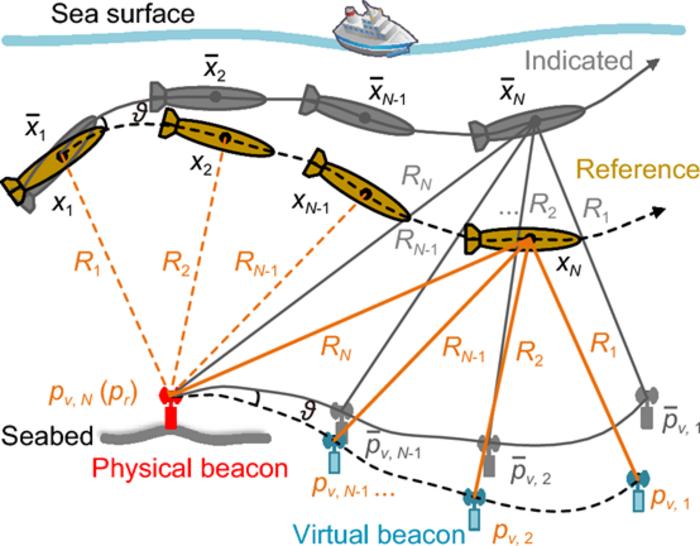
Credit: Satellite Navigation
New exploration in underwater navigation, a team from the Naval University of Engineering in Wuhan, China, has created novel algorithms that rectify inertial errors using sparse acoustic signals. This exploration offers novel method for the issue of underwater navigation , where traditional satellite systems are ineffective due to their signals’ inability to penetrate water effectively.
The increasing demand for precise underwater Positioning, Navigation, and Timing (PNT) due to expanding marine exploration and activities highlights the limitations of traditional Global Satellite Navigation Systems (GNSS) underwater. Various methods like Inertial/Dead Reckoning Navigation System (INS/DRNS), Acoustic Positioning Systems (APS), and Geophysical Matching Aided Navigation (GMAN) have been developed. However, these standalone systems often fall short, especially for long-duration and distance missions, due to issues like accumulating inertial navigation errors and the logistical challenges of deploying acoustic beacons.
On a recently published study (https://doi.org/10.1186/s43020-023-00123-4) in the journal Satellite Navigation, introduces two novel algorithms for underwater inertial error rectification – RMAN and VLBL – both of which exploit minimal acoustic beacon interactions to correct inertial navigation errors. Through extensive simulations and field experiments, these methods demonstrated remarkable improvements in accuracy and stability over existing systems.
The crux of this research lies in the development of the RMAN and VLBL algorithms, which leverage sparse acoustic beacon interactions to amend inertial navigation inaccuracies. RMAN, inspired by matching navigation without the need for reference maps, and VLBL, which adjusts for errors in relative position increments, are both novel approaches in this context. These methodologies were subjected to rigorous simulation and real-world testing, demonstrating a substantial enhancement in positioning precision. The results showcased an impressive reduction of inertial error by over 90% with single beacon and more than 98% with double beacon configurations, marking a significant improvement over traditional methods. This research not only addresses the persistent challenge of underwater navigation but also opens new avenues for oceanic exploration, environmental monitoring, and defense applications by providing a more reliable and efficient means of underwater positioning.
Dr. Fangneng Li, the lead researcher, highlighted, “Our techniques offer a paradigm shift in underwater navigation, providing over 90% reduction in inertial error with single and double beacon configurations, respectively.”
The study offered enhanced precision and reliability for positioning, navigation, and timing (PNT). These advancements hold great promise for a range of applications, from oceanic exploration to environmental surveillance and defense operations, marking a significant improvement in the functionality and dependability of underwater navigational technologies.
###
References
DOI
10.1186/s43020-023-00123-4
Original Source URL
https://doi.org/10.1186/s43020-023-00123-4
Funding information
The funding was provided by Natural Science Foundation of China (Grant numbers 42004067, 62373367, 42176195).
About Satellite Navigation
Satellite Navigation (E-ISSN: 2662-1363; ISSN: 2662-9291) is the official journal of Aerospace Information Research Institute, Chinese Academy of Sciences. The aims is to report innovative ideas, new results or progress on the theoretical techniques and applications of satellite navigation. The journal welcomes original articles, reviews and commentaries.
Journal
Satellite Navigation
DOI
10.1186/s43020-023-00123-4
Subject of Research
Not applicable
Article Title
Underwater inertial error rectification with limited acoustic observations
Article Publication Date
5-Feb-2024
COI Statement
The authors declare that they have no competing interests