In its first NSF Engineering Research Center collaboration, NAU will receive nearly $2 million in funding as a CQN contributing partner in the areas of research, education and workforce development
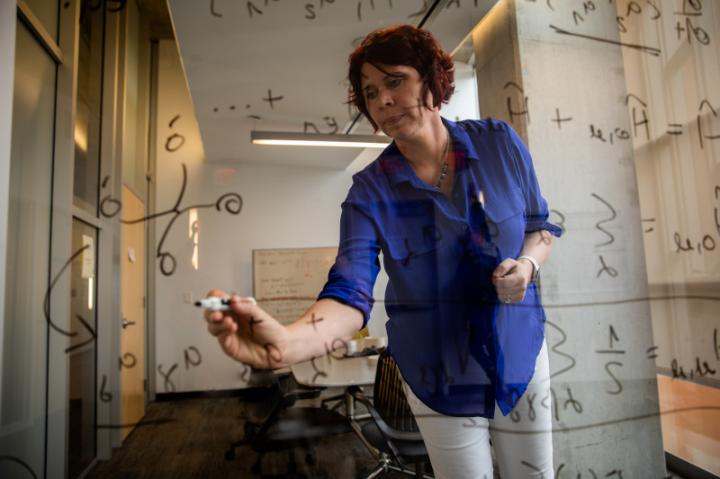
Credit: Northern Arizona University
Northern Arizona University is a partner institution in a major new initiative, funded through an initial $26 million grant from the National Science Foundation (NSF), to establish and lead the Center for Quantum Networks, or CQN. The five-year project–which represents NAU’s first participation in an NSF-designated Engineering Research Center (ERC)–will begin in October 2020, and the grant includes an additional five-year $24.6 million renewal option.
Defining the future of the quantum internet
CQN aims to lay the foundations of the quantum internet, which will revolutionize how humankind computes, communicates and senses the world by creating a fabric to connect quantum computers, data centers and gadgets using their native quantum information states of “quantum bits,” or qubits. Qubits offer dramatic increases in processing capacity over classical bits because they can hold more information–instead of having only a single binary value (0 or 1), qubits are capable of what is termed a “superposition” of both states (0 and 1) at the same time.
A major focus of the CQN team will be research to advance key underlying technologies, including fundamental quantum materials and devices; the quantum and classical processing required at a network node; and quantum network protocols and architectures.
In addition to addressing the enormous scientific and engineering challenges, the CQN will investigate the impact of a future quantum internet on education, workforce development, innovation and society. The White House National Quantum Coordination Office recently underscored the importance of the field by issuing “A Strategic Vision for America’s Quantum Networks.” The statement read, “By leading the way in quantum networking, America is poised to revolutionize national and financial security, patient privacy, drug discovery and the design and manufacturing of new materials, while increasing our scientific understanding of the universe.”
NAU to contribute research, education, workforce development through CQN
NAU will receive nearly $2 million in funding as a CQN contributing partner in the areas of research, education and workforce development.
“NAU’s research contributions to this new ERC will be focused in the areas of quantum networks and quantum materials. This truly is the beginning of a new era and we are excited to be part of this incredible interdisciplinary team,” said Inès Montaño, principal investigator for NAU’s CQN. An associate professor of Applied Physics and Materials Science, Montaño is also a core faculty member of NAU’s Center of Materials Interfaces in Research and Applications (¡MIRA!), an interdisciplinary research center focused on the development of advanced functional materials through the exploration of materials interfaces and on increasing diversity in the field of materials science.
Montaño and Stephanie Hurst, professor of Chemistry and Biochemistry and affiliate faculty of ¡MIRA!, will co-lead CQN research initiatives at NAU. The pair will coordinate efforts with other CQN research teams at the University of Arizona (CQN lead institute), Harvard University, the Massachusetts Institute of Technology, Yale University, Brigham Young University, Howard University, the University of Chicago, the University of Massachusetts Amherst and the University of Oregon.
As part of the NSF’s fourth generation of the ERC program, CQN’s mandate goes beyond creating a quantum internet–the initiative is also focused on the educational and workforce needs to propel the quantum internet age. NAU will play a leading role in the education and workforce development components of CQN, with Montaño serving as the CQN Engineering Workforce Development co-lead and Hurst as the co-lead of the Diversity and Culture of Inclusion.
“We are excited about introducing the next generation of scientists and engineers to quantum science, and will be highly focused on regional outreach to underserved and minoritized communities,” said Montaño.
“Quantum networks have the potential to revolutionize science and engineering, but the CQN is unique in also being dedicated to understanding how this technology will impact people and society more broadly,” Hurst said.
Some of the NAU team’s efforts will benefit local communities, including development of “Quantum Mobile,” a pilot program intended to take hands-on quantum science experiences to the rural communities of Arizona and beyond. NAU is also taking a lead in evaluation of the entire ERC, with Nena Bloom of NAU’s Center for Science Teaching and Learning (CSTL) serving as the CQN evaluation coordinator. Bloom’s team will focus on understanding the impacts of the CQN and driving future research, educational and workforce efforts in quantum information.
“The CQN is a tremendously exciting opportunity for NAU’s research enterprise as well as for our students,” said NAU President Rita Cheng. “NAU will not only contribute world-class research capability in quantum information science, but expertise in education and evaluation as well. CQN will shape the future of computing technology, and NAU faculty researchers, along with their undergraduate and graduate students, will be integral team members leading the way.”
###
About Northern Arizona University
Northern Arizona University is a higher-research institution providing exceptional educational opportunities in Arizona and beyond. NAU delivers a student-centered experience to its 31,000 students in Flagstaff, statewide and online through rigorous academic programs in a supportive, inclusive and diverse environment. Dedicated, world-renowned faculty help ensure students achieve academic excellence, experience personal growth, have meaningful research opportunities and are positioned for personal and professional success.
Media Contact
Diane Rechel
[email protected]