

• HOME
  • NEWS
  • EXPLORE
    • CAREER
      • Companies
      • Jobs
    • EVENTS
    • iGEM
      • News
      • Team
    • PHOTOS
    • VIDEO
    • WIKI
  • BLOG
  • COMMUNITY
    • FACEBOOK
    • INSTAGRAM
    • TWITTER
Wednesday, July 8, 2026
BIOENGINEER.ORG
No Result
View All Result
  • Login
  • HOME
  • NEWS
  • EXPLORE
    • CAREER
      • Companies
      • Jobs
        • Lecturer
        • PhD Studentship
        • Postdoc
        • Research Assistant
    • EVENTS
    • iGEM
      • News
      • Team
    • PHOTOS
    • VIDEO
    • WIKI
  • BLOG
  • COMMUNITY
    • FACEBOOK
    • INSTAGRAM
    • TWITTER
  • HOME
  • NEWS
  • EXPLORE
    • CAREER
      • Companies
      • Jobs
        • Lecturer
        • PhD Studentship
        • Postdoc
        • Research Assistant
    • EVENTS
    • iGEM
      • News
      • Team
    • PHOTOS
    • VIDEO
    • WIKI
  • BLOG
  • COMMUNITY
    • FACEBOOK
    • INSTAGRAM
    • TWITTER
No Result
View All Result
Bioengineer.org
No Result
View All Result
Home NEWS Science News Biology

Nature provides a key to repelling liquids

Bioengineer by Bioengineer
July 31, 2017
in Biology
Reading Time: 2 mins read
0
Share on FacebookShare on TwitterShare on LinkedinShare on RedditShare on Telegram
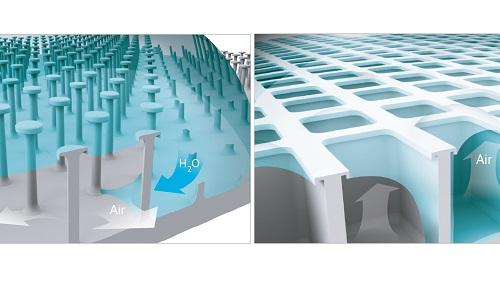
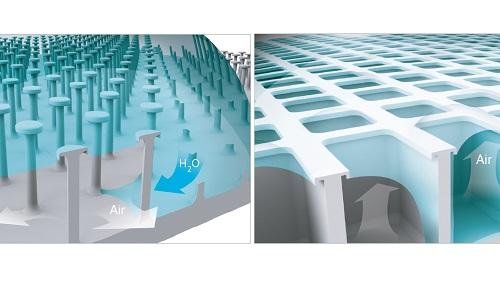
IMAGE

Credit: Reproduced with permission from ref 1.© 2017 American Chemical Society

Inspired by nature, an inexpensive green technique that enables common materials to repel liquid has been developed by KAUST scientists and could lead to diverse applications from underwater drag reduction to antifouling.

Making surfaces liquid repellent, referred to as omniphobicity, is used in a range of industrial processes from reducing biofouling and underwater drag to membrane distillation, waterproofing and oil-water separation.

Producing such a veneer generally relies on applying perfluorinated coatings; however, these degrade under harsh physical and chemical environments, increasing costs and both health and environmental impacts and limiting their use.

Rendering conventional materials, such as plastics and metals, omniphobic has been a tantalizing goal for some time; this challenge led Himanshu Mishra and colleagues from the KAUST Water Desalination and Reuse Center to seek inspiration from nature.

The researchers first tested microtextures comprising doubly reentrant pillars: they were inspired by a US-based research team who, in 2014, demonstrated these pillars exhibited unprecedented omniphobicity in air, even when the materials were intrinsically wetting.

"At first, these results seemed to defy conventional wisdom as roughening intrinsically wetting surfaces makes them even more wetting," said Mishra. "So we decided to investigate these microtextures for ourselves."

The team confirmed that intrinsically wetting surfaces with doubly reentrant micropillars do indeed exhibit omniphobicity in air, but they also found that it was catastrophically lost in the presence of localized physical defects or damage or upon immersion in wetting liquids.

"These were serious limitations because real surfaces get damaged during use," said Mishra. "This inspired us to look to nature and investigate the skins of springtails."

Patterns on the skin of springtails–tiny soil-dwelling insects that live in moist conditions–exploit surface textures that contain doubly reentrant cavities, keeping them dry. By using photolithography and dry-etching tools at the KAUST Nanofabrication Core Lab, the researchers recreated these doubly reentrant microcavities on silica surfaces.

Taking advantage of the doubly reentrant features showed that the microcavities trapped air and prevented penetration of liquids, even under elevated pressures. In addition, their compartmentalized nature prevented any loss of omniphobicity in the presence of localized damage or defects or upon immersion in wetting liquids.

"Having demonstrated the proof of concept, we now plan to translate the fabrication process from the lab to the Workshop Core Lab in KAUST to create doubly reentrant cavities on common materials, such as polyethylene terephthalate and low-carbon steels," said Mishra. "This may help to unlock their potential for applications to reduce hydrodynamic drag and antifouling."

###

Media Contact

Michelle D'Antoni
[email protected]

http://kaust.edu.sa/

Original Source

https://discovery.kaust.edu.sa/en/article/385/nature-provides-a-key-to-repelling-liquids http://dx.doi.org/10.1021/acsami.7b03526


Share12Tweet8Share2ShareShareShare2

Related Posts

Here are a few rewritten headlines for a science magazine post, each with a slightly different tone: Intriguing & poetic: How do organs sculpt themselves? Sea stars hold the secret Direct & research-focused: Sea stars reveal the hidden rules of organ formation Metaphorical & inviting: Tiny architects beneath the waves: What sea stars teach us about building organs Short & punchy: Star-shaped clues to how our organs take shape Question-led: Could a sea star show us how organs form? Elegant & feature-style: The body’s blueprint, glimpsed in a sea star’s arm

July 6, 2026
Bacteria evolve faster with unconventional gene copies — Biology

Bacteria evolve faster with unconventional gene copies

July 6, 2026

Neighbours rewire soil feedback via root microbiome shifts

July 6, 2026

Evolution-Inspired Biosensors Revolutionize Lipid Tracking in Real Time

July 2, 2026
Please login to join discussion

POPULAR NEWS

  • Detection of EDCs in Breast Milk and Infant Urine Up to Six Months Highlights Early Exposure Risks

    77 shares
    Share 31 Tweet 19
  • New Drug Candidate Developed at McMaster Shows Potential for Treating Brain Cancer

    58 shares
    Share 23 Tweet 15
  • Saying Goodbye to PGY-6: Pediatric Fellowship Realities

    103 shares
    Share 41 Tweet 26
  • KTU Researchers Explore Ultrasound’s Role in Enhancing Blood Flow Beyond Diagnostics

    53 shares
    Share 21 Tweet 13

About

We bring you the latest biotechnology news from best research centers and universities around the world. Check our website.

Follow us

Recent News

Flame retardant BDE-209 targets molecularly linked to ulcerative colitis

Ultra-high frequency particle impacts mimic rockbursts to shatter hard rock

Kidney transplant outcomes in older adults studied by German researchers

Subscribe to Blog via Email

Success! An email was just sent to confirm your subscription. Please find the email now and click 'Confirm' to start subscribing.

Join 83 other subscribers
  • Contact Us

Bioengineer.org © Copyright 2023 All Rights Reserved.

Welcome Back!

Login to your account below

Forgotten Password?

Retrieve your password

Please enter your username or email address to reset your password.

Log In
No Result
View All Result
  • Homepages
    • Home Page 1
    • Home Page 2
  • News
  • National
  • Business
  • Health
  • Lifestyle
  • Science

Bioengineer.org © Copyright 2023 All Rights Reserved.
