WOODS HOLE, Mass. — We know that sharks are voracious eaters, but what do we know about the source of its microbiome? To date, not much. But a recent study from the University of Chicago and the Marine Biological Laboratory (MBL) fills a gap in understanding the microbiome associated with a close relative in the Chondrichthyes, a class of fish that includes sharks, rays and skates.
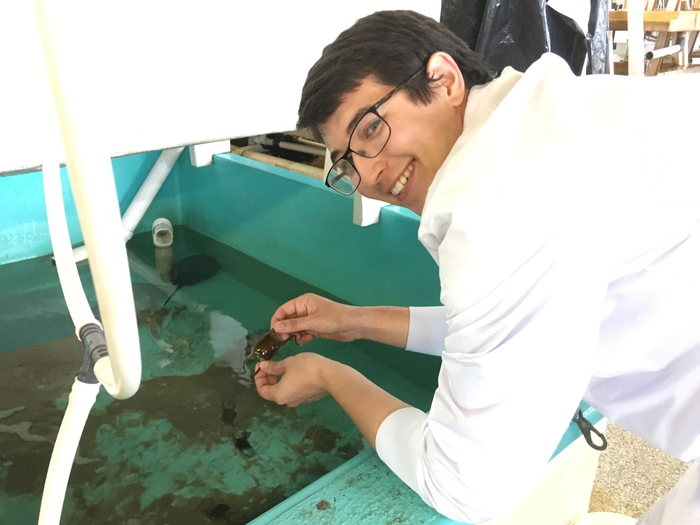
Credit: Marine Biological Laboratory
WOODS HOLE, Mass. — We know that sharks are voracious eaters, but what do we know about the source of its microbiome? To date, not much. But a recent study from the University of Chicago and the Marine Biological Laboratory (MBL) fills a gap in understanding the microbiome associated with a close relative in the Chondrichthyes, a class of fish that includes sharks, rays and skates.
“There’s a new understanding that microbiomes are very important for all multicellular organisms,” said MBL Senior Scientist David Mark Welch, senior author on the paper. “We’re essentially taking what we’ve learned from the NIH Human Microbiome Project, including the central role the microbiome plays in human health, and recognizing that microbiomes play a role in a wide variety of organisms, particularly marine organisms.”
Among the ocean dwellers, corals and certain fish have had their microbiomes analyzed, but “there are huge gaps [in knowledge], and one of them has been the microbiomes of non-bony fish – sharks, rays, skates and other cartilaginous fish,” Mark Welch said.
An animal can acquire its microbiome in three different ways, the team’s study explains. First, the parent can transmit all or part of its microbiome to its offspring. Second, the animal can acquire it during social or sexual interactions with other members of its species. And third, animals can recruit microbes from their environment through contact with fluids, habitat, or diet. Humans acquire their microbiome in all three ways.
First authors Katelyn Mika and Alexander Okamoto were inspired to discover how the microbiome originates in the little skate (Leucoraja erinacea) in 2018, when they spending the summer at the MBL with University of Chicago Professor Neil Shubin. The little skate’s embryo develops in the contained environment of an egg case, commonly called a devil’s purse.
“The skate egg case is a very interesting place to study microbiome development because the egg is separate from the outside world up until [about two-thirds of the way through] development, when little apertures open in the egg case and there starts to be an exchange with seawater,” said Mark Welch. “So, you can ask the question more easily than in other organisms, is there vertical transmission of the microbiome? Namely, does the mother pass on part of her microbiome to the offspring?”
“We began wondering what happens with the little skate’s microbiome, given the egg’s fairly dramatic life-history changes,” said Okamoto. “[The egg case] is basically dumped on the bottom of the ocean, abandoned by its parent for many months, and then it opens up suddenly and seawater rushes in.”
The team used next-generation sequencing to characterize the microbial community at six points in the skate’s embryonic development. Their efforts yielded the first evidence of vertical transmission of the microbiome from parent to offspring in the Chondrichthyes.
Their findings are a useful step in the study of microbiomes, which can be indicators of how well an organism is doing in its environment, said Mark Welch.
“We know that a lot of marine species are under stress because of anthropogenic changes, global warming,” he said. “One of our broader goals is to be able to study the microbiomes of these organisms and determine very quickly, how healthy are they?”
There’s plenty of room for more research on animal microbiomes, said Mika – including on sharks.
“There’s a chain catshark at the MBL whose eggs look incredibly similar to the skates’ eggs,” she said. “They go through the same sort of development where they’re in that egg case for the first two thirds, then they have slits that open, and then they finish developing with that open waterflow through the eggs. I’m desperate to know if their microbiomes are similar to the skates’ or if they’re totally different.”
This research was funded by a grant from the Microbiome Center, a collaboration between University of Chicago, Marine Biological Laboratory, and Argonne National Laboratory; and by a National Science Foundation Graduate Research Fellowship to Alexander Okamoto.
—###—
The Marine Biological Laboratory (MBL) is dedicated to scientific discovery – exploring fundamental biology, understanding marine biodiversity and the environment, and informing the human condition through research and education. Founded in Woods Hole, Massachusetts in 1888, the MBL is a private, nonprofit institution and an affiliate of the University of Chicago.
Journal
Animal Microbiome
DOI
10.1186/s42523-021-00136-x
Method of Research
Experimental study
Subject of Research
Animals
Article Title
Bacterial community dynamics during embryonic development of the little skate (Leucoraja erinacea)
Article Publication Date
13-Oct-2021