ANN ARBOR, Mich. – As they grow, children start doing certain activities without their parents watching over them, including trick-or-treating with friends, staying home alone or biking to a friend’s house.
Credit: University of Michigan Health C.S. Mott Children’s Hospital National Poll on Children’s Health
ANN ARBOR, Mich. – As they grow, children start doing certain activities without their parents watching over them, including trick-or-treating with friends, staying home alone or biking to a friend’s house.
And while most parents agree that kids benefit from opportunities to be independent, they may be engaging in more “helicopter parenting” than they realize, suggests a new University of Michigan Health C.S. Mott Children’s Hospital National Poll on Children’s Health.
“There’s a sizable gap between parent attitudes about promoting children’s independence and what they actually allow or encourage their children to do without supervision,” said Mott Poll co-director Sarah Clark, M.P.H.
“This suggests some parents may be missing opportunities to guide their children in tasks of autonomy and unintentionally hindering kids’ development of independence and problem-solving skills.”
Four in five parents of children ages 9-11 agree that it’s good for children to have free time without adult supervision. But fewer report their child actually does certain things without an adult present, the poll suggests.
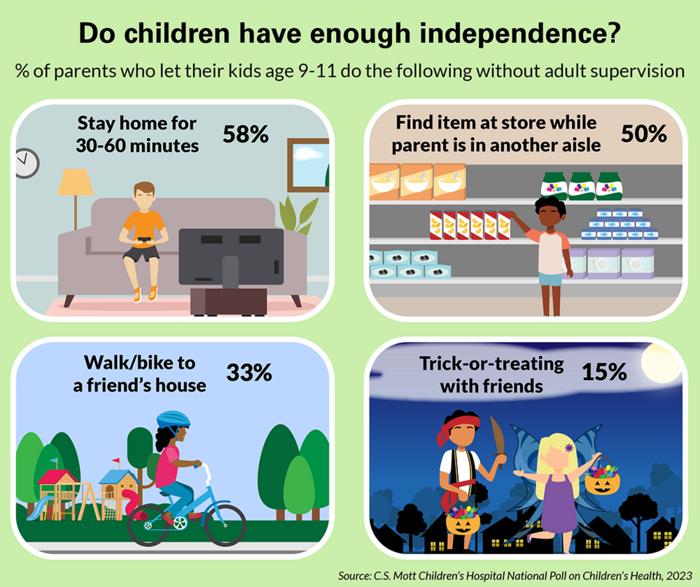
About three in five parents have let their tween-aged child stay home for 30-60 minutes while half say their child has separated from them to find an item at another aisle in the store. Less than half say their child has waited in the car while the parent runs a quick errand, walked or biked to a friend’s house or played at the park with a friend, and less than a sixth of parents have let their child trick-or-treat with friends.
The top reason behind parents’ hesitancy to promote such independent milestones was safety. Yet, while a little more than half worried someone might scare or follow their child, just 17% of parents say their neighborhood is not safe for children to be alone.
“To some extent, worrying about your child is natural. But some parents are limiting their child’s independent activities due to highly publicized media reports, even if those outcomes are very unlikely to occur or cannot be prevented,” Clark said.
“Parents can ease in with small steps such as letting their child spend time with a friend at a familiar public place. Discussions before and after can help parents assess if their kids understand the importance of following safety rules.”
Other parents say they keep children from taking on such tasks alone because they don’t believe they’re ready while some parents believe state or local laws don’t allow children that age to be alone and that someone might call the police. A little more than one in 10 parents also think others will think they are a bad parent if their child is seen unsupervised.
Over half of parents say that unsupervised children cause trouble while a quarter have criticized another parent, and 13% have been criticized for not adequately supervising their child.
“Parents may be affected by ‘blame culture’ – the expectation that they will be criticized if something happens to their child,” Clark said.
The poll report also suggests a disconnect between what parents of younger children ages 5-8 say and what they do in fostering independence.
Nearly three quarters say they make it a point to have their child do things themselves. But less than half of these parents say their child regularly engages in actions such as talking with the doctor or nurse at health visits, deciding how to spend allowance or gift money, speaking to unfamiliar adults in business situations, such as ordering at a restaurant, or preparing their own meal or snack.
Among reasons were safety, getting stuck in habits, the parent belief that their child doesn’t want to do things themselves or isn’t mature enough, thinking it will take too long or that it won’t be done in the parent’s preferred way.
The elementary school years, Clark notes, is an important phase for developing independence with parental guidance.
“Becoming independent is a gradual process of allowing children increasing amounts of freedom, with parents there to teach skills and help the child understand the consequences of their choices,” Clark said.
“As children become more experienced and comfortable with tasks, they can assume responsibility for doing them regularly. Research shows encouraging independence fosters a child’s self-confidence, resilience, problem-solving ability, and mental health.”
The nationally representative poll is based on responses from 1,044 parents of children 5-11 years surveyed in August.