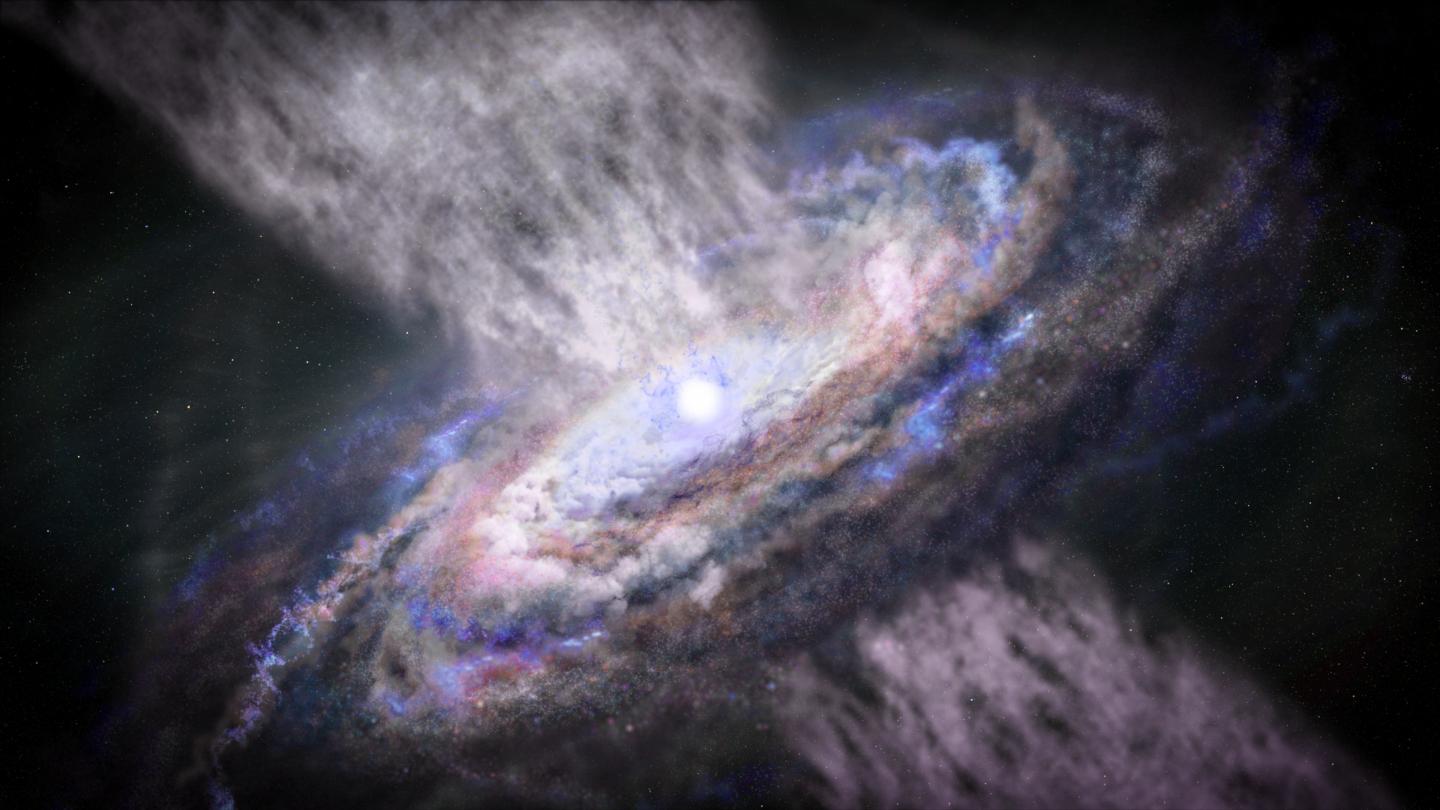
Credit: Credits: STScI
Supermassive black holes, which likely reside at the centers of virtually all galaxies, are unimaginably dense, compact regions of space from which nothing — not even light — can escape. As such a black hole, weighing in at millions or billions of times the mass of the Sun, devours material, it is surrounded by a swirling disk of gas. When gas from this disk falls towards the black hole, it releases a tremendous amount of energy. This energy creates a brilliant and powerful galactic core called a quasar, whose light can greatly outshine its host galaxy.
Astronomers widely believe that the energy from quasars is responsible for limiting the growth of massive galaxies. Shortly after the launch of NASA’s James Webb Space Telescope, scientists plan to study the effect of three carefully selected quasars on their host galaxies in a program called Q3D.
A supermassive black hole is very small compared to its host galaxy — it’s the equivalent of a penny in relation to the size of the entire Moon. Still, supermassive black holes have an immense influence on the galaxies they inhabit.
“Physically very small objects, supermassive black holes seem to have an enormous impact on the evolution of galaxies and eventually on the way our universe looks today,” said Q3D principal investigator Dominika Wylezalek, a Research Group Leader at the University of Heidelberg in Germany.
Two decades ago, scientists hypothesized the critical role of quasars in limiting galaxy growth, but specific observational evidence has been surprisingly hard to come by. Scientists think a quasar’s torrential winds push out the equivalent of hundreds of solar masses of material each year. As the quasar winds sweep across the galaxy’s disk, material that otherwise would have formed new stars is violently carried away from the galaxy, causing star birth to cease. But observing the power and reach of quasars on their host galaxies remains a major unresolved issue in modern astrophysics. The Webb telescope could change that.
Analyzing Data in 3D
In addition to its exquisite sensitivity, resolution and infrared vision, Webb’s capabilities include unique three-dimensional imaging spectroscopy. This special observing technique allows the team to get detailed measurements of light for every single pixel across the field of view. It stitches together many images at slightly different wavelengths. This allows scientists to spatially map gas motions inside the galaxy. The technique will revolutionize the understanding of the relationship between supermassive black holes and their host galaxies by allowing scientists to probe the stars, gas and dust in nearby and distant galaxies.
“Imaging spectroscopy is important for us because the winds in these distant quasars are not necessarily symmetric,” explained co-principal investigator Sylvain Veilleux, a professor of astronomy at the University of Maryland, College Park. “So, one needs a spectrum at every position to determine what is their geometry and be able to draw the important information from these winds and the impact they have on their host galaxies.”
Studying Three Quasars and Their Hosts
The Q3D team will study three bright quasars to measure the activity that comes from accreting material onto supermassive black holes, and how the host galaxies are affected by that activity. The team chose the three quasars for scientific reasons, but also to test and assess the capabilities of Webb. The objects intentionally span a very broad range of distance from Earth, from relatively nearby to very far away. They are also among the most luminous quasars at their respective distances and are known to have outflows of material.
Powerful quasar outflows appear to prevent a galaxy’s gas from forming new stars and growing the galaxy. Scientists think this quasar-galaxy connection is crucial in determining how galaxies evolve from the early universe to today. It’s especially important for galaxies a few times larger than the Milky Way, because quasar hosts are generally more massive galaxies.
Seeing Beyond the Bright Light
Quasars are very bright compared with the material around them, so the team is developing special software tools that allow them to study the phenomena. When quasars were discovered in the 1950s, they were brilliant radio sources that looked like stars on photographic plates, so they were called “quasi-stellar radio sources.” Eventually, astronomers learned that quasars were actually inside of galaxies, but they were so bright that they outshone their host galaxies.
“We’re interested in the quasar itself — the bright, star-like thing in the middle — but we’re also interested in the fainter host galaxy. And not just the host galaxy, but the even fainter outflow from the host. This is the gas that’s not circling around the quasar, or the center of the galaxy, but is instead flowing out. To see this really faint stuff behind the quasar, we have to remove the quasar’s light. That’s one unique thing the software will do.” said co-investigator David Rupke, associate professor of physics at Rhodes College in Memphis, Tennessee. Rupke is leading the effort to write the software to analyze the Q3D data.
Paving the Way for Future Webb Studies
The Q3D study is part of the Director’s Discretionary-Early Release Science program, which provides public data to the entire scientific community early in the telescope’s mission. This program allows the astronomical community to quickly learn how best to use Webb’s capabilities, while also yielding robust science.
“From a technical standpoint, with our observations, we are testing different modes, filters and combinations,” explained Wylezalek. “It will be very useful for the scientific community to see the performance in these different modes. Scientifically, we are probing quasars at different luminosities and cosmic times to inform the community about Webb’s performance when assessing different scientific questions.”
The Q3D software will not only be useful for users observing quasars but for anyone observing bright, point-like, central sources on top of fainter sources. Such observations could include super star clusters, supernovas, tidal disruption events, or gamma-ray bursts.
The James Webb Space Telescope will be the world’s premier space science observatory when it launches in 2021. Webb will solve mysteries in our solar system, look beyond to distant worlds around other stars, and probe the mysterious structures and origins of our universe and our place in it. Webb is an international program led by NASA with its partners, ESA (European Space Agency) and the Canadian Space Agency.
For more information about Webb, visit http://www.
###
Media Contact
Ann Jenkins
[email protected]
Original Source
https:/