• HOME
  • NEWS
  • EXPLORE
    • CAREER
      • Companies
      • Jobs
    • EVENTS
    • iGEM
      • News
      • Team
    • PHOTOS
    • VIDEO
    • WIKI
  • BLOG
  • COMMUNITY
    • FACEBOOK
    • INSTAGRAM
    • TWITTER
Wednesday, November 18, 2026
BIOENGINEER.ORG
No Result
View All Result
  • Login
  • HOME
  • NEWS
  • EXPLORE
    • CAREER
      • Companies
      • Jobs
        • Lecturer
        • PhD Studentship
        • Postdoc
        • Research Assistant
    • EVENTS
    • iGEM
      • News
      • Team
    • PHOTOS
    • VIDEO
    • WIKI
  • BLOG
  • COMMUNITY
    • FACEBOOK
    • INSTAGRAM
    • TWITTER
No Result
View All Result
Bioengineer.org
No Result
View All Result
Home NEWS Science News

NASA’s Webb ‘powerhouse’ solar array reconnects to the telescope

Bioengineer by Bioengineer
September 2, 2020
in Science News
Reading Time: 2 mins read
0
IMAGE
Share on FacebookShare on TwitterShare on LinkedinShare on RedditShare on Telegram

IMAGE

Credit: Image Credit: NASA/Chris Gunn

One kilowatt is about what it takes to heat up some leftovers in a microwave — or to power the largest and most technically advanced telescope ever built. Thanks to its solar array, NASA’s James Webb Space Telescope will stay energy-efficient more than 1 million miles (1.5 million kilometers) from Earth.

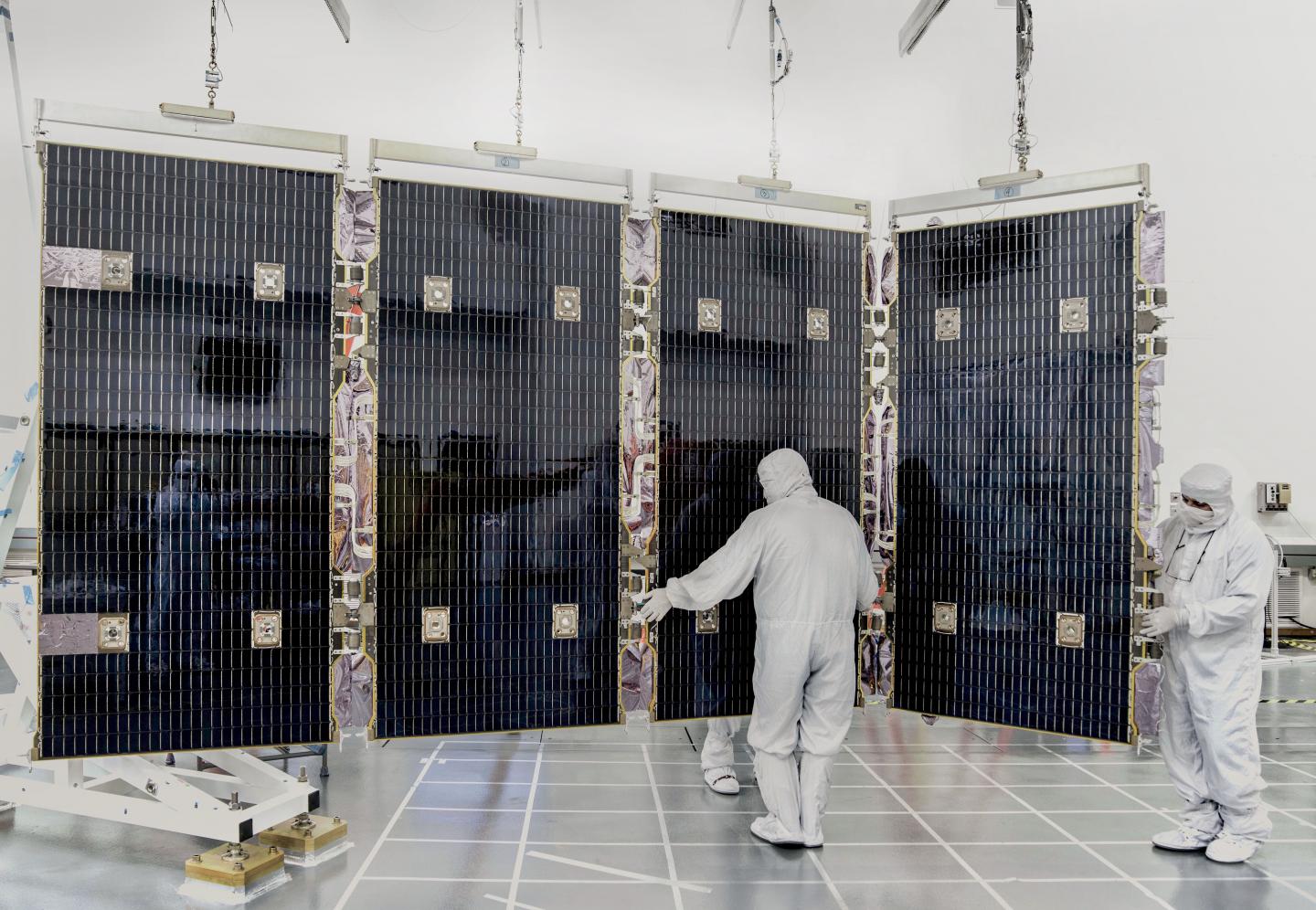
Webb’s 20-foot (6-meter) solar array was recently attached to the main observatory for one of the final times before launch. The “powerhouse” of the telescope, the array will supply energy to all of the telescope’s scientific instruments and communication and propulsion systems. While Webb will only use 1 kilowatt of power, the solar array is capable of generating nearly double that amount to factor in the gradual wear and tear of a harsh space environment.

The solar array is made up of five panels that are hinged together to easily fold up and stow in Webb’s launch vehicle, the Ariane 5 rocket. When Webb launches in 2021, this deployment will be the first and one of the most critical steps in the observatory’s full deployment process. The telescope’s onboard battery is intended to last only a few hours, up until the solar array unfolds in space and begins converting sunlight into electricity.

In spring 2019, the array was removed from the spacecraft for deployment testing. To minimize friction and mimic the zero-gravity conditions of deep space, the team conducted tests by hanging the array on its side.

NASA’s James Webb Space Telescope will be the world’s premier space science observatory when it launches. Webb will solve mysteries in our solar system, look beyond to distant worlds around other stars, and probe the mysterious structures and origins of our universe and our place in it. Webb is an international program led by NASA with its partners, ESA (European Space Agency) and the Canadian Space Agency.

###

For more information about Webb, visit http://www.nasa.gov/webb.

Media Contact
Laura Betz
Laura.e.betz@nasa.gov

Original Source

https://www.nasa.gov/feature/goddard/2020/nasa-s-webb-powerhouse-solar-array-reconnects-to-the-telescope

Tags: AstronomyElectrical Engineering/ElectronicsHardwareMechanical EngineeringResearch/DevelopmentSatellite Missions/ShuttlesSoftware EngineeringSpace/Planetary ScienceTechnology/Engineering/Computer Science
Share12Tweet8Share2ShareShareShare2

Related Posts

Theory Paper Evaluates Inositol as Untested Countermeasure Against Psychotropic Metabolic Risks

Theory Paper Evaluates Inositol as Untested Countermeasure Against Psychotropic Metabolic Risks

November 18, 2026
Family Members in Hungary Report High Hospice Satisfaction Despite Access Barriers

Family Members in Hungary Report High Hospice Satisfaction Despite Access Barriers

November 18, 2026

Kinematically Controlled 3D Printing Transforms Polymer Stringing into Suspended Tissue Scaffolds

November 18, 2026

Combined Inflammatory Biomarkers Distinguish Active Tuberculosis from Latent Infection

November 18, 2026
Please login to join discussion

POPULAR NEWS

  • Machine Learning Predicts Post-Viral Encephalitis Epilepsy Risk Using Routine Tests

    Machine Learning Predicts Post-Viral Encephalitis Epilepsy Risk Using Routine Tests

    29 shares
    Share 12 Tweet 7
  • Barium Titanate Preferentially Localizes in Epoxidized Rubber Blends with Tunable Properties

    29 shares
    Share 12 Tweet 7
  • Multidisciplinary Care Pathway Expedites Hip Fracture Surgery and Shortens Hospital Stay

    29 shares
    Share 12 Tweet 7
  • Caesarean Birth Linked to Greater Childhood Fat Mass in Southampton Cohort

    29 shares
    Share 12 Tweet 7

About

We bring you the latest biotechnology news from best research centers and universities around the world. Check our website.

Follow us

Recent News

Theory Paper Evaluates Inositol as Untested Countermeasure Against Psychotropic Metabolic Risks

Family Members in Hungary Report High Hospice Satisfaction Despite Access Barriers

Kinematically Controlled 3D Printing Transforms Polymer Stringing into Suspended Tissue Scaffolds

Subscribe to Blog via Email

Enter your email address to subscribe to this blog and receive notifications of new posts by email.

Join 88 other subscribers
  • Contact Us

Bioengineer.org © Copyright 2023 All Rights Reserved.

Welcome Back!

Login to your account below

Forgotten Password?

Retrieve your password

Please enter your username or email address to reset your password.

Log In
No Result
View All Result
  • Homepages
    • Home Page 1
    • Home Page 2
  • News
  • National
  • Business
  • Health
  • Lifestyle
  • Science

Bioengineer.org © Copyright 2023 All Rights Reserved.