NASA uses the International Space Station — a football field-sized spacecraft orbiting Earth — to learn more about living and working in space. For over 20 years, the space station has provided a unique platform for investigation and research in areas like biology, technology, agriculture, and more. It serves as a home for astronauts conducting experiments, including advancing NASA’s space communications capabilities.
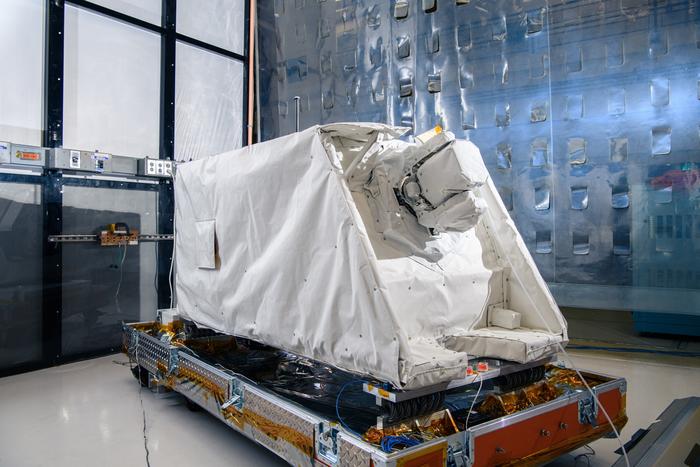
Credit: Credit: Dennis Henry
NASA uses the International Space Station — a football field-sized spacecraft orbiting Earth — to learn more about living and working in space. For over 20 years, the space station has provided a unique platform for investigation and research in areas like biology, technology, agriculture, and more. It serves as a home for astronauts conducting experiments, including advancing NASA’s space communications capabilities.
In 2023, NASA is sending a technology demonstration known as the Integrated LCRD Low Earth Orbit User Modem and Amplifier Terminal (ILLUMA-T) to the space station. Together, ILLUMA-T and the Laser Communications Relay Demonstration (LCRD), which launched in December 2021, will complete NASA’s first two-way, end-to-end laser relay system.
With ILLUMA-T, NASA’s Space Communications and Navigation (SCaN) program office will demonstrate the power of laser communications from the space station. Using invisible infrared light, laser communications systems send and receive information at higher data rates. With higher data rates, missions can send more images and videos back to Earth in a single transmission. Once installed on the space station, ILLUMA-T will showcase the benefits higher data rates could have for missions in low Earth orbit.
“Laser communications offer missions more flexibility and an expedited way to get data back from space,” said Badri Younes, former deputy associate administrator for NASA’s SCaN program. “We are integrating this technology on demonstrations near Earth, at the Moon, and in deep space.”
In addition to higher data rates, laser systems are lighter and use less power — a key benefit when designing spacecraft. ILLUMA-T is approximately the size of a standard refrigerator and will be secured to an external module on the space station to conduct its demonstration with LCRD.
Currently, LCRD is showcasing the benefits of a laser relay in geosynchronous orbit – 22,000 miles from Earth – by beaming data between two ground stations and conducting experiments to further refine NASA’s laser capabilities.
“Once ILLUMA-T is on the space station, the terminal will send high-resolution data, including pictures and videos to LCRD at a rate of 1.2 gigabits-per-second,” said Matt Magsamen, deputy project manager for ILLUMA-T. “Then, the data will be sent from LCRD to ground stations in Hawaii and California. This demonstration will show how laser communications can benefit missions in low Earth orbit.”
ILLUMA-T is launching as a payload on SpaceX’s 29th Commercial Resupply Services mission for NASA. In the first two weeks after its launch, ILLUMA-T will be removed from the Dragon spacecraft’s trunk for installation on the station’s Japanese Experiment Module-Exposed Facility (JEM-EF), also known as “Kibo” — meaning “hope” in Japanese.
Following the payload’s installation, the ILLUMA-T team will perform preliminary testing and in-orbit checkouts. Once completed, the team will make a pass for the payload’s first light — a critical milestone where the mission transmits its first beam of laser light through its optical telescope to LCRD.
Once first light is achieved, data transmission and laser communications experiments will begin and continue throughout the duration of the planned mission.
Testing Lasers in Different Scenarios
In the future, operational laser communications will supplement radio frequency systems, which most space-based missions use today to send data home. ILLUMA-T is not the first mission to test laser communications in space but brings NASA closer to operational infusion of the technology.
Aside from LCRD, ILLUMA-T’s predecessors include the 2022 TeraByte InfraRed Delivery system, which is currently testing laser communications on a small CubeSat in low Earth orbit; the Lunar Laser Communications Demonstration, which transferred data to and from lunar orbit to the Earth and back during the Lunar Atmosphere and Dust Environment Explorer mission in 2014; and the 2017 Optical Payload for Lasercomm Science, which demonstrated how laser communications can speed up the flow of information between Earth and space compared to radio signals.
Testing the ability for laser communications to produce higher data rates in a variety of scenarios will help the aerospace community further refine the capability for future missions to the Moon, Mars, and deep space.
The ILLUMA-T payload is managed by NASA’s Goddard Space Flight Center in Greenbelt, Maryland. Partners include the International Space Station program office at NASA’s Johnson Space Center in Houston and the Massachusetts Institute of Technology Lincoln Laboratory. ILLUMA-T is funded by the Space Communications and Navigation (SCaN) program at NASA Headquarters in Washington.