• HOME
  • NEWS
  • EXPLORE
    • CAREER
      • Companies
      • Jobs
    • EVENTS
    • iGEM
      • News
      • Team
    • PHOTOS
    • VIDEO
    • WIKI
  • BLOG
  • COMMUNITY
    • FACEBOOK
    • INSTAGRAM
    • TWITTER
Thursday, April 9, 2026
BIOENGINEER.ORG
No Result
View All Result
  • Login
  • HOME
  • NEWS
  • EXPLORE
    • CAREER
      • Companies
      • Jobs
        • Lecturer
        • PhD Studentship
        • Postdoc
        • Research Assistant
    • EVENTS
    • iGEM
      • News
      • Team
    • PHOTOS
    • VIDEO
    • WIKI
  • BLOG
  • COMMUNITY
    • FACEBOOK
    • INSTAGRAM
    • TWITTER
  • HOME
  • NEWS
  • EXPLORE
    • CAREER
      • Companies
      • Jobs
        • Lecturer
        • PhD Studentship
        • Postdoc
        • Research Assistant
    • EVENTS
    • iGEM
      • News
      • Team
    • PHOTOS
    • VIDEO
    • WIKI
  • BLOG
  • COMMUNITY
    • FACEBOOK
    • INSTAGRAM
    • TWITTER
No Result
View All Result
Bioengineer.org
No Result
View All Result
Home NEWS Science News

NASA sees the remnants of Tropical Cyclone Debbie moving off Australia’s east coast

Bioengineer by Bioengineer
March 31, 2017
in Science News
Reading Time: 2 mins read
0
Share on FacebookShare on TwitterShare on LinkedinShare on RedditShare on Telegram
IMAGE

Credit: Credits: NASA

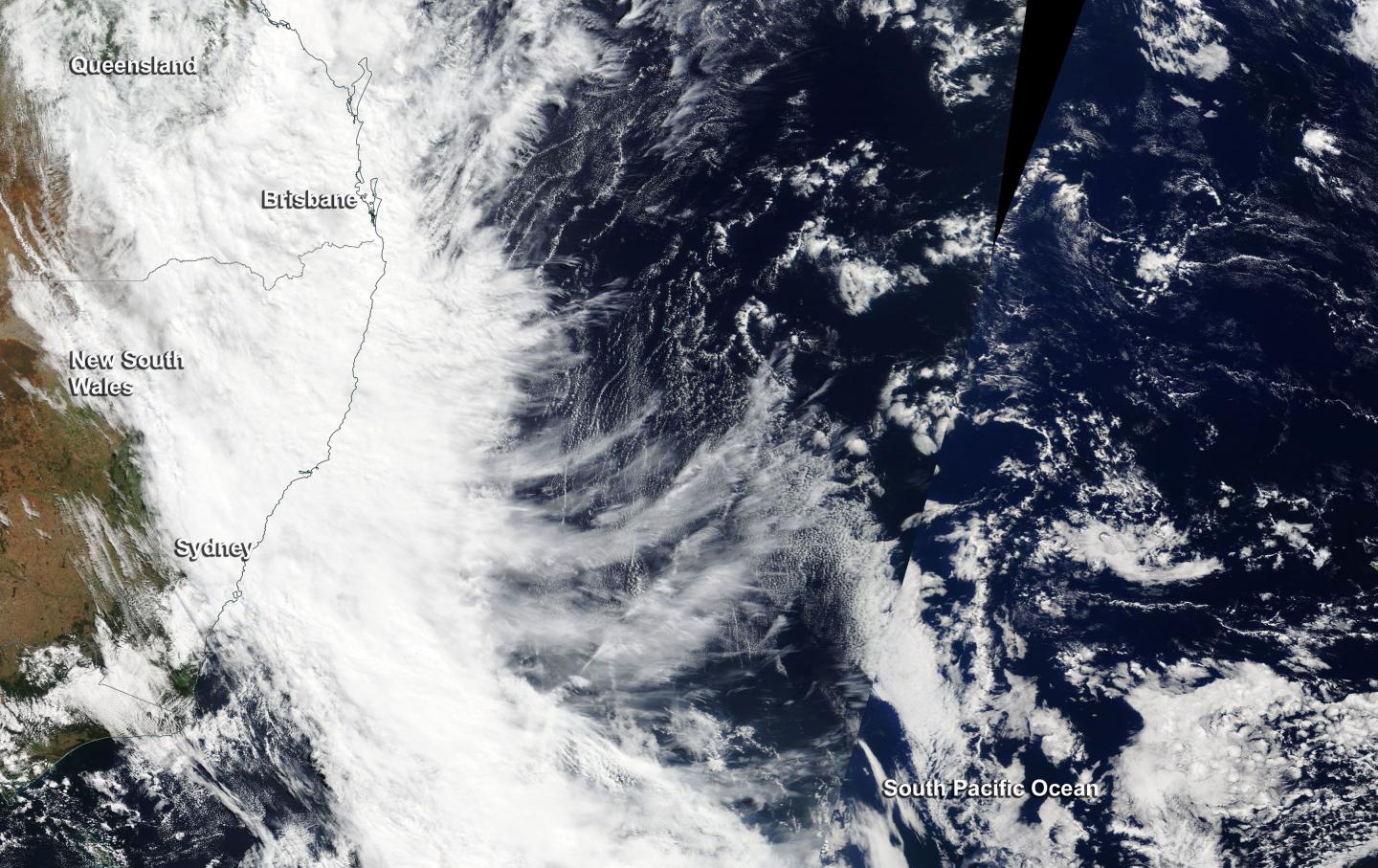
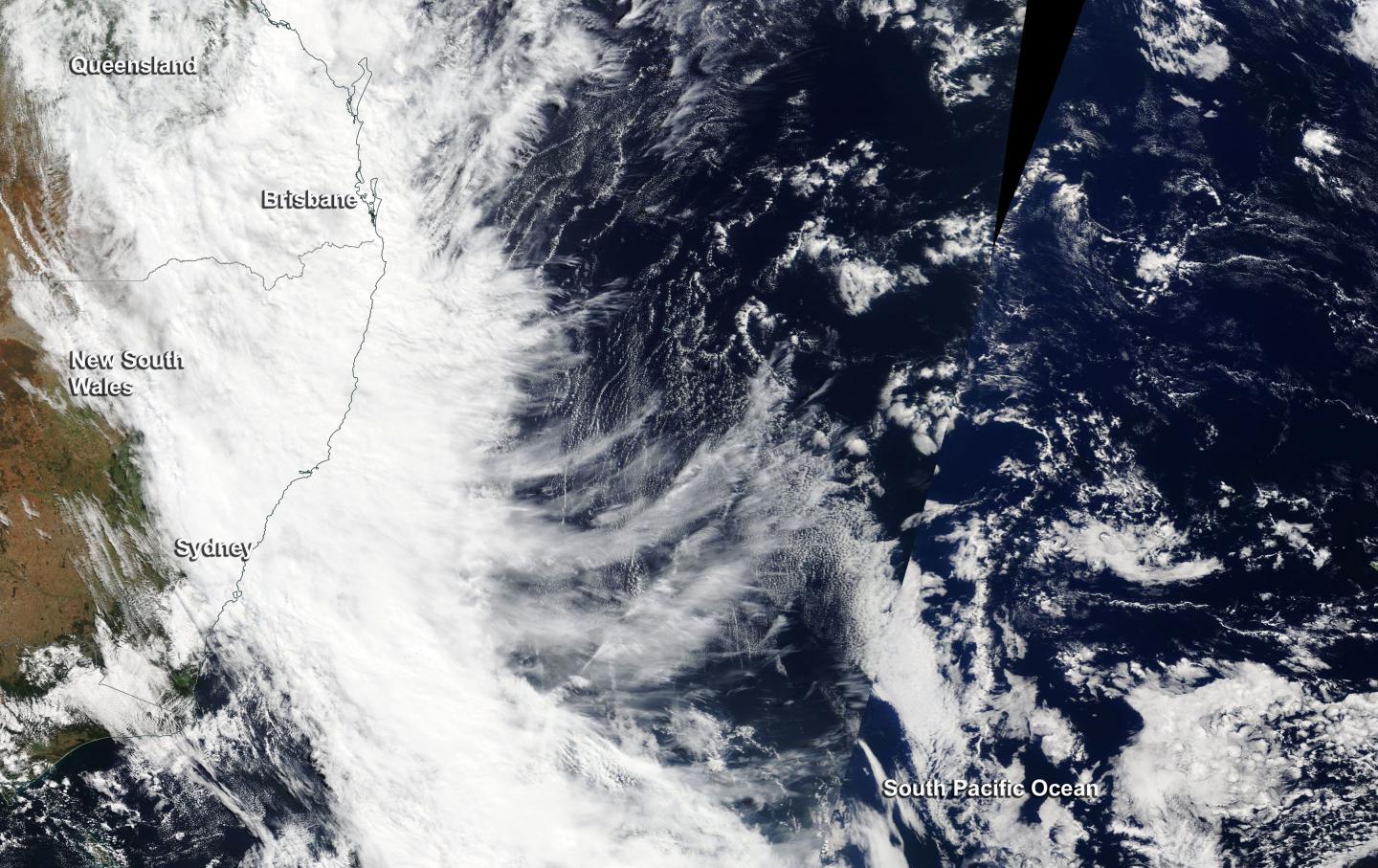
The remnant clouds and showers associated with Ex-Tropical Cyclone Debbie were slowly moving off the coasts of Queensland and New South Wales as NASA's Terra satellite passed overhead on March 31.

On March 31 at 01:30 p.m. AEST/Queensland (March 30 at 11:30 p.m. / U.S.), the Moderate Resolution Imaging Spectroradiometer aboard NASA's Terra satellite captured a visible image of Debbie's remnants. The remnant clouds and showers were blanketing southeastern Queensland and northeastern New South Wales, Australia. The system appeared frontal in nature, stretching from north to south over the eastern Australian coast.

On March 31, Debbie's remnants were still generating rough surf along coastal areas, as the heavy rainfall the storm generated continued to trigger warnings for rivers. At 11 p.m. AEST/Queensland local time (9 a.m. EST/U.S.) the Australian Bureau of Meteorology noted that Ex-Tropical Cyclone Debbie was located 500 km to the east of the Gold Coast. Debbie's remnants are forecast to slowly move away from the east coast over the next few days.

Although dangerous surf and abnormally high tides are no longer expected over Southeast Queensland, the surf is expected to be rough for several into the next week. Several river flood warning remain in effect. There is currently a major Flood Warning for the Logan and Albert Rivers in Queensland, and for the Bremer River and Warrill Creeks River. There was also a Minor Flood Warning in effect for the Lockyer and Laidley Creeks and Lower Brisbane River.

Further south, in New South Wales, large waves are forecast for the North Coast. ABM noted "Damaging surf conditions are expected along the Northern Rivers coast tonight and early Saturday. Waves exceeding 5 meters in the surf zone may produce significant beach erosion, especially on this evening's high tide. South-facing parts of coast are more likely to be affected. High tide is expected around midnight, and may exceed the highest astronomical tide of the year in some localities."

Coastal areas north of Seal Rocks are expected to experience dangerous surf conditions Friday, March 31 and Saturday, April 1. Locations which may be affected by beach erosion include Wooli, Evans Head and Ballina.

The Australian Bureau of Meteorology noted that Tropical Cyclone Debbie established some records. According to ABM, "Severe tropical cyclone Debbie is the first tropical cyclone to reach severe status (category 3 or higher) since the Australian 2014-15 cyclone season. Debbie attained a maximum intensity of category 4 and made landfall on the central Queensland coast, near Airlie Beach, around mid-day on March 28.

An unofficial wind gust of 263 kph was recorded at Hamilton Island airport on the morning of 28 March as Debbie made a direct impact on the site; if this observation is verified it would be the highest wind gust on record for Queensland. Heavy rainfall was also a feature in the Central Coast region with daily rainfall observations at multiple locations above 200 mm and a peak recording of 470 mm at Mount William, west of Mackay."

For more warnings and watches in Queensland, visit: http://www.bom.gov.au/qld/warnings/

###

Media Contact

Rob Gutro
[email protected]
@NASAGoddard

http://www.nasa.gov/goddard

############

Story Source: Materials provided by Scienmag

Share12Tweet8Share2ShareShareShare2

Related Posts

Integrated Acoustic Sensing Enhances Optical Network Security

Integrated Acoustic Sensing Enhances Optical Network Security

April 9, 2026
Insilico Achieves Breakthrough in Cancer Therapy by Uncovering Selective PKMYT1 Inhibitors Through Sulfur-Lone Pair Interactions

Insilico Achieves Breakthrough in Cancer Therapy by Uncovering Selective PKMYT1 Inhibitors Through Sulfur-Lone Pair Interactions

April 9, 2026

Unveiling Graphene’s Role in Photocatalytic Composites Through Theoretical Modeling

April 9, 2026

Dr. Nancy L. Lewis Appointed Chief Scientific Officer at National Comprehensive Cancer Network (NCCN)

April 9, 2026
Please login to join discussion

POPULAR NEWS

  • blank

    Revolutionary AI Model Enhances Precision in Detecting Food Contamination

    98 shares
    Share 39 Tweet 25
  • Imagine a Social Media Feed That Challenges Your Views Instead of Reinforcing Them

    1012 shares
    Share 400 Tweet 250
  • Popular Anti-Aging Compound Linked to Damage in Corpus Callosum, Study Finds

    44 shares
    Share 18 Tweet 11
  • Revolutionary Theory Transforms Quantum Perspective on the Big Bang

    40 shares
    Share 16 Tweet 10

About

We bring you the latest biotechnology news from best research centers and universities around the world. Check our website.

Follow us

Recent News

Integrated Acoustic Sensing Enhances Optical Network Security

Insilico Achieves Breakthrough in Cancer Therapy by Uncovering Selective PKMYT1 Inhibitors Through Sulfur-Lone Pair Interactions

Unveiling Graphene’s Role in Photocatalytic Composites Through Theoretical Modeling

Subscribe to Blog via Email

Enter your email address to subscribe to this blog and receive notifications of new posts by email.

Join 78 other subscribers
  • Contact Us

Bioengineer.org © Copyright 2023 All Rights Reserved.

Welcome Back!

Login to your account below

Forgotten Password?

Retrieve your password

Please enter your username or email address to reset your password.

Log In
No Result
View All Result
  • Homepages
    • Home Page 1
    • Home Page 2
  • News
  • National
  • Business
  • Health
  • Lifestyle
  • Science

Bioengineer.org © Copyright 2023 All Rights Reserved.