• HOME
  • NEWS
  • EXPLORE
    • CAREER
      • Companies
      • Jobs
    • EVENTS
    • iGEM
      • News
      • Team
    • PHOTOS
    • VIDEO
    • WIKI
  • BLOG
  • COMMUNITY
    • FACEBOOK
    • INSTAGRAM
    • TWITTER
Saturday, February 7, 2026
BIOENGINEER.ORG
No Result
View All Result
  • Login
  • HOME
  • NEWS
  • EXPLORE
    • CAREER
      • Companies
      • Jobs
        • Lecturer
        • PhD Studentship
        • Postdoc
        • Research Assistant
    • EVENTS
    • iGEM
      • News
      • Team
    • PHOTOS
    • VIDEO
    • WIKI
  • BLOG
  • COMMUNITY
    • FACEBOOK
    • INSTAGRAM
    • TWITTER
  • HOME
  • NEWS
  • EXPLORE
    • CAREER
      • Companies
      • Jobs
        • Lecturer
        • PhD Studentship
        • Postdoc
        • Research Assistant
    • EVENTS
    • iGEM
      • News
      • Team
    • PHOTOS
    • VIDEO
    • WIKI
  • BLOG
  • COMMUNITY
    • FACEBOOK
    • INSTAGRAM
    • TWITTER
No Result
View All Result
Bioengineer.org
No Result
View All Result
Home NEWS Science News

NASA-funded sounding rocket will take 1,500 images of sun in 5 minutes

Bioengineer by Bioengineer
May 4, 2017
in Science News
Reading Time: 2 mins read
0
Share on FacebookShare on TwitterShare on LinkedinShare on RedditShare on Telegram
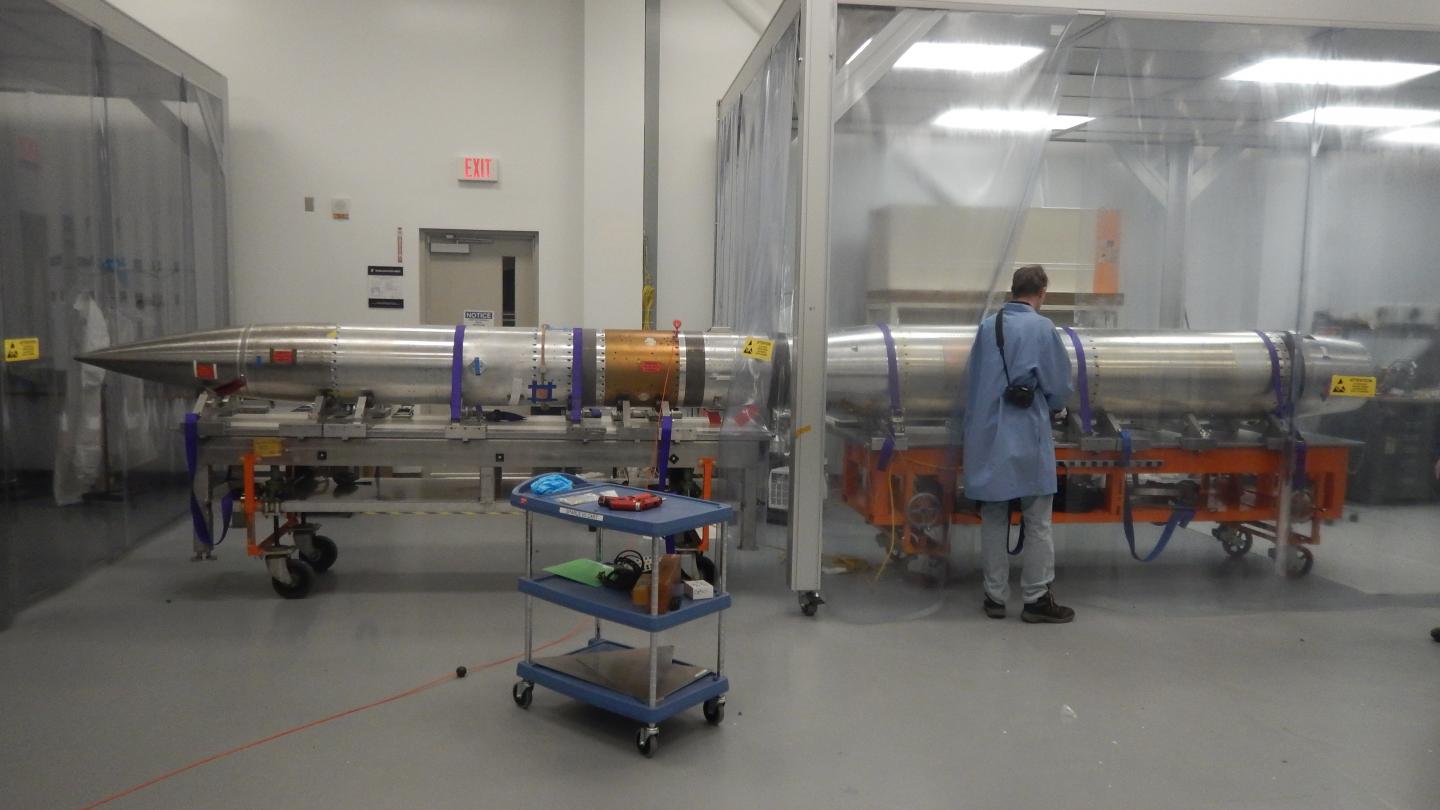
IMAGE

Credit: Amir Caspi, Southwest Research Institute

On May 5, 2017, scientists will launch a sounding rocket 200 miles up into the atmosphere, where in just five minutes, it will take 1,500 images of the sun. The NASA-funded RAISE mission is designed to scrutinize split-second changes occurring near the sun's active regions — areas of intense, complex magnetic activity that can give rise to solar flares, which eject energy and solar material out into space.

Several missions continuously study the sun — such as NASA's Solar Dynamics Observatory, or SDO, and the Solar Terrestrial Relations Observatory, or STEREO — but certain areas of the sun demand especially high-cadence observations in order to understand the rapid changes occurring there. That's where RAISE — short for Rapid Acquisition Imaging Spectrograph Experiment — comes in.

"Dynamic processes happen on all timescales," said Don Hassler, principal investigator for the RAISE mission at the Southwest Research Institute in Boulder, Colorado. "With RAISE, we'll read out an image every two-tenths of a second, so we can study very fast processes and changes on the sun. That's around five to 10 times faster than comparable instruments on other sounding rocket or satellite missions."

RAISE images are used to create a data product called a spectrogram, which separates light from the sun into all its different wavelength components. By looking at the intensity of light at each wavelength, scientists can assess how solar material and energy moves around the sun, and how that movement evolves into massive solar eruptions.

"RAISE is pushing the limits of high-cadence observations, and doing so is challenging," Hassler said. "But that's exactly what the NASA sounding rocket program is for."

The flight of a sounding rocket is short-lived, and has a parabolic trajectory — the shape of a frown. Most sounding rocket flights last for 15 to 20 minutes, and just five to six of those minutes are spent making observations from above the atmosphere, observations that can only be done in space. In RAISE's case, the extreme ultraviolet light the instruments observe can't penetrate Earth's atmosphere. After the flight, the payload parachutes to the ground, where it can be recovered for use again.

This will be the RAISE mission's third flight, and the scientists have continuously updated its technology. For the upcoming flight, they have refurbished the detectors and updated the flight software, and the payload carries a new diffraction grating, which reflects light and separates it into its separate wavelengths.

The launch window for RAISE opens at 2:25 p.m. EDT at the White Sands Missile Range near Las Cruces, New Mexico. The precise timing of the launch depends on weather conditions, and coordinated timing with other space observatories such as NASA's SDO and IRIS, as well as the joint Japan Aerospace Exploration Agency/NASA's Hinode.

###

RAISE is supported by NASA's Sounding Rocket Program at NASA's Wallops Flight Facility in Virginia. NASA's Heliophysics Division manages the Sounding Rocket Program.

Media Contact

Lina Tran
[email protected]
@NASAGoddard

http://www.nasa.gov/goddard

############

Story Source: Materials provided by Scienmag

Share12Tweet8Share2ShareShareShare2

Related Posts

Scientists Identify SARS-CoV-2 PLpro and RIPK1 Inhibitors Showing Potent Synergistic Antiviral Effects in Mouse COVID-19 Model

February 7, 2026

Neg-Entropy: The Key Therapeutic Target for Chronic Diseases

February 7, 2026

Multidisciplinary Evidence-Based Guidelines for Therapeutic Drug Monitoring of Biologics in Inflammatory Bowel Disease

February 7, 2026

Early Tuberculosis Treatment Lowers Sepsis Mortality in People with HIV

February 7, 2026
Please login to join discussion

POPULAR NEWS

  • Robotic Ureteral Reconstruction: A Novel Approach

    Robotic Ureteral Reconstruction: A Novel Approach

    82 shares
    Share 33 Tweet 21
  • Digital Privacy: Health Data Control in Incarceration

    63 shares
    Share 25 Tweet 16
  • Study Reveals Lipid Accumulation in ME/CFS Cells

    57 shares
    Share 23 Tweet 14
  • Breakthrough in RNA Research Accelerates Medical Innovations Timeline

    53 shares
    Share 21 Tweet 13

About

We bring you the latest biotechnology news from best research centers and universities around the world. Check our website.

Follow us

Recent News

Scientists Identify SARS-CoV-2 PLpro and RIPK1 Inhibitors Showing Potent Synergistic Antiviral Effects in Mouse COVID-19 Model

Neg-Entropy: The Key Therapeutic Target for Chronic Diseases

Multidisciplinary Evidence-Based Guidelines for Therapeutic Drug Monitoring of Biologics in Inflammatory Bowel Disease

Subscribe to Blog via Email

Enter your email address to subscribe to this blog and receive notifications of new posts by email.

Join 73 other subscribers
  • Contact Us

Bioengineer.org © Copyright 2023 All Rights Reserved.

Welcome Back!

Login to your account below

Forgotten Password?

Retrieve your password

Please enter your username or email address to reset your password.

Log In
No Result
View All Result
  • Homepages
    • Home Page 1
    • Home Page 2
  • News
  • National
  • Business
  • Health
  • Lifestyle
  • Science

Bioengineer.org © Copyright 2023 All Rights Reserved.