

• HOME
  • NEWS
  • EXPLORE
    • CAREER
      • Companies
      • Jobs
    • EVENTS
    • iGEM
      • News
      • Team
    • PHOTOS
    • VIDEO
    • WIKI
  • BLOG
  • COMMUNITY
    • FACEBOOK
    • INSTAGRAM
    • TWITTER
Wednesday, April 22, 2026
BIOENGINEER.ORG
No Result
View All Result
  • Login
  • HOME
  • NEWS
  • EXPLORE
    • CAREER
      • Companies
      • Jobs
        • Lecturer
        • PhD Studentship
        • Postdoc
        • Research Assistant
    • EVENTS
    • iGEM
      • News
      • Team
    • PHOTOS
    • VIDEO
    • WIKI
  • BLOG
  • COMMUNITY
    • FACEBOOK
    • INSTAGRAM
    • TWITTER
  • HOME
  • NEWS
  • EXPLORE
    • CAREER
      • Companies
      • Jobs
        • Lecturer
        • PhD Studentship
        • Postdoc
        • Research Assistant
    • EVENTS
    • iGEM
      • News
      • Team
    • PHOTOS
    • VIDEO
    • WIKI
  • BLOG
  • COMMUNITY
    • FACEBOOK
    • INSTAGRAM
    • TWITTER
No Result
View All Result
Bioengineer.org
No Result
View All Result
Home NEWS Science News

NASA analyzed Tropical Cyclone Alcide’s rainfall before dissipation

Bioengineer by Bioengineer
November 13, 2018
in Science News
Reading Time: 2 mins read
0
Share on FacebookShare on TwitterShare on LinkedinShare on RedditShare on Telegram
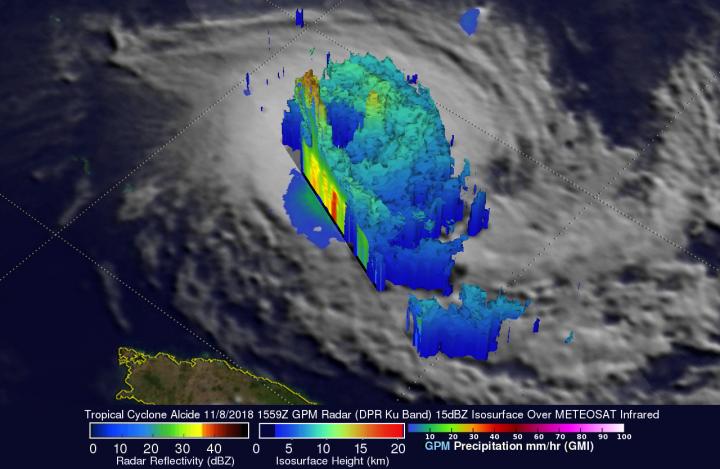
IMAGE

Credit: Credit: NASA/JAXA, Hal Pierce

Tropical Cyclone Alcide dissipated over the weekend of Nov. 11 and 12 in the Southern Indian Ocean.

However, when it was near peak intensity, the Global Precipitation Measurement mission or GPM core satellite provided a look at the rain falling within.

The GPM core observatory satellite, a joint mission between NASA and the Japan Aerospace Exploration Agency, JAXA, had an excellent view of tropical cyclone Alcide on November 8, 2018 at 10:59 a.m. EDT (1559 UTC) after it had moved to a location northeast of Madagascar. At that time Alcide had reached its peak intensity with winds of about 95 knots (109 mph) making it the equivalent of a strong category two hurricane on the Saffir-Simpson hurricane wind scale.

Data collected by GPM's Microwave Imager (GMI) and GPM's Dual-Frequency Precipitation Radar (DPR) instruments revealed that the powerful tropical cyclone was producing extremely heavy rainfall. GPM's radar (DPR Ku Band) indicated that tall convective storms in the northwestern side of Alcide's eyewall were dropping rain at a rate of more than 255 mm (10 inches) per hour.

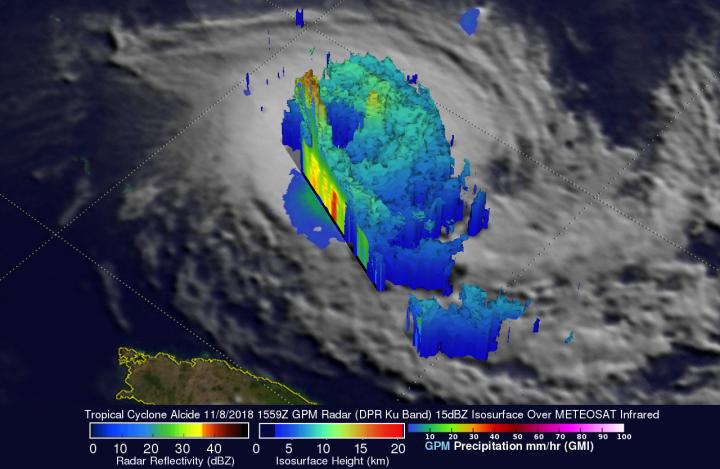
GPM's radar data (DPR Ku Band) were used to create an image to probe the 3D structure of precipitation within tropical cyclone Alcide. The well-defined eye of the powerful tropical cyclone is revealed with this simulated view from the southwest. GPM's DPR found that the most powerful convective storms were located in tropical cyclone Alcide's western eye wall. A few of these tall storms were found by GPM to reach heights above 16.0 km (9.92 miles).

On Nov. 11, Tropical cyclone Alcide dissipated near 12.3 south latitude and 51.9 east longitude, about 529 miles north-northwest of St Denis, La Reunion.

###

Media Contact

Rob Gutro
[email protected]
@NASAGoddard

http://www.nasa.gov/goddard

Original Source

https://blogs.nasa.gov/hurricanes/tag/alcide-2018/

Share12Tweet8Share2ShareShareShare2

Related Posts

Portable Air Cleaners Reduce Indoor Pollution, Improve Perception

April 22, 2026

DNA Methyltransferase 3a Loss Sparks Cardiomyocyte Pyroptosis

April 22, 2026

Economic Models in Neonatal Intensive Care: A Review

April 22, 2026

Quinone-Based Hydrogel Enables Instant Wet Tissue Hemostasis

April 22, 2026
Please login to join discussion

POPULAR NEWS

  • Research Indicates Potential Connection Between Prenatal Medication Exposure and Elevated Autism Risk

    795 shares
    Share 318 Tweet 199
  • Scientists Investigate Possible Connection Between COVID-19 and Increased Lung Cancer Risk

    65 shares
    Share 26 Tweet 16
  • Salmonella Haem Blocks Macrophages, Boosts Infection

    58 shares
    Share 23 Tweet 15
  • NSF funds machine-learning research at UNO and UNL to study energy requirements of walking in older adults

    101 shares
    Share 40 Tweet 25

About

We bring you the latest biotechnology news from best research centers and universities around the world. Check our website.

Follow us

Recent News

Portable Air Cleaners Reduce Indoor Pollution, Improve Perception

DNA Methyltransferase 3a Loss Sparks Cardiomyocyte Pyroptosis

Economic Models in Neonatal Intensive Care: A Review

Subscribe to Blog via Email

Enter your email address to subscribe to this blog and receive notifications of new posts by email.

Join 79 other subscribers
  • Contact Us

Bioengineer.org © Copyright 2023 All Rights Reserved.

Welcome Back!

Login to your account below

Forgotten Password?

Retrieve your password

Please enter your username or email address to reset your password.

Log In
No Result
View All Result
  • Homepages
    • Home Page 1
    • Home Page 2
  • News
  • National
  • Business
  • Health
  • Lifestyle
  • Science

Bioengineer.org © Copyright 2023 All Rights Reserved.