In a significant advancement for next-generation semiconductors, a collaborative research team, led by Professor Kyoung-Duck Park and Mingu Kang in the Department of Physics at POSTECH, Professor Yong Doug Suh in the Department of Chemistry at UNIST, who concurrently holds the position of Associate Director at the IBS Center for Multidimensional Carbon Materials (CMCM), and Professor Hyun Seok Lee in the Department of Physics at Chungbuk National University, has made groundbreaking discoveries in the field of two-dimensional (2D) semiconductors. Their findings, published in Nano Letters, shed light on the generation and control of trions, providing valuable insights into the optical properties of these materials.
Credit: UNIST
In a significant advancement for next-generation semiconductors, a collaborative research team, led by Professor Kyoung-Duck Park and Mingu Kang in the Department of Physics at POSTECH, Professor Yong Doug Suh in the Department of Chemistry at UNIST, who concurrently holds the position of Associate Director at the IBS Center for Multidimensional Carbon Materials (CMCM), and Professor Hyun Seok Lee in the Department of Physics at Chungbuk National University, has made groundbreaking discoveries in the field of two-dimensional (2D) semiconductors. Their findings, published in Nano Letters, shed light on the generation and control of trions, providing valuable insights into the optical properties of these materials.
Two-dimensional (2D) semiconductors, known for their exceptional light characteristics per unit volume with high flexibility due to their atomic layer thickness, hold immense potential for applications in areas, such as advanced flexible devices, nano photonics, and solar cells. The research team focused on harnessing the optical properties of 2D semiconductors, particularly the generation and recombination processes of electron-hole pairs, to develop light-emitting devices and optical applications.
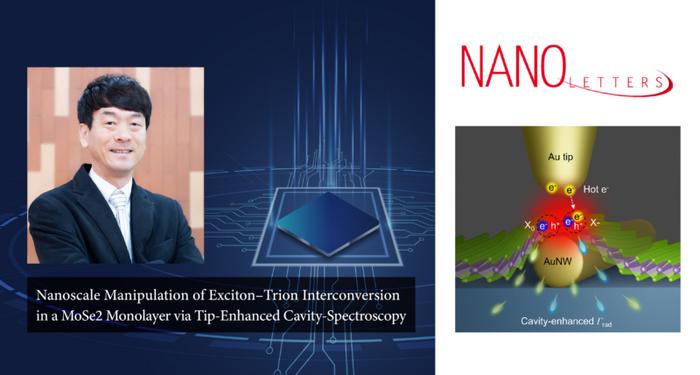
To actively control the interaction of excitons and trions and analyze real-time luminous properties, the team developed their own probe-enhanced resonant spectroscopy system based on gold nanowires. By combining a single layer of MoSe2, a two-dimensional semiconductor, with gold nanowires and a probe-enhanced resonance spectroscopy system, the researchers created a composite structure and a powerful analysis platform. Through this, they succeeded in identifying the principle of generating trions, which had not been known before.
The researchers discovered that the multipolar mode of electric charge plays a significant role in inducing the conversion of excitons to trions in two-dimensional semiconductors. With the probe-enhanced resonance spectroscopy system, they achieved real-time analysis of nano-light properties with an exceptional spatial resolution of approximately 10 nm, surpassing the limit of light diffraction. This enabled the identification of the principle behind trion generation and the development of reversible active control over the exciton-trion conversion.
Moreover, the gold probe acted as an antenna, focusing light on a nano-sized area and generating high-energy thermocrons. The electrons generated by this process were then injected into the two-dimensional semiconductor, further enhancing the control over trion generation. This breakthrough led to the proposal of a novel “nano active control platform,” enabling real-time, ultra-high-resolution control over the state of matter, surpassing traditional measuring equipment.
Mingu Kang, the first author of the study, expressed their excitement, stating, “Not only have we successfully controlled excitons and trions, but we have also identified the underlying principles governing their interaction with plasmons and thermotrons.” He further added, “We believe our research will present a significant breakthrough for researchers in fields utilizing excitons and trions, such as solar cells and photoelectric integrated circuits.”
Meanwhile, the study involved Su Jin Kim of the Department of Physics at Chungbuk National University, Huitae Joo, Yeonjeong Koo, and Hyongwoo Lee of the Department of Physics at POSTECH. The study, which was recently published in Nano Letters, was conducted with support from the Korea Research Foundation, the Ministry of Science and ICT, the Korea Electronics and Telecommunications Research Institute, the Samsung Future Technology Promotion Project, the Korea Institute of Science and Technology Commercialization, the Korea Institute of Chemical Technology, UNIST, and IBS.
Journal Reference
Mingu Kang, Su Jin Kim, Huitae Joo, et al., “Nanoscale Manipulation of Exciton–Trion Interconversion in a MoSe2 Monolayer via Tip-Enhanced Cavity-Spectroscopy,” Nano Letters, (2023).
Journal
Nano Letters
Article Title
Nanoscale Manipulation of Exciton–Trion Interconversion in a MoSe2 Monolayer via Tip-Enhanced Cavity-Spectroscopy